
Last Updated on November 23, 2025 11:58 pm by INDIAN AWAAZ
NEWS DESK
Prime Minister Narendra Modi has urged G-20 nations to shift from profit-driven innovation to a model that prioritizes humanity, equity and global cooperation.
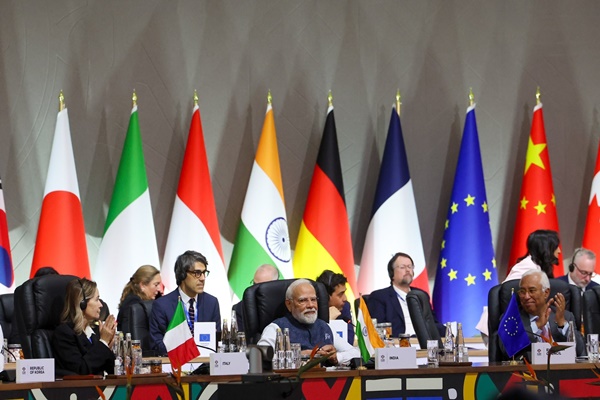
At the 3rd Session of the G-20 Summit in Johannesburg, held under the theme “A Fair and Just Future for All: Critical Minerals, Decent Work, Artificial Intelligence,” Prime Minister Modi said, technology should be human-centric, global, and open-source. He noted that India’s digital ecosystem follows this vision, helping the country lead the world in digital payments.
Highlighting India’s growing leadership in AI and space, Prime Minister Modi said the country is promoting broad participation across sectors through inclusivity and accessibility. He outlined India’s AI philosophy, based on equitable access, population-scale skilling, and responsible deployment, and said the India-AI Mission is building high-performance computing infrastructure to reach every district and language. The Prime Minister stressed that AI must serve the global good and called for a global compact ensuring transparency, human oversight, safety-by-design, and strict prevention of misuse.
Prime Minister Modi also announced that India will host the AI Impact Summit in February 2026, themed Sarvajana Hitaya, Sarvajana Sukhaya -welfare and happiness for all, and invited all G20 nations to participate.
The Prime Minister urged countries to focus on building the “capabilities of tomorrow” rather than just the “jobs of today.” Recalling the progress made during the New Delhi Summit, Mr Modi proposed that the G20 work on a Global Framework for Talent Mobility to support innovation.
English Translation of Prime Minister’s statement during the G20 Summit: Session 3
Posted On: 23 NOV 2025 3:58PM by PIB Delhi
Excellencies,
As technology continues to advance, both opportunities and resources are becoming increasingly concentrated in a few hands. Around the world, competition over critical technologies is intensifying. This is a matter of concern for humanity, and it also poses an obstacle to innovation. To address this, we must bring about a fundamental change in our approach.
We must promote technology applications that are ‘human-centric’ rather than ‘finance-centric’, that are ‘global’ rather than merely ‘national’, and that follow ‘open-source’ models rather than ‘exclusive’ ones. India has sought to integrate this very vision into all of its technology projects.
For this very reason, India today records the highest number of digital payments in the world. From space technology to artificial intelligence, we are witnessing positivity and broad-based participation across every sector.
Friends,
India’s approach to AI is anchored on three pillars – equitable access, population-scale skilling, and responsible deployment. Under the India–AI Mission, we are developing accessible high-performance computing so that the benefits of AI reach every district and every language. This will provide both scale and speed to our efforts toward human development.
At the same time, we must all ensure that AI is used for the global good and that its misuse is prevented. For this, we need a global compact on AI, built upon certain fundamental principles. These should include effective human oversight, safety-by-design, transparency, and strict prohibitions on the use of AI for deepfakes, crime, and terrorist activities.
AI systems that impact human life, security, or public trust must be responsible and auditable. And most importantly, while AI may enhance human capabilities, the ultimate responsibility for decision-making must always remain with human beings.
In February 2026, India will host the AI Impact Summit, with the theme: Sarvajana Hitaya, Sarvajana Sukhaya – welfare for all, happiness for all. We extend an invitation to all G20 countries to participate in this summit.
Friends,
In this age of AI, we must swiftly shift our approach from the ‘jobs of today’ to the ‘capabilities of tomorrow’. Unlocking talent mobility is essential for rapid innovation. We made progress on this issue at the New Delhi G20 Summit. We hope that in the coming years, the G20 will develop a global framework for talent mobility.
Friends,
The COVID era exposed the vulnerabilities of global supply chains. Even during that challenging time, India provided vaccines and medicines to more than 150 countries. Nations cannot be viewed merely as markets; we must adopt a sensitive and long-term approach.
India’s message is clear:
· Development must be sustainable,
· Trade should be trusted,
· Finance must be fair,
· And progress must ensure all-inclusive prosperity.
Only then can we build a fair and just future for all.
Thank you.