
Last Updated on October 12, 2026 6:52 pm by INDIAN AWAAZ
Our Correspondent / NEW DELHI
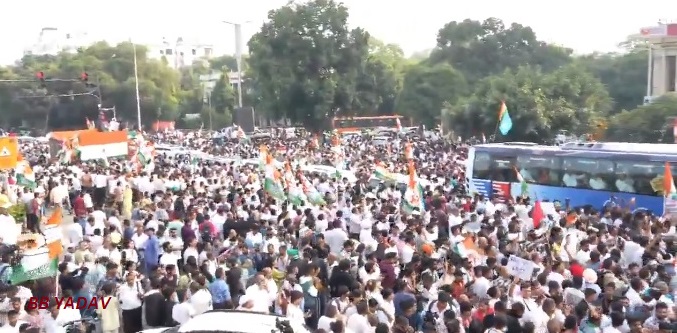
Congress leader Rahul Gandhi on Monday led a massive crowd of opposition leaders and protesters towards the Supreme Court, demanding action against Chief Election Commissioner (CEC) Gyanesh Kumar over alleged irregularities in the Special Intensive Revision (SIR) of electoral rolls.
The march, joined by Priyanka Gandhi Vadra and other opposition figures, was accompanied by the submission of a petition in the Supreme Court seeking action over allegations of large-scale voter deletions and electoral irregularities.
The petition lists several prominent opposition leaders, including Congress president Mallikarjun Kharge, Rahul Gandhi, Priyanka Gandhi Vadra, Samajwadi Party chief Akhilesh Yadav, Trinamool Congress leader Saugata Roy and Rashtriya Janata Dal leader Tejashwi Prasad Yadav. Other petitioners named in the court record include Sanjay Jha, M.A. Baby, D. Raja, Mahua Majhi, Supriya Sule and E.T. Mohammed Basheer.
The Election Commission of India, Gyanesh Kumar, Election Commissioners Sukhbir Singh Sandhu and Vivek Joshi are named as respondents. The case status displayed in the supplied court record is pending.
The legal challenge has given the opposition’s campaign against the CEC a new dimension, taking the dispute over electoral rolls from street demonstrations to the country’s highest court. The allegations remain subject to judicial consideration.
Police halt march before protesters reach Supreme Court
Thousands of protesters gathered in central Delhi as Rahul Gandhi and other opposition leaders moved towards the Supreme Court, situated around two kilometres from the protest area. Police stopped the march on Bhagwan Das Road, preventing the gathering from proceeding to its intended destination.
The confrontation unfolded amid heightened security arrangements in the capital following Saturday’s crackdown on demonstrators. The protesters remained in and around Bhagwan Das Road as police sought to restrict their movement.
Before the march, Rahul Gandhi rejected suggestions that the demonstrations represented separate political campaigns. He said the opposition was united around the demand for action against Gyanesh Kumar.
“There are no parallel protests, there is one protest,” Gandhi said, reiterating his demand for the CEC’s removal. He also declared that the campaign would continue against Prime Minister Narendra Modi and Union Home Minister Amit Shah.
Gandhi alleged that the Chief Election Commissioner was acting under pressure from the Prime Minister, the Home Minister and National Security Advisor Ajit Doval. These are allegations made by the Congress leader and have not been established by a judicial finding.
Opposition takes fight over SIR to court
At the centre of the dispute is the Special Intensive Revision of electoral rolls, an exercise that the opposition says has raised serious questions about the inclusion of eligible voters and the deletion of names from voter lists.
The petition’s broad-based list of opposition leaders signals an effort to pursue the issue through a joint legal challenge rather than relying exclusively on political demonstrations. By naming the Election Commission and its senior officials as respondents, the petition brings the controversy directly before the Supreme Court.
The opposition has repeatedly demanded accountability over the revision exercise, arguing that any wrongful deletion of eligible voters could affect the integrity of the electoral process. The Election Commission’s position and the legal merits of the allegations will be matters for consideration through the appropriate proceedings.
The case status shown in the supplied court record remains pending; the filing itself should not be interpreted as a judicial finding that the allegations are true or that the requested action has been granted.
Saturday’s detentions set the stage for Monday’s march
Monday’s protest followed a tense weekend in Delhi, where police detained demonstrators on Saturday, October 10, as they attempted to reach Jantar Mantar. The action triggered fresh criticism from opposition leaders and civil society groups over restrictions on demonstrations.
A day before the latest march, leaders of the Cockroach Janata Party (CJP), Saurav Das and Ashutosh Ranka, wrote to Delhi Police seeking a date for a peaceful demonstration against the CEC over the alleged SIR irregularities. Police subsequently designated Ramlila Ground, Burari Ground and CBD Ground in east Delhi as alternative protest venues following the request.
The developments have widened the protest campaign beyond the Congress and its principal INDIA bloc partners, drawing attention to the role of smaller political organisations and civil society groups in challenging the electoral-roll revision process.
Metro restrictions and Supreme Court directions
Security arrangements also affected public transport in central Delhi. The Delhi Metro Rail Corporation announced that entry and exit gates at Janpath, Mandi House, Barakhamba Road, Central Secretariat, Rajiv Chowk and Patel Chowk would remain closed until 4 pm on Monday. Interchange facilities were to remain available at the affected stations, with further decisions dependent on the security assessment.
The Supreme Court, meanwhile, directed the Centre to ensure normal Delhi Metro services and uninterrupted internet access amid the protests. It emphasised that any restrictions must comply with the constitutional provisions governing public order and the permissible limits on freedom of speech and expression under Article 19(2).
The directions placed the management of public order and the protection of ordinary civic services at the centre of the unfolding situation.
With the petition against the CEC pending and the opposition maintaining its demand for accountability, Monday’s developments marked a further escalation in the political and legal confrontation over electoral-roll revision. The next stage will depend on the court proceedings, the response of the Election Commission and whether the competing sides can resolve their differences through constitutional and legal channels.