
Last Updated on August 26, 2026 11:56 pm by INDIAN AWAAZ
AMN / NEWS DESK
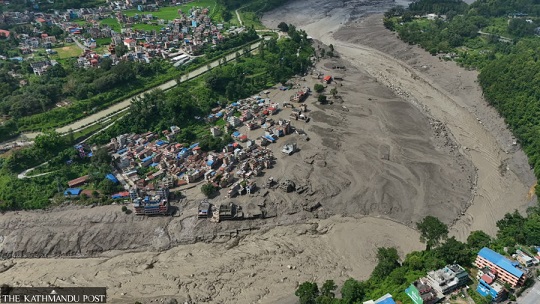
A devastating flash flood triggered by an avalanche in Nepal’s northern Himalayas killed at least 157 people and left hundreds missing on Wednesday, sweeping through communities, destroying infrastructure and washing away vehicles, homes and major public facilities across three districts.
The disaster struck without warning along the Bhotekoshi River, near Nepal’s border with China, after an avalanche is believed to have blocked the flow of the Lhende tributary and created a sudden surge of water and debris.
The flood first hit Timure, a settlement near the Rasuwagadhi border crossing in Rasuwa district. Much of the settlement was swept away within minutes. The flood then raced downstream towards Syaphrubesi and other communities, carrying people, livestock, vehicles, buildings and debris in its path.
The scale of the destruction has raised fears that the disaster could become one of the deadliest floods in Nepal in decades.
No Rain, No Warning
The disaster was particularly devastating because there was reportedly no rainfall in the affected area immediately before the flood. Residents were going about their normal morning activities when the wall of water suddenly descended from upstream.
Rajendra Dhungana, chief customs officer in Rasuwa, said the initial tremor made him believe an earthquake had struck.
When he went outside, however, he saw a huge mass of water and debris rushing towards Timure. “It was the flood, rising like a wave nearly 100 metres high and sweeping through the market,” Dhungana told local media. “Within moments, the market was gone.”
Dhungana and dozens of other people escaped towards nearby forests as the water swept through the settlement.
More than 300 vehicles and trucks parked at the customs checkpoint were reportedly washed away, underscoring the extraordinary force of the flood.
Foreign Nationals Among Missing
According to information released by Nepal’s Prime Minister’s Office, hundreds of people remain unaccounted for, including 391 foreign nationals and 44 security personnel.
The number of missing people has made rescue and identification operations particularly difficult, with roads, bridges and communications infrastructure severely damaged.
The affected region includes a major trade and transport route connecting Nepal with China through the Rasuwagadhi border point. The destruction of the settlement and infrastructure has therefore created not only a humanitarian emergency but also a major disruption to cross-border trade and transportation.
Entire Communities Swept Away
As the flood travelled downstream, it destroyed settlements along the river corridor. In Bidur Municipality in Nuwakot district, local officials reported that hundreds of houses had been swept away between Sole and Akkare Bazaar.
Ravindra Nepal, chair of Ward 7 of Bidur Municipality, said many residents escaped, but elderly people and children remained unaccounted for.
He said he had been stranded at the municipal building since early morning because the roads and bridges connecting the area had disappeared.
Local residents described scenes of widespread devastation, with homes buried under mud and debris.
Gokarna Adhikari, a resident of Dandathok Tupche, said most of the people he knew remained missing and that little was left of his village.
Even buildings that appeared to have survived were reportedly covered in thick layers of mud and debris.
Hydropower and Transport Infrastructure Destroyed
The flood inflicted extensive damage on Nepal’s infrastructure. Preliminary assessments indicate that nine hydropower projects and nine commercial bank branches were destroyed or severely damaged.
At least 19 motorable bridges and approximately 40 kilometres of highway were also swept away.
The loss of bridges and roads has severely complicated rescue and relief operations, cutting off several communities from the wider road network.
The disaster also destroyed automatic flood-monitoring stations installed in the upper reaches of the Bhotekoshi River. Their loss has raised concerns about Nepal’s ability to monitor future flooding in the region.
The destruction of hydropower infrastructure could have longer-term implications for electricity generation and the local economy, while damage to highways and bridges could disrupt trade and movement between northern Nepal and China.
Avalanche Believed to Have Triggered Flood
Preliminary investigations indicate that the flood was not caused by conventional monsoon rainfall.
Instead, authorities and disaster experts believe an avalanche blocked the Lhende River, creating conditions for a sudden release of water and debris.
Nepal’s National Disaster Risk Reduction and Management Authority said satellite imagery analysed from Planet Labs indicated that an avalanche occurred roughly 20 kilometres northeast of the Rasuwagadhi border crossing, in Tibet.
Satellite images from August 25 and 26 reportedly showed the avalanche and subsequent flooding along the Lhende River.
The avalanche debris is believed to have temporarily obstructed the river. The resulting accumulation of water may then have been released suddenly, generating a powerful debris-laden flood that travelled rapidly downstream into Nepal.
Such events can be particularly dangerous because they can occur without significant rainfall in downstream areas, leaving communities with little or no time to evacuate.
Questions Over Early-Warning Systems
The disaster has raised serious questions about Nepal’s early-warning arrangements for rivers originating in or passing through the Himalayan region.
Officials in Rasuwa said they received no advance information about the flood originating upstream.
The absence of warning was particularly significant because communities along the Bhotekoshi River had already experienced severe flooding in the past.
Experts say the challenge goes beyond information-sharing between Nepal and China. Monitoring equipment installed within Nepal also appears to have failed to provide an effective warning before Wednesday’s flood.
Anil Pokhrel, former executive chief of Nepal’s National Disaster Risk Reduction and Management Authority, said similar difficulties had been encountered during earlier floods originating on the Chinese side of the border.
He argued that Nepal needs a permanent mechanism for receiving information about potentially dangerous events in upstream Himalayan areas before floodwaters enter vulnerable downstream communities.
The issue has become increasingly important as climate change, rapid glacier and snow dynamics and growing infrastructure development increase exposure to high-altitude hazards.
Region Hit by Major Flooding Last Year
The latest disaster has also struck an area that had not fully recovered from severe flooding last year.
On July 8, 2025, flooding in the Lhende River killed at least 11 people and damaged roads along the same corridor. The flood also destroyed the Miteri Bridge connecting Nepal and China.
The recurrence of severe flooding in the same region has intensified concerns about the vulnerability of settlements and infrastructure built along Himalayan river valleys.
Experts say the repeated disasters demonstrate the need for a long-term approach to disaster risk reduction rather than relying primarily on post-disaster rescue and reconstruction.
Potentially One of Nepal’s Deadliest Recent Disasters
With hundreds still missing, officials and disaster experts warn that the final death toll could rise substantially.
Based on the number of people unaccounted for and the scale of destruction, Wednesday’s flood could become one of Nepal’s deadliest natural disasters in the modern era.
Nepal’s historical benchmark remains the devastating 1993 floods in Sarlahi, Rautahat and Makawanpur, which killed around 1,400 people.
The latest disaster has already surpassed the death toll of many recent individual flood events, although the final scale of the catastrophe will depend on rescue operations and the identification of missing people.
Rescue Efforts Hampered by Destroyed Roads
Rescue agencies face significant logistical challenges.
The destruction of bridges and highways has isolated affected communities, while debris, damaged buildings and unstable terrain are complicating access.
The loss of communication and monitoring infrastructure could further slow the authorities’ ability to determine where survivors are located.
Security personnel are among those missing, adding to concerns about the capacity of local authorities to conduct large-scale rescue operations.
Foreign nationals reported missing in the disaster also add an international dimension to the emergency, with authorities likely to face increasing pressure to identify victims and coordinate with diplomatic missions.
A Broader Himalayan Warning
The disaster highlights the particular vulnerability of Himalayan communities to sudden, high-impact natural hazards.
Floods caused by landslides, avalanches, glacial lake outbursts and debris flows can occur with little warning and can generate destructive waves capable of travelling rapidly through narrow mountain valleys.
The Bhotekoshi disaster demonstrates how an event occurring high in the mountains can quickly become a major humanitarian and infrastructure crisis hundreds of kilometres downstream.
For Nepal and its neighbours, the incident also underscores the importance of cross-border disaster monitoring, particularly for rivers originating in high-altitude areas.
A reliable system would require real-time monitoring of avalanches, landslides, river levels and glacial lakes, along with direct communication between authorities on both sides of the border.
Economic Impact Likely to Be Significant
Beyond the human tragedy, the flood is expected to have a substantial economic impact.
The destruction of hydropower projects could affect electricity generation and local economic activity. Damage to highways and bridges will increase the cost and time required to restore transport connectivity.
The disruption at Rasuwagadhi could also affect Nepal-China trade, particularly the movement of goods through one of the country’s principal northern border corridors.
For businesses operating in the affected districts, the destruction of bank branches, roads, warehouses and commercial premises could create further difficulties in accessing financial services and restarting operations.
The government is likely to face significant reconstruction costs once the immediate rescue and relief phase is completed.
Focus Shifts to Rescue and Prevention
The immediate priority remains locating survivors, rescuing stranded residents and accounting for those missing.
But the disaster is also likely to trigger a wider debate over Nepal’s preparedness for increasingly complex Himalayan hazards.
The central question is no longer simply how quickly authorities can respond after a flood reaches downstream communities. It is whether governments can develop systems capable of detecting dangerous events upstream and transmitting warnings before disaster strikes.
Wednesday’s tragedy has demonstrated the consequences of failing to provide that window of preparation.
As rescue teams continue to search devastated settlements, Nepal faces the immediate challenge of dealing with one of its most destructive floods in years—and the longer-term task of building an early-warning system capable of preventing a similar catastrophe from claiming so many lives again.