
Last Updated on April 28, 2026 5:32 pm by INDIAN AWAAZ
Aafreen Hussain From Kolkata
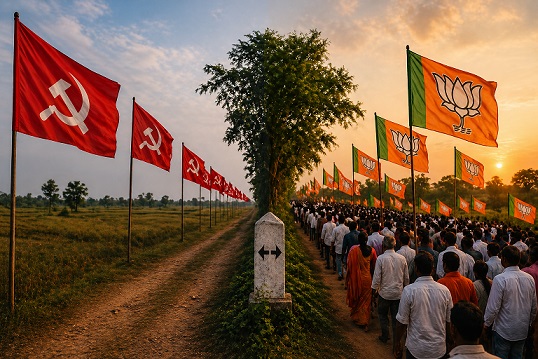
In what may be called an irony of history, the political landscape of several regions in West Bengal is undergoing a significant transformation. Naxalbari, once a symbol of radical left-wing politics and agrarian revolution, is now witnessing a visible shift towards saffron politics.
There was a time when Naxalbari was closely associated with the Naxalite movement led by Charu Majumdar. The area was marked by red flags and revolutionary slogans that represented the struggle of peasants and agricultural workers for their rights. Today, however, that picture has changed dramatically. The dominance of red has faded, and saffron flags have become increasingly prominent across the region.
The roots of this movement go back to 1967, when a peasant uprising broke out under the leadership of Kanu Sanyal and Jangal Santhal. The rebellion intensified after a violent police crackdown, in which several villagers, including women and children, were reportedly killed. This incident triggered a wider movement that later spread to different parts of India and became known as the Naxalite movement. It was even described by China’s Communist Party as the “Spring Thunder over India.”
Over the decades, however, the ideological intensity of the movement has declined. Slogans such as “Power flows from the barrel of a gun” have gradually disappeared from the walls of Naxalbari. In their place, political campaigns today are marked by chants like “Jai Shri Ram,” reflecting a major shift in public sentiment.
At present, the region falls under the Darjeeling parliamentary constituency, which is represented by the Bharatiya Janata Party (BJP). The party has steadily increased its influence in the area, with its flags and campaign activities visible in many villages. BJP candidate Anandamay Barman has claimed that people have moved away from extremist ideologies and are now supporting the party in the hope of development and stability.
Meanwhile, leaders of the All India Trinamool Congress (TMC) argue that the BJP’s earlier success was based on unfulfilled promises. They claim that voters are now becoming aware of these issues and are gradually shifting their support towards the ruling party in the state.
The role of left parties has diminished considerably. Although organizations such as the Communist Party of India (Marxist–Leninist) Liberation still exist, their influence in Naxalbari is no longer as strong as it once was. Efforts to revive the legacy of leaders like Kanu Sanyal through memorial projects and local initiatives have not significantly changed the current political trend.
Political analysts find this transformation noteworthy. A region that once stood at the forefront of a radical left-wing movement has now become a key area of right-wing political expansion. This shift is often attributed to changing socio-economic aspirations, as well as sustained political outreach by emerging forces.
As the assembly elections approach, Naxalbari remains a crucial battleground. Whether the region will continue along its current political path or witness another shift remains uncertain. However, one fact is clear: the land that once symbolized a red revolution is now experiencing a strong saffron wave, marking a profound change in its political identity.