
Last Updated on May 12, 2026 12:03 am by INDIAN AWAAZ
ANDALIB AKHTER
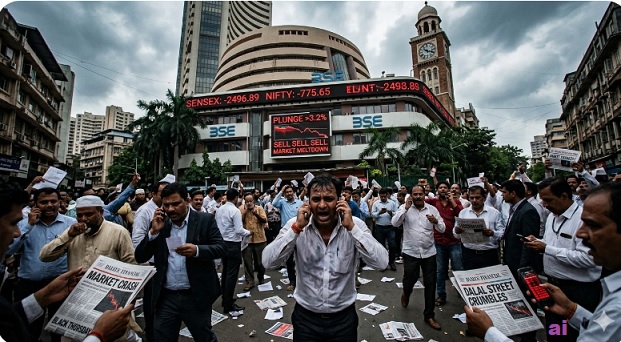
Indian equity benchmarks witnessed a sharp selloff on Monday, marking a third straight session of losses, as escalating tensions in West Asia triggered fears of prolonged geopolitical instability and rising energy costs. Investor sentiment turned cautious after U.S. President Donald Trump rejected Iran’s latest peace proposal, deepening concerns over disruptions in the Persian Gulf region.
Surging crude oil prices, a weakening rupee and growing worries over imported inflation weighed heavily on Dalal Street. Brent crude climbed above the $103-per-barrel mark, while the rupee slipped close to the 95-per-dollar level, amplifying pressure on import-dependent sectors.
The domestic market mood was further impacted after Prime Minister Narendra Modi urged citizens to adopt austerity measures, conserve fuel, reduce non-essential imports and prioritise locally manufactured goods amid the ongoing global crisis.
The benchmark BSE Sensex plunged 1,312.91 points, or 1.70 per cent, to close at 76,015.28, while the Nifty 50 declined 360.30 points, or 1.49 per cent, to settle at 23,815.85. Over the last three trading sessions, the Sensex has lost nearly 2.5 per cent, while the Nifty has fallen over 2 per cent.
Heavyweight stocks led the decline, with shares of Bharti Airtel falling 4.18 per cent, Reliance Industries dropping 3.31 per cent and HDFC Bank slipping 2.13 per cent.
Broader markets also remained under pressure. The BSE MidCap index fell 1.26 per cent, while the SmallCap index declined 0.96 per cent. Market breadth remained weak, with declining shares significantly outnumbering gainers on the BSE.
Volatility surged sharply, with India VIX rising more than 10 per cent to 18.55, reflecting heightened investor anxiety over global uncertainties.
Modi Calls for Economic Restraint
Against the backdrop of elevated oil prices and geopolitical tensions, Modi appealed to citizens to reduce petrol and diesel consumption, postpone non-essential foreign travel and avoid discretionary purchases such as gold. He also encouraged greater use of public transport, electric vehicles, work-from-home practices and domestic tourism to conserve foreign exchange reserves.
The Prime Minister further stressed the need to reduce dependence on edible oil imports and chemical fertilisers while promoting natural farming and solar-powered irrigation systems. Reiterating the importance of the “Vocal for Local” initiative, he said increasing the use of indigenous products would help strengthen India’s economic resilience amid global disruptions.
Currency, Bonds and Commodities Under Pressure
In the currency market, the rupee weakened sharply and hovered around 95.31 against the U.S. dollar, compared with its previous close of 94.49. India’s benchmark 10-year government bond yield rose to 7.033 per cent, indicating rising concerns over inflationary pressures and fiscal risks linked to higher crude prices.
Meanwhile, MCX gold futures eased marginally despite heightened global uncertainty, while the U.S. dollar index edged higher. Brent crude futures surged more than 2 per cent to settle above $103 a barrel amid concerns over supply disruptions following Iran’s reported closure of the Strait of Hormuz.
Global Markets Mixed Amid Geopolitical Anxiety
Asian markets ended on a mixed note, while European equities traded cautiously as investors monitored developments in the stalled U.S.-Iran negotiations. Concerns intensified after Trump dismissed Tehran’s latest proposal as “totally unacceptable,” while Benjamin Netanyahu reportedly said the conflict with Iran was “not over.”
Rising energy costs and supply-chain disruptions also pushed China’s inflation higher in April, adding to global macroeconomic concerns.
Sectoral Impact: Jewellery, Airlines Hit Hard
Jewellery stocks witnessed steep declines after Modi advised citizens to defer gold purchases for the next year. Shares of Kalyan Jewellers India tumbled over 9 per cent, while Titan Company and Senco Gold also ended sharply lower.
Airline stocks remained under pressure after the Prime Minister urged citizens to avoid non-essential foreign travel. Shares of InterGlobe Aviation and SpiceJet declined nearly 5 per cent each.
Earnings Drive Stock-Specific Action
Despite the broader market weakness, select companies gained on the back of strong quarterly earnings.
Tata Consumer Products surged more than 8 per cent after reporting robust growth in fourth-quarter profit and revenue. MCX gained nearly 3 per cent following a sharp rise in quarterly earnings.
Shares of Birla Corporation, Grindwell Norton and Northern Arc Capital also advanced after posting healthy financial results.
On the losing side, Canara Bank, Utkarsh Small Finance Bank, Blue Dart Express and Aarti Surfactants came under selling pressure after weak quarterly numbers disappointed investors.
Market analysts said volatility is likely to remain elevated in the near term as investors closely track crude oil prices, geopolitical developments in West Asia and the potential impact on inflation, currency stability and corporate earnings.