
Last Updated on July 19, 2026 1:58 pm by INDIAN AWAAZ
Religious Leaders, Legal Experts Unite at Lucknow Conference to Promote Social Harmony
Staff Reporter / Lucknow
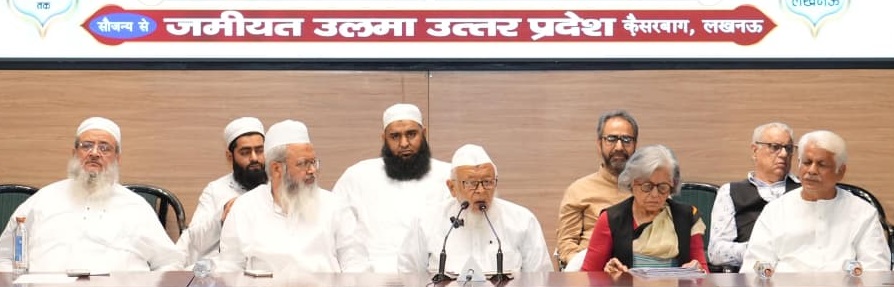
Launching what he described as a nationwide movement to strengthen communal harmony and India’s shared cultural heritage, Jamiat Ulama-i-Hind President Maulana Arshad Madani on Saturday called upon people of all faiths to unite against hatred, communalism and social divisions. Addressing the Hindu-Muslim Unity Conference, organised by Jamiat Ulama Uttar Pradesh at the Atal Bihari Vajpayee Scientific Convention Centre in Lucknow, Madani said the country’s present social and political climate required sustained efforts to restore trust and brotherhood among communities.
In his presidential address, Madani expressed concern over what he termed the growing politics of hatred in recent years, alleging that it had not only targeted Muslims but also created deep divisions within society. He said India had reached a critical juncture where rebuilding social harmony had become imperative. The conference, he said, marked the beginning of a nationwide campaign aimed at bringing together people of different faiths, intellectuals and civil society members to collectively oppose communalism.
Describing the initiative as a long-term movement rather than a one-time event, Madani said lasting change would only come through practical efforts at every level of society. “The task is difficult but not impossible. In these storms of hatred, Jamiat Ulama-i-Hind has chosen to light the lamps of love,” he said, urging justice-loving citizens to become part of the campaign.
Drawing on India’s freedom struggle, Madani recalled the role played by Islamic scholars in resisting British colonial rule. Referring to Shah Abdul Aziz Muhaddith Dehlavi, he said the first organised call against British rule emerged from a Delhi madrasa, inspiring later uprisings, including the Revolt of 1857. Though many scholars sacrificed their lives, he said, their movement eventually contributed to India’s Independence. He expressed confidence that the present campaign against communalism would also gather nationwide support over time.
Madani reiterated that Jamiat Ulama-i-Hind was a religious and social organisation with no political affiliation. “We neither contest elections nor support political candidates. Our objective is only to spread the message of unity and solidarity,” he said, adding that hatred ultimately leads to destruction and benefits no community.
Highlighting Jamiat’s humanitarian work, he said the organisation had consistently served people irrespective of religion. He cited relief and rehabilitation work undertaken during floods in Kerala and Punjab, including the construction of houses for affected families without discrimination on religious grounds.
He also referred to Jamiat’s legal intervention during the National Register of Citizens (NRC) process in Assam, claiming that the organisation had fought a case in the Supreme Court that helped safeguard the citizenship of around 40 lakh women, including nearly 25 lakh non-Muslims.
Addressing current public issues, Madani expressed concern over repeated examination paper leaks, saying they had jeopardised the future of lakhs of students. He called for systemic reforms to ensure transparency and accountability in the examination process.
On the controversy surrounding Maulana Mohammad Ali Jauhar University in Rampur, Madani said that if there were violations related to building approvals, legal penalties could be imposed, but actions leading to demolition should take into account the interests of thousands of students studying at the institution.
The conference witnessed participation from leaders representing different faiths and sections of society. Dr Vishwambhar Nath Mishra, Mahant of the Sankat Mochan Hanuman Temple in Varanasi and the chief guest, said India’s freedom had been achieved through the sacrifices of people from all communities and that the country’s unity must be preserved. He urged citizens not to remain silent in the face of injustice and extended support to the harmony campaign launched by Jamiat.
Senior Supreme Court advocate Indira Jaising described the gathering as a powerful message of constitutional values, equality and brotherhood. Referring to the Constitution’s guarantee of equal rights, she said no one could divide the country as long as citizens remained committed to its democratic ideals. She also expressed concern over what she described as the silence of the country’s intellectual class on issues affecting democracy and social cohesion.
The conference declaration was presented by Maulana Asjad Madani, Vice-President of Jamiat Ulama-i-Hind and convener of the campaign. The declaration, endorsed by participants, stated that the movement was entirely non-political and aimed at promoting trust, mutual respect and cooperation among different religions and communities. It announced that similar programmes would be organised across the country involving religious leaders, scholars, legal experts, youth, women and social activists to strengthen the spirit of harmony and India’s composite culture.
The event concluded with an appeal to citizens to carry the message of peace, brotherhood and mutual respect to their homes, educational institutions, places of worship and communities. Representatives of the Buddhist, Christian and Sikh faiths also addressed the gathering and expressed support for the initiative, describing interfaith dialogue and cooperation as essential for preserving social harmony in the country.