
Our Correspondent / NEW DELHI
Students of Jamia Millia Islamia have intensified protests over alleged irregularities in the university’s 2026-27 spot admission process, demanding transparency in the allocation of vacant seats and a clear explanation of how candidates were selected.
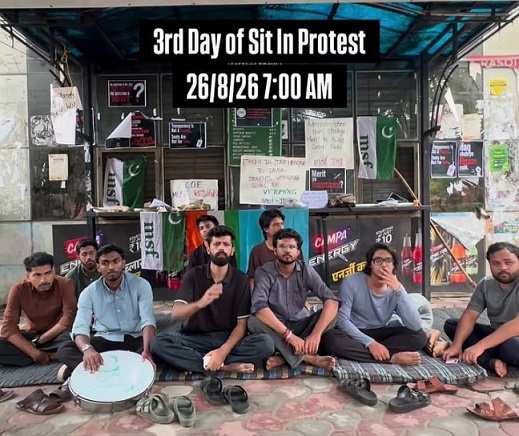
NSUI members and other students group who were sitting on Dharana since Monday demanding that the administration release a full transparent account of what really happened during spot admissions were allegedly removed forcibly today. However student said that they will continue their protest.
The protests come amid wider student concerns across the country over admission systems, entrance examinations, paper leaks, counselling procedures and alleged deficiencies in educational institutions.
At Jamia, students have questioned the decision to conduct spot registrations offline this year, arguing that the change has created scope for discrepancies in the allocation of seats. The university issued its first notice for offline spot registrations on July 31 for programmes where seats remained vacant after the regular admission and counselling process.
Spot admission is generally intended to fill seats left vacant after the regular counselling rounds. Students protesting at Jamia maintain that such seats should be allotted strictly according to the applicable merit and waiting-list order, subject to category and reservation rules.
The case of Faizan Ali Khan, an MA Gender Studies aspirant, has emerged as one of the key issues in the protest. Khan said he was placed at rank 12 in the Muslim waiting list and at 27 in the general waiting list after the entrance examination results were announced. However, he alleged that during the second spot round announced on August 19, candidates ranked below him were allotted seats while his name was initially missing.
According to students, four candidates below Khan in the general list and three below him in the Muslim list were admitted. The discrepancy triggered questions over whether the published waiting-list order was being followed consistently.
Khan subsequently raised the issue publicly and posted a video on social media on August 20. He was later called to the proctorial office following a complaint from the Controller of Examinations’ office, which allegedly accused him of creating a disturbance. Khan said he was asked to issue a clarification attributing the problem to a technical glitch.
The university subsequently issued a fresh admission list that included Khan and another applicant, Ayaan Ali, who had also raised concerns about his admission. However, students continued to demand answers over the broader admission process.
Students, however, contend that the issue extends beyond an individual case. The National Students’ Union of India (NSUI) has been leading a sit-in at campus Gate, with protesters demanding a complete and transparent account of the spot admission process.
Another applicant, Insha Rehmani, who appeared for the B.Ed entrance examination, has also alleged discrepancies in seat allocation. She claimed that although she was ranked fourth on the Muslim category waiting list and first on the Muslim OBC list, a candidate ranked fifth in the Muslim category was allotted a seat under the general category.
Students have also raised concerns over admissions to the B.Arch programme, particularly regarding candidates from Jammu and Kashmir. Protesters questioned why eligible J&K candidates were allegedly not allotted seats despite the university’s provision of two seats for J&K students in each programme.
The protesters are also questioning the introduction of interviews for certain programmes, including BA LLB, arguing that an additional assessment stage could disadvantage students from regions with fewer educational opportunities.
The central demand of the protesting students is therefore not limited to individual admissions. They are seeking publication of the complete vacancy position, waiting-list movement, category-wise allocation details and the criteria used for spot admissions, along with an independent review of disputed cases.
Jamia’s Chief Public Relations Officer Saima Saeed however refuted the allegations that the protesting students were forcibly removed from Dharna site, rather, she said they were asked to protest at designated place as suggested by High court, which is near Gate Number 18 of the campus.
On Spot Admission Process she said that there is nothing against prescribed rule and regulation. “Spot Admission is being done according prescribed rules”, she said. She also said the administration had examined Faizan Khan’s complaint, identified a technical glitch and rectified the error by issuing a fresh list. She maintained that the student began protesting before the matter could be resolved and suggested that allegations beyond the technical issue appeared to serve “other interests.”
With admissions determining students’ academic futures, protesters argue that Jamia must ensure that every vacant seat is filled through a process that is transparent, verifiable and consistent with the university’s stated admission rules.