
Last Updated on July 5, 2026 1:36 am by INDIAN AWAAZ
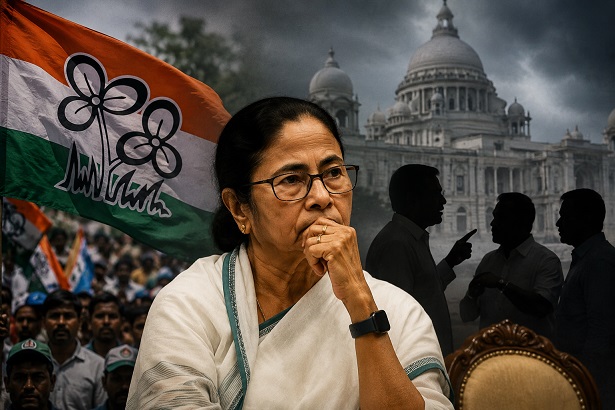
Aafreen Hussain in Kolkata
West Bengal politics has entered a phase that would have seemed almost unimaginable just a few years ago. A leader who once appeared politically invincible now finds herself defending not just her party, but its very identity.
Mamata Banerjee’s latest virtual address was emotional, combative and defiant. She accused the BJP government of political vendetta, defended her organisation, announced changes in the Trinamool Congress leadership, and declared that no force could erase the party from Bengal’s political landscape.
But beneath the determined words lies an uncomfortable question: If everything is under control, why does the party appear to be fighting on so many fronts at the same time?
The emergence of the so-called “Baghi TMC” led by Ritabrata has changed the political conversation. For the first time, the Election Commission is reportedly being asked to examine competing claims over who represents the “real” Trinamool Congress. Whether that challenge succeeds or fails legally is a separate issue. Politically, however, the damage is already visible. A party that once projected absolute unity is now spending valuable political energy proving its own legitimacy.
The Assembly has reflected that transformation as well. Defections, rival claims, organisational disputes and bitter exchanges have replaced the confidence that once defined the Trinamool benches. The debate is no longer simply BJP versus TMC. Increasingly, it has become BJP versus TMC, alongside TMC versus its own rebels.
Then comes the most symbolic setback of all.
A politician who built her image as Bengal’s undisputed mass leader could not retain her own Bhabanipur seat. In politics, symbolism often matters as much as numbers. Losing one’s traditional political fortress sends a message that no speech can easily erase.
Mamata Banerjee insists that elections were manipulated and that history will eventually reveal the truth. Her critics counter that repeated allegations cannot substitute for electoral victory. Between these competing narratives stands the ordinary voter, asking a simpler question: if the people’s mandate was ignored, where is the evidence that can decisively change the political verdict?
Her speech repeatedly returned to memories of past struggles, sacrifices and betrayals. Yet politics rewards today’s organisation more than yesterday’s achievements. Nostalgia can inspire loyal supporters, but it rarely rebuilds a fractured political machine.
Perhaps the strongest irony is this: for years Mamata Banerjee was the politician who challenged the establishment. Today she presents herself as the victim of an establishment led by her former political rivals. The roles have reversed dramatically.
The appointment of trusted loyalists such as Kunal Ghosh and Madan Mitra, and Mamata’s decision to personally oversee the party organisation, can be read in two different ways. Supporters see decisive leadership. Critics see a leader who no longer trusts the existing organisational structure to hold together without her direct supervision.
And that raises the biggest question of all.
Is Mamata Banerjee still leading Bengal’s opposition movement, or is she now leading a battle simply to keep the Trinamool Congress united?
Political history shows that great leaders rarely disappear overnight. They gradually move from commanding the political narrative to reacting to it. Every press conference becomes a defence. Every organisational reshuffle becomes crisis management. Every appeal to loyalty suggests that loyalty itself has become uncertain.
The BJP today governs Bengal. The rebel Trinamool faction has complicated Mamata Banerjee’s political space. The Assembly reflects a new balance of power. The Election Commission is reportedly hearing rival organisational claims. None of these developments alone determine her political future. Together, however, they present the greatest challenge of her career.
So, is Mamata Banerjee politically finished? That would be an easy headline—but politics is rarely that simple.
A more accurate question may be: Is Bengal witnessing the final chapter of Mamata Banerjee’s dominance, or merely the toughest chapter of her long political career? The answer will not come from speeches or slogans. It will come from whether she can rebuild a fractured organisation, counter an emboldened BJP, contain internal rebellion, and once again convince Bengal that she represents its future rather than its past.