
Last Updated on May 27, 2025 5:44 pm by INDIAN AWAAZ
ANDALIB AKTER / New Delhi
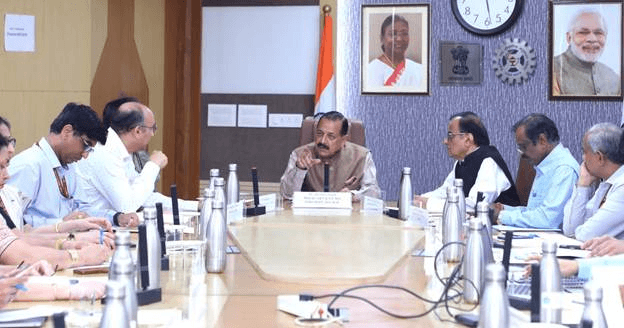
In a significant push towards green aviation and indigenous technology development, India has officially initiated the process of developing its first next-generation electric trainer aircraft, the Electric Hansa (E-Hansa). The announcement was made today by Dr. Jitendra Singh, Union Minister of State (Independent Charge) for Science & Technology, during a high-level review meeting at the Science Centre.
The E-Hansa, a two-seater electric trainer aircraft, is being developed indigenously by the Council of Scientific and Industrial Research–National Aerospace Laboratories (CSIR-NAL), Bengaluru. Speaking in his capacity as Vice President of CSIR, Dr. Singh described the initiative as a “matter of national pride” and a major milestone for India’s clean energy and aviation goals.
The E-Hansa is projected to cost around ₹2 crore, roughly half the price of comparable imported trainer aircraft, making it a cost-effective solution for pilot training. It forms a crucial component of the broader HANSA-3 (NG) program aimed at providing affordable, indigenous options for India’s aviation training ecosystem.
“This electric aircraft is not just a breakthrough in aerospace engineering but a strong statement on India’s commitment to green technologies and self-reliance,” Dr. Singh noted.
Science & Technology in Reform Mode
The meeting, attended by top science and technology leaders of the country, focused on performance reviews, implementation status of ongoing projects, and shaping transformative reforms across the sector. Dr. Singh emphasized the need for commercializing indigenous technologies and urged stronger public-private partnerships (PPP).
He directed the National Research Development Corporation (NRDC) to adopt successful models like DBT-BIRAC and IN-SPACe to enhance technology transfer and industry collaboration. Advocating for a hub-and-spoke PPP model, he proposed leveraging AI-driven IP exchange platforms and regional National Technology Transfer Offices (NTTOs) for broader impact.
“Private players should not just be knowledge partners, but also investment partners,” he asserted.
ISRO Commended; Space Science Milestones
Lauding the Indian Space Research Organisation (ISRO) for the successful SPADEX mission, Dr. Singh underscored the significance of the tested docking and undocking capability for India’s upcoming Gaganyaan human spaceflight. He also highlighted ISRO’s vital role in Operation Sindoor, commending the organisation’s ongoing collaborations with 40 Union Ministries and 28 State Governments.
On the international front, Dr. Singh announced that Group Captain Subhash Shukla’s participation in the Axiom Space Mission will include seven microgravity experiments aboard the International Space Station (ISS), further cementing India’s presence in global space research.
Roadmap for a ‘Viksit Bharat’
Aligning with Prime Minister Narendra Modi’s ‘Viksit Bharat’ vision, Dr. Singh called for a Whole-of-Science and Whole-of-Government approach. He announced plans to organize region-wise Chintan Shivirs across the country, bringing together DST, DBT, CSIR, ISRO, and other departments to foster integrated scientific planning and innovation.
In a move to bolster India’s biomanufacturing sector, the minister proposed setting up a Global Science Talent Bridge to attract international researchers and innovators. He also confirmed that the recent security-related pause on public access to CSIR labs—opened following a Mann Ki Baat announcement—would be lifted soon.
Global Scientific Collaboration on the Rise
With growing international interest, countries like Switzerland and Italy are exploring bilateral science collaboration centers modeled after India’s partnerships with France and Germany.
The review meeting was attended by key scientific figures including Prof. Ajay Kumar Sood, Principal Scientific Advisor; Dr. N. Kalaiselvi, DG, CSIR; Dr. V. Narayanan, Chairman, ISRO; Dr. Abhay Karandikar, Secretary, DST; Dr. Rajesh Gokhale, Secretary, DBT; Dr. M. Ravichandran, Secretary, Earth Sciences; Dr. M. Mohapatra, DG, IMD; and Commodore Amit Rastogi (Retd), CMD, NRDC, among others.