
Last Updated on August 25, 2025 11:08 pm by INDIAN AWAAZ
Staff Reporter
India and Fiji have reiterated zero tolerance towards terrorism by rejecting double standards on it. During the bilateral talks between Prime Minister Narendra Modi and Prime Minister of Fiji Sitiveni Rabuka in New Delhi, both leaders agreed to strengthen cooperation against terrorism and condemned terrorism in all its forms and manifestations.
The two leaders condemned the Pahalgam terrorist attack which took the lives of 26 innocent civilians in Jammu and Kashmir in April this year. India and Fiji stressed on the need to counter radicalization, combat terror financing, prevent exploitation of new and emerging technologies for terrorist activities and tackle terrorist recruitment.
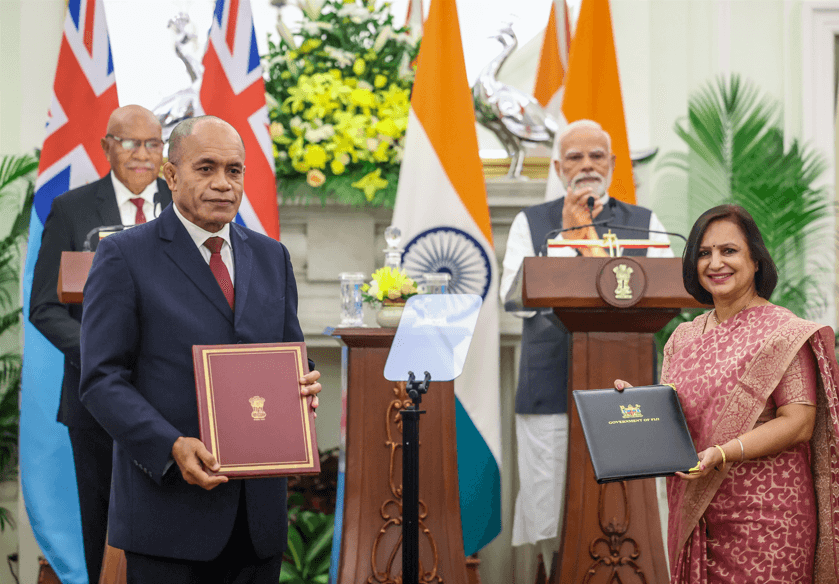
Briefing media in New Delhi today, Secretary (South) of Ministry of External Affairs Neena Malhotra said, Prime Minister Narendra Modi and Prime Minister Sitiveni Rabuka witnessed the exchange of nine bilateral documents and MoUs. She said the talks covered the entire gamut of relations, including political cooperation, high-level engagements, trade, agriculture, education, healthcare, mobility, defence, capacity building, and people-to-people ties.
India and Fiji reaffirmed their commitment to climate action, resilience building, and sustainable development in the spirit of India’s Mission LiFE and the 2050 strategy for the blue Pacific continent. The two leaders shared a commitment to promoting biofuels as sustainable energy solutions within the framework of the Global Biofuels Alliance. Both leaders acknowledged the potential of bilateral defence ties emphasizing the importance of their shared interests in advancing regional peace, stability, and prosperity.
The leaders expressed satisfaction with the ongoing defence collaboration and reaffirmed their commitment to further strengthen these ties, emphasising the need to enhance defence and maritime security cooperation. The leaders also underscored the importance of a free, open, secure, and inclusive Indo-Pacific region. They announced their intent to collaborate on strengthening regional maritime security, contributing to peace and stability in the Indo-Pacific. Both Prime Ministers expressed their commitment to supporting an open, inclusive, stable and prosperous Indo-Pacific.
Defence and Security Cooperation
The leaders reviewed growing momentum in defence ties and agreed to enhance cooperation in maritime security, humanitarian assistance, disaster relief and capacity building. India announced the gifting of two ambulances to the Republic of Fiji Military Forces, the setting up of a defence wing at its High Commission in Suva, and the establishment of a Cyber Security Training Cell. Rabuka welcomed India’s support in securing Fiji’s Exclusive Economic Zone, and the planned port call by an Indian naval ship.
Health and Development Partnership
Healthcare emerged as a major pillar of cooperation, with the signing of an MoU for the construction of a 100-bed Super Specialty Hospital in Suva—the largest Indian grant project in the Pacific. The leaders also welcomed collaboration under India’s telemedicine initiative e-Sanjeevani and the upcoming second Jaipur Foot camp in Fiji. India will also extend tertiary medical care in Indian hospitals to Fijians under the Heal in India programme.
On development cooperation, the leaders announced the Tubalevu Ground Water Supply Project, the first Quick Impact Project (QIP) in Fiji, aimed at providing clean drinking water.
Climate Action and Energy
Both sides reaffirmed their shared commitment to sustainable development under India’s Mission LiFE and the Pacific’s 2050 Blue Strategy. Fiji’s active membership in the International Solar Alliance, the Coalition for Disaster Resilient Infrastructure and the Global Biofuels Alliance was welcomed, alongside new initiatives such as a solar training centre at Fiji National University.
Trade, Agriculture and Innovation
The leaders noted untapped potential in bilateral trade and pledged to diversify economic cooperation. India welcomed Fiji’s decision to grant market access for Indian ghee. To boost agriculture, PM Modi announced the gifting of 12 drones, two mobile soil testing labs, and cowpea seeds. An ITEC expert will also be deputed to Fiji Sugar Corporation to support innovation in the sugar sector.
Cultural and People-to-People Links
Recognising deep-rooted cultural ties, both sides welcomed initiatives such as deputing a Hindi-Sanskrit teacher to Fiji and training a cohort of Fijian pundits in India. An International Geeta Mahotsav will also be organised in Fiji later this year. A Declaration of Intent on Migration and Mobility was signed to facilitate movement of professionals and students.
Regional and Global Issues
Both leaders strongly condemned terrorism, including the recent Pahalgam attack in India, and pledged zero tolerance against radicalisation and terror financing. They reiterated support for a free, open and inclusive Indo-Pacific, with Rabuka announcing Fiji’s intention to join India’s Indo-Pacific Oceans Initiative. PM Modi, in turn, commended Rabuka’s advocacy of the “Ocean of Peace” concept for the Pacific.
On global governance, Fiji reaffirmed support for India’s bid for permanent membership of a reformed UN Security Council and its candidature for a non-permanent seat in 2028-29. Rabuka also praised India’s leadership in amplifying the concerns of the Global South through initiatives like the Voice of Global South Summit.
New Agreements Signed
Five key agreements were signed, including MoUs between Fiji Development Bank and NABARD; Bureau of Indian Standards and Fiji’s trade measurement body; NIELIT and Pacific Polytechnic; Confederation of Indian Industry and Fiji Commerce and Employers Federation; and a supply agreement for affordable medicines under India’s Jan Aushadhi scheme.
Prime Minister Rabuka expressed gratitude for India’s hospitality and invited Prime Minister Modi to visit Fiji. The two leaders pledged to continue working together to advance shared goals of peace, prosperity and sustainable development.