
Andalib Akhter
New Delhi: The government of India is expanding its welfare and support infrastructure for senior citizens, with a focus on shelter, healthcare, nutritious food, mobility assistance and dignified independent living for elderly persons across the country.
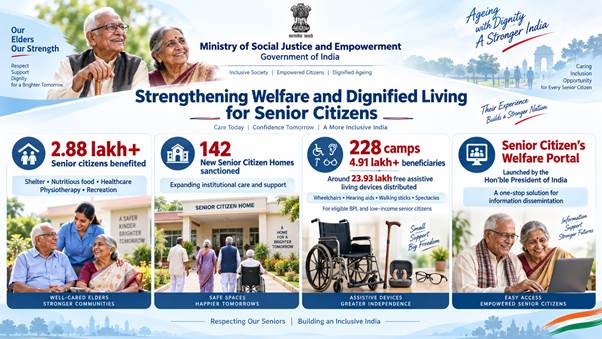
Secretary, Ministry of Social Justice and Empowerment, Sudhansh Pant said that more than 2.88 lakh senior citizens have benefited from institutional support services, including shelter, nutritious food, healthcare, physiotherapy, recreation and other essential facilities. The measures are aimed at addressing the day-to-day needs of elderly persons while improving their physical well-being and overall quality of life.
A major focus of the government’s intervention is the expansion of dedicated care facilities. Pant said 142 new Senior Citizen Homes have been sanctioned across different parts of the country. The additional homes are expected to strengthen the availability of institutional care and provide elderly persons with access to essential support services closer to their communities.
The government is also seeking to improve the ability of senior citizens, particularly those from economically weaker sections, to live independently. According to the ministry, 228 camps were organised for more than 4.91 lakh beneficiaries, through which elderly persons were provided assistance and access to support services.
Around 23.93 lakh assistive living devices were distributed free of cost to eligible senior citizens belonging to Below Poverty Line (BPL) categories and low-income groups. The devices included wheelchairs, hearing aids, walking sticks and spectacles, helping beneficiaries overcome mobility, hearing and vision-related difficulties.
The distribution of assistive devices is particularly significant for elderly persons with limited financial resources, as such equipment can directly improve their ability to perform everyday activities and remain connected with their families and communities. The initiative is intended not only to provide physical assistance but also to promote greater participation and independence among senior citizens.
The ministry has also taken steps to improve access to information about government schemes and welfare services. Pant said the Senior Citizen’s Welfare Portal, launched by the President of India, functions as a one-stop platform for information relating to the welfare of senior citizens.
The portal is intended to make information more accessible to elderly persons and their families, particularly those seeking details about available welfare measures, support services and institutional assistance.
The government’s approach, according to the ministry, extends beyond providing financial or institutional assistance and seeks to address the broader requirements of an ageing population. Access to healthcare, physiotherapy, nutrition, recreation, mobility aids and reliable information are being brought together as part of a wider support framework.
The expansion of Senior Citizen Homes is also expected to strengthen institutional care for elderly persons who may require regular assistance or do not have adequate support systems at home. At the same time, the distribution of assistive devices seeks to enable senior citizens to remain independent for as long as possible.
Pant said the initiatives demonstrate the ministry’s continuing commitment to ensuring accessible care, stronger welfare infrastructure and dignified living for senior citizens.
With more than 2.88 lakh elderly persons already benefiting from institutional support, 142 additional Senior Citizen Homes sanctioned and nearly 23.93 lakh assistive devices distributed, the measures represent a significant expansion of the government’s support framework for India’s ageing population. The emphasis is increasingly shifting towards ensuring that senior citizens can live not merely with basic support, but with greater dignity, mobility, healthcare access and independence.