
Last Updated on September 12, 2026 8:09 pm by INDIAN AWAAZ
New Delhi Declaration Sets Out BRICS Agenda on Trade, Energy and Economic Resilience
R. Suryamurthy
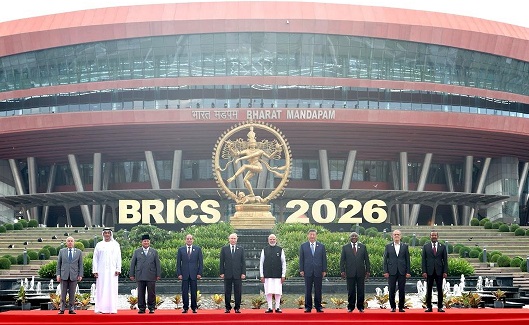
BRICS leaders on Saturday adopted the New Delhi Declaration 2026, using the 18th summit to mount a broad challenge to unilateral trade restrictions and the existing global economic governance system while laying out measures to strengthen energy security, supply chains and economic resilience across the expanded grouping.
The declaration, adopted after intensive negotiations, comes two decades after BRICS emerged as a political and economic platform for major emerging economies and reflects the bloc’s increasingly ambitious attempt to give developing countries greater influence over global trade and financial institutions.
Opening the economic plenary under India’s theme of “Building for Resilience, Innovation, Cooperation and Sustainability,” Prime Minister Narendra Modi called for a more inclusive global economic system in which developing economies have a greater role in shaping international rules.
“We must transform this ‘pyramid of privilege’ into a ‘platform of partnership,’ where every country has a voice, every member has a stake, and human development remains at the heart of every effort,” Modi said.
“Countries that drive global economic growth should also have an appropriate role in shaping global economic governance,” he added.
The declaration combines two seemingly competing approaches: a renewed defence of multilateral institutions such as the World Trade Organization, alongside efforts to strengthen intra-BRICS economic mechanisms that could provide alternatives when global trade and financial systems are disrupted by geopolitical tensions.
That dual approach is likely to shape BRICS’ economic agenda as the expanded grouping confronts higher tariffs, sanctions, supply-chain disruptions and increasing fragmentation of global commerce.
Energy security moves to the centre
Energy security emerged as a major concern, with BRICS leaders warning that geopolitical conflicts and threats to critical maritime routes are increasing the vulnerability of global energy supplies and commodity networks.
The declaration expressed concern over the vulnerability of critical energy infrastructure, transit routes and supply chains to geopolitical tensions and conflict-driven disruptions, stressing the importance of unrestricted and non-discriminatory access to energy sources and major maritime corridors.
The warning comes amid continuing security risks around strategic shipping routes, including the Red Sea and Bab el-Mandeb, which have forced vessels to take longer routes and contributed to higher freight costs and uncertainty over commodity deliveries.
BRICS also called for greater protection of critical infrastructure and more predictable energy markets.
The declaration reaffirmed that energy security remains essential for economic development and social stability, while supporting “balanced energy transitions” that take into account the different circumstances of developing economies.
The formulation reflects a significant tension within global climate and energy policy.
While developed economies are accelerating efforts to reduce fossil-fuel dependence, many emerging economies continue to rely on hydrocarbons to support industrialisation, electricity generation and transport.
BRICS therefore backed a transition that combines renewable energy and emerging technologies with continued access to conventional fuels, rather than imposing a uniform timetable on all members.
The bloc is also seeking greater cooperation in areas including smart grids, hydrogen and other low-emission technologies, potentially allowing members to preserve energy security while building capacity for a lower-carbon economy.

BRICS attacks unilateral tariffs
Trade protectionism emerged as another major fault line.
The declaration voiced “serious concerns” over the growing use of unilateral tariff and non-tariff measures, arguing that such policies distort trade and are inconsistent with World Trade Organization rules.
The criticism comes as major economies increasingly deploy tariffs, subsidies, export controls and other measures linked to industrial policy and national security.
For developing economies, BRICS argues, the resulting fragmentation threatens to raise import costs, disrupt supply chains and restrict access to major markets.
The bloc reaffirmed its support for a rules-based, non-discriminatory multilateral trading system with the WTO at its core.
It also called for the immediate restoration of a fully functioning WTO dispute-settlement mechanism, including its two-tier structure and binding character.
“We strongly advocate for the immediate restoration of an accessible, effective, fully functioning, two-tier binding WTO dispute settlement mechanism as a foundation for trust and predictability for all WTO members,” the declaration said, while calling for the appointment of new Appellate Body members.
The demand comes after years of paralysis in the WTO’s dispute-settlement system, leaving countries with fewer effective mechanisms to challenge trade measures they consider discriminatory.
Pushback against unilateral sanctions
BRICS also criticised unilateral coercive measures and secondary sanctions, arguing that they can disrupt trade and financial flows beyond the countries directly targeted.
The declaration condemned unilateral coercive measures that it said were contrary to international law and warned that such actions undermine the principles and purposes of the UN Charter.
The language reflects the differing geopolitical priorities within BRICS.
Some members see sanctions primarily as a direct threat to their economies and financial systems, while others are more focused on preserving strategic autonomy and ensuring that access to international markets is not determined by unilateral decisions of individual powers.
The result is a carefully constructed position that criticises unilateral economic coercion without explicitly turning BRICS into an anti-Western economic alliance.
Building alternative economic channels
At the same time as defending the WTO, BRICS is moving to strengthen its own economic infrastructure.
The bloc is pursuing initiatives covering trade standards, global value chains, commodities, energy, critical minerals and supply-chain integration.
Plans for stronger intra-BRICS trade mechanisms, including work around a BRICS Grain Exchange and other commodity initiatives, are aimed at improving food and commodity security while reducing vulnerabilities created by disruptions in established global trading networks.
The grouping is also looking at special economic zones, critical-mineral cooperation and measures to integrate developing economies more deeply into global value chains.
The objective is not necessarily to replace existing global markets but to provide additional channels through which BRICS economies can trade and invest when geopolitical tensions or protectionist policies disrupt conventional routes.
That strategy could become increasingly important if trade fragmentation persists.
IMF and World Bank reform
The declaration also renewed the bloc’s campaign to reform the Bretton Woods institutions, arguing that the governance structures of the IMF and World Bank no longer adequately reflect the changing distribution of global economic power.
“With the growing share of EMDEs in global output and growth, reform of global economic governance remains a consistent BRICS priority,” the declaration said.
It called for the institutions to become more “agile, effective, credible, inclusive, fit for purpose, unbiased, accountable” and representative.
The bloc has previously called for changes in IMF quota shares and greater representation of emerging and developing economies in decision-making.
The issue is likely to remain a major BRICS demand as members seek to translate their increased share of global output and trade into greater institutional influence.
Financial alternatives gain momentum
The declaration’s financial agenda also includes strengthening the BRICS Contingent Reserve Arrangement and expanding the role of the New Development Bank.
The CRA is intended to provide a financial safety net during balance-of-payments or liquidity pressures, while the NDB is being positioned as a source of development financing, including greater use of local currencies.
These institutions could become increasingly important if developing economies face tighter global financial conditions or greater restrictions on access to international capital.
BRICS is also advancing work on cross-border payments and local-currency settlements, seeking greater interoperability among national payment systems.
Rather than immediately pursuing a common BRICS currency, the bloc’s approach increasingly focuses on connecting existing systems and enabling trade to be settled in national currencies.
That could reduce transaction costs and exposure to foreign-exchange risks in some bilateral trade corridors, although the scale of any shift will ultimately depend on currency liquidity, convertibility, financial-market depth and commercial adoption.
A pragmatic compromise
The declaration’s economic agenda reflects the political diversity of the expanded BRICS membership.
Some members favour a more fundamental challenge to Western economic dominance, while others, including India and Brazil, have stronger incentives to preserve strategic autonomy and maintain economic relationships with both Western and non-Western powers.
The final document therefore stops short of establishing a rigid alternative economic bloc.
Instead, it emphasises voluntary cooperation, national circumstances and practical mechanisms that can coexist with existing global institutions.
That makes the New Delhi Declaration less a blueprint for replacing the current economic order than an attempt to build resilience against its potential fragmentation.
For BRICS, the next challenge will be implementation.
The credibility of the declaration will ultimately depend not on the number of initiatives announced but on whether they can lower trade and financing costs, strengthen supply-chain resilience, expand access to development capital and give emerging economies greater influence over the rules governing global commerce.
As the expanded grouping moves beyond its second decade, the test will be whether BRICS can turn political solidarity into economic infrastructure — and whether that infrastructure becomes sufficiently credible for businesses, banks and investors to actually use it.