
Last Updated on August 31, 2026 9:23 pm by INDIAN AWAAZ
Andalib Akhter / NEW DELHI
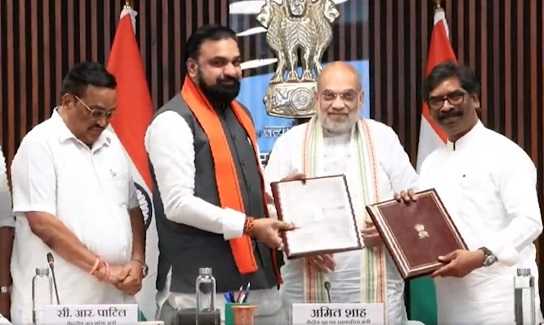
Bihar and Jharkhand on Monday signed a long-awaited Memorandum of Understanding (MoU) for sharing the waters of the Sone River, marking a major step towards resolving a nearly 25-year-old inter-state water dispute and improving water availability for irrigation and drinking purposes in both states.
The agreement was signed in New Delhi in the presence of Union Home Minister Amit Shah, Jharkhand Chief Minister Hemant Soren, Bihar Chief Minister Samrat Choudhary and Union Jal Shakti Minister C.R. Patil, among other senior officials.
Describing the agreement as a significant achievement, Shah said the settlement had resolved a long-pending water dispute in eastern India and would benefit millions of people across rural areas of Bihar and Jharkhand. He said the arrangement would provide water for irrigation to large numbers of farmers while also strengthening drinking-water availability for local populations.
The Home Minister said the agreement demonstrated the importance of dialogue and cooperation between states and reflected Prime Minister Narendra Modi’s vision of “Team Bharat” and the principle of cooperative federalism.
End to a decades-long dispute
The Sone River water-sharing issue has remained a contentious matter between Bihar and Jharkhand for nearly a quarter of a century. The signing of the MoU is being seen as an important breakthrough because the dispute affected water availability across several districts and had implications for agriculture, rural development and drinking-water supplies.
Shah said the resolution demonstrated that even complex inter-state issues involving large geographical areas and the interests of farmers and rural communities could be settled through dialogue and a spirit of cooperative federalism.
He described the agreement as an example of states working together to address issues that directly affect people’s livelihoods and basic needs.
According to Shah, the agreement would ensure adequate water for irrigation and drinking purposes across a substantial population in Bihar, particularly in the districts of Bhojpur, Buxar, Rohtas, Kaimur, Aurangabad, Arwal, Gaya and Patna.
In Jharkhand, the arrangement would facilitate greater availability of water for irrigation and drinking in Palamu, Garhwa and other areas, potentially benefiting farmers and rural communities dependent on reliable water supplies.
Focus on farmers and rural development
Water availability remains a critical factor for agriculture in both Bihar and Jharkhand, where large rural populations depend on farming and allied activities. A more clearly defined mechanism for sharing Sone River water could help improve irrigation access and reduce uncertainty for agricultural communities in the affected regions.
The agreement is also significant from the perspective of drinking-water security. Shah said the settlement would make water available for both irrigation and domestic consumption, linking the river-sharing arrangement to broader rural-development objectives.
The government has emphasised that better water availability can have a wider economic impact by supporting agricultural productivity, strengthening rural livelihoods and improving access to essential services.
Shah highlights cooperative federalism
Speaking at the signing ceremony, Shah said the Bihar-Jharkhand agreement was an example of the “Team Bharat” approach and cooperative federalism advocated by Prime Minister Modi.
He also pointed out that this was the fourth water-sharing agreement between states this year, describing such agreements as important steps towards improving water availability for irrigation, drinking purposes and rural development.
The Home Minister stressed that resolving inter-state water disputes requires states to work together rather than allowing disagreements to remain unresolved for long periods.
The agreement, he said, demonstrated that a settlement could be reached when negotiations were conducted in the spirit of cooperation and mutual understanding.
Wider regional significance
The Sone River is an important tributary of the Ganga and plays a significant role in the water resources of eastern India. The river passes through areas where agriculture depends heavily on irrigation, making the management and distribution of its waters an important economic and social issue.
The settlement between Bihar and Jharkhand could therefore have significance beyond the immediate legal and administrative resolution of the dispute. By establishing an agreed framework for water sharing, the two states can potentially focus greater attention on the efficient use and development of water resources.
For Bihar, improved access to Sone water is expected to support irrigation across several districts, including major agricultural areas. In Jharkhand, the arrangement is expected to benefit districts such as Palamu and Garhwa, where water availability remains important for both farming and household requirements.
Chief ministers welcome agreement
Both Chief Ministers expressed their gratitude to Prime Minister Narendra Modi and Union Home Minister Amit Shah for facilitating the resolution of the long-standing dispute.
The agreement brings an end to a prolonged phase of disagreement over the sharing of Sone River waters and establishes a cooperative framework between the two neighbouring states.
The signing also underlines the growing importance of negotiated settlements in managing India’s inter-state water resources. With water increasingly linked to agriculture, drinking-water security and rural development, mechanisms that allow states to coordinate their resources can have significant implications for local economies and communities.
For Bihar and Jharkhand, the immediate focus will now be on implementing the understanding reached through the MoU and ensuring that the promised water availability translates into tangible benefits for farmers and residents in the identified districts.
The agreement is consequently being viewed not merely as the settlement of a long-running dispute but also as an opportunity to strengthen inter-state cooperation over a resource that is vital to agriculture, livelihoods and everyday life.