
Last Updated on October 17, 2025 10:53 pm by INDIAN AWAAZ
A betrayal with the nation,” says NCP Nahid Islam
Zakir Hossain from Dhaka
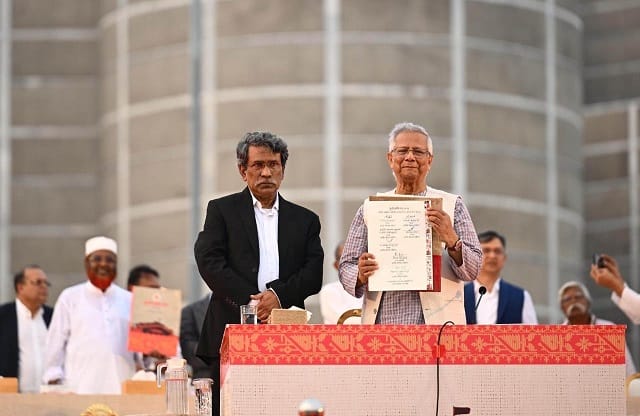
In what interim leader Professor Muhammad Yunus termed “the beginning of a New Bangladesh,” the July National Charter 2025 was signed on Friday evening at the South Plaza of the National Parliament in Dhaka, marking a major milestone in the country’s post-Hasina political transition.
The historic ceremony, organized by the National Consensus Commission (NCC), began at 4:37 pm with the national anthem and concluded at 5:07 pm. It was conducted by Monir Haidar, Special Assistant to the Chief Adviser on Consensus Building, while Professor Ali Riaz, NCC Vice President, delivered the inaugural address.
Two representatives from each major political party joined Yunus on stage for the signing. Signatories included Mirza Fakhrul Islam Alamgir and Salahuddin Ahmed (BNP); Syed Abdullah Mohammad Taher and Mia Golam Parwar (Jamaat-e-Islami); and centrist-progressive leaders Mahmudur Rahman Manna, Zonayed Saki, and Ashraf Ali Akon. Diplomats from several countries, including European missions, and civil society figures were also in attendance.
“This is a great day — the beginning of a New Bangladesh,” Yunus declared after signing the Charter. Paying tribute to those who died in the July 2024 Uprising, which toppled Sheikh Hasina’s long rule, he said, “The nation is indebted to the July fighters who made this day possible.” Yunus emphasized the government’s commitment to “free and fair elections that no one from outside can raise questions about,” and highlighted plans to develop the Bay of Bengal’s economic potential and establish a deep-sea port as part of the national development strategy.
However, several left-wing parties, including the Communist Party of Bangladesh (CPB), Bangladesher Samajtantrik Dal (BSD), BSD (Marxist), and Bangladesh JASAD, abstained from signing, saying they had not received the final revised draft. The National Citizen Party (NCP), led by student activists from the 2024 uprising, also refused to sign, demanding legal guarantees for implementation.
Tensions flared hours before the ceremony when a group calling themselves the “July Fighters” clashed with police near Manik Mia Avenue. The group demanded constitutional recognition, rehabilitation, and compensation for those injured during last year’s uprising. Police baton-charged the protesters and fired tear gas and sound grenades after demonstrators occupied parts of the venue and set fire to temporary structures. Several were injured and taken to Dhaka Medical College Hospital.
Following the violence, the NCC swiftly amended the fifth clause of the Charter to include the protesters’ key demands. Reading the revised clause, Professor Ali Riaz announced: “Justice will be ensured for those subjected to enforced disappearances, killings, and torture during the 16-year struggle against Awami fascism and the July–August 2024 uprising. State recognition will be granted to the martyrs and July fighters, including monthly allowances, rehabilitation, and legal protection.” He assured that the NCC would formally present the amended pledge to the government for execution.
But not everyone saw the day as a triumph. Nahid Islam, a leading figure of the 2024 uprising and convener of the National Citizen Party (NCP), denounced the signing as “a betrayal with the nation under the guise of unity.” Speaking at the launch of the new workers’ organization Jatiya Sramik Shakti, he said, “National unity is formed when people unite for a common cause. But this Charter is an elite pact — not a people’s agreement.” He added that his movement would continue fighting for the working class, saying, “Workers endured extreme oppression under Sheikh Hasina’s fascist regime. We will ensure liberation and dignity for the working class.”
The July National Charter 2025, drafted by the National Consensus Commission, serves as a blueprint for political, constitutional, and institutional reforms in post-Hasina Bangladesh, focusing on transitional justice and electoral reform.
Former Prime Minister Sheikh Hasina, ousted during the July 2024 mass uprising, remains in exile in India and faces multiple trials in absentia for alleged crimes against humanity. The interim government, led by Nobel laureate Professor Yunus, has pledged to hold national elections in February 2026, promising to restore democracy, accountability, and rule of law in the country.