
Last Updated on February 22, 2026 1:41 am by INDIAN AWAAZ
Zakir Hossain, Dhaka
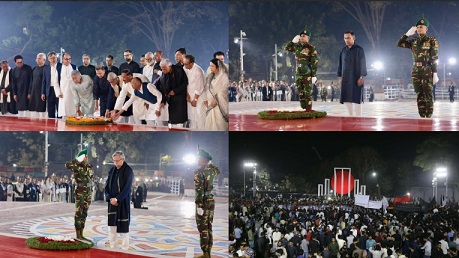
Bangladesh paid homage to the martyrs of the 1952 Language Movement at the Central Shaheed Minar in Dhaka from midnight and through Saturday, observing Language Martyrs’ Day and International Mother Language Day with solemnity.
As the clock struck midnight, President Mohammed Shahabuddin laid a wreath at the memorial. At 12.08am, Prime Minister Tarique Rahman followed, paying silent tribute and offering prayers. It was his first visit to the Shaheed Minar since assuming office. He later returned with cabinet colleagues and family members to place flowers again.
After tributes by the president, prime minister and other dignitaries, the memorial was opened to the public. People from all walks of life, many dressed in the traditional black-and-white attire of Ekushey February, queued barefoot to lay wreaths. Leaders of political parties, social and cultural organisations, citizens from across the country and the chiefs of the three armed forces paid homage. Opposition leader Dr Shafiqur Rahman led an 11-party alliance to the memorial. In a first, Bangladesh Jamaat-e-Islami formally paid its respects at the Shaheed Minar. Brief tension was reported when leaders and activists of the Jatiya Party arrived with banners but were blocked by a rival party’s local unit and could not reach the memorial. Flags flew at half-staff nationwide.
Dawn processions were held across neighbourhoods, black badges were worn and wreaths placed at the martyrs’ graves at Azimpur. The Bangla Academy hosted lectures and poetry readings, while Chhayanaut and the Liberation War Museum organised cultural programmes. Media carried special coverage marking the day.
The Language Movement began in 1947 in protest against Pakistan’s language policy and culminated on February 21, 1952, when police opened fire on demonstrators demanding recognition of Bangla as a state language, killing Salam, Jabbar, Shafiq, Barkat and Rafiq. Bangla was recognised as a state language in Pakistan’s constitution in 1956 and declared Bangladesh’s official language in 1987.
International recognition followed an initiative by expatriate Bangladeshis. In 1998, Rafiqul Islam and Abdus Salam wrote to then UN secretary-general Kofi Annan. With backing from UNESCO, February 21 was recognised in 1999 by 188 countries and first observed globally in 2000. A decade later, the UN General Assembly made the observance permanent.