
Last Updated on September 2, 2026 10:50 pm by INDIAN AWAAZ
Staff Reporter / NEW DELHI
In a significant political development ahead of the Uttar Pradesh Assembly elections, senior AIMIM spokesperson Syed Asim Waqar joined the Congress on Wednesday, accusing the Asaduddin Owaisi-led party of pursuing a contradictory political strategy by claiming to oppose the BJP while simultaneously targeting opposition parties seeking to defeat it.
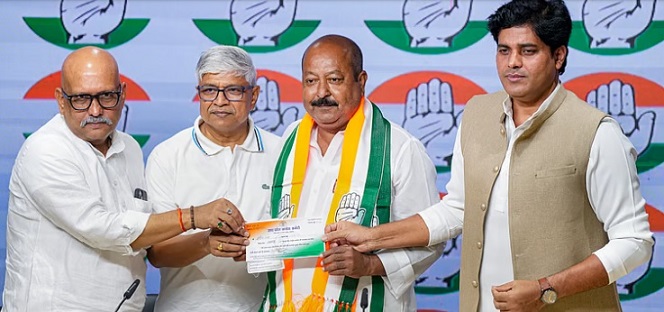
Waqar formally joined the Congress at the AICC headquarters in New Delhi in the presence of Uttar Pradesh Congress in-charge Rajendra Pal Gautam, state Congress president Ajay Rai and AICC Minority Department chairman Imran Pratapgarhi.
Explaining his decision to leave the All India Majlis-e-Ittehadul Muslimeen (AIMIM), Waqar said his political priority was to defeat the BJP and facilitate the formation of a secular government focused on public welfare.
“All those who love the country have only one objective — to dislodge this anti-national government of the BJP and form a secular government which works for people’s interest,” he said.
Waqar, who was regarded as one of AIMIM’s prominent voices in Uttar Pradesh and was considered close to party chief Asaduddin Owaisi, said his experience within the organisation had led him to question its approach towards other opposition parties.
He alleged that while the AIMIM publicly opposed the BJP, it often found itself engaged in political battles with the Congress, Samajwadi Party and other parties that were also seeking to challenge the ruling party.
“If we keep fighting the opposition and do not allow it to blossom, then who are we helping the BJP?” Waqar asked.
He argued that parties genuinely committed to defeating the BJP should concentrate their political energies on challenging the ruling party rather than weakening other opposition forces.
“If we are true nationalists and want to remove the BJP honestly, then our objective should be to fight the BJP. If we are fighting the enemies of the BJP, then we are friends of the BJP,” he said.
Waqar also praised Congress leader Rahul Gandhi, saying that the Congress and Gandhi’s team were leading the political fight against the BJP across the country.
His entry into the Congress comes at a politically significant time in Uttar Pradesh, where Assembly elections are due early next year. The BJP is expected to face a combined challenge from the Congress and the Samajwadi Party, although the contours of opposition coordination remain an important factor in the state’s electoral battle.
Welcoming Waqar into the Congress, Rajendra Pal Gautam said the party was spearheading a broader political movement around issues concerning education, employment, students, women and marginalised communities.
“Rahul Gandhi ji is firmly raising the voice of every section and continuously cautioning the government on every front,” Gautam said.
He added that leaders and workers from different political parties were joining the Congress, which, he claimed, was strengthening the leadership of party president Mallikarjun Kharge and Rahul Gandhi.
Waqar’s departure could have implications for the AIMIM’s efforts to expand its political presence in Uttar Pradesh. The party, which has attempted to establish itself as a significant political force among Muslim voters in the state, has increasingly sought electoral space beyond its traditional strongholds.
His decision to join the Congress could therefore add another layer to the contest for opposition votes, particularly in constituencies where Muslim voters form a substantial part of the electorate.
For the Congress, Waqar’s induction provides an opportunity to project itself as the principal national opposition force capable of challenging the BJP. For the AIMIM, however, the defection of a prominent Uttar Pradesh spokesperson and a leader associated with Owaisi’s political circle could raise questions about its organisational strategy and electoral expansion plans in the state.
The development is also likely to intensify the debate over the role of smaller opposition parties in Uttar Pradesh’s highly competitive electoral landscape. With the BJP seeking to retain its political dominance and opposition parties attempting to consolidate their support bases, the division or consolidation of votes among rival anti-BJP forces could prove crucial.
Waqar’s move, therefore, is not merely a change of political affiliation. It reflects the continuing contest among opposition parties over strategy, alliances and the most effective route to challenge the BJP in Uttar Pradesh ahead of the Assembly polls.