Last Updated on November 23, 2026 3:23 pm by INDIAN AWAAZ
A AKHTER
New Delhi: India and Nepal on Monday signed eight agreements covering key areas of bilateral cooperation, including health, traditional medicine, satellite communications, infrastructure, sustainable urban development, academic research, capacity building, and livestock and fisheries development, as Prime Minister Narendra Modi held talks with his Nepalese counterpart Balendra Shah in New Delhi.
The agreements are aimed at expanding cooperation across critical sectors and strengthening the longstanding partnership between the two neighbouring countries.
Addressing a joint press statement after the talks, Prime Minister Modi described India-Nepal relations as being rooted in shared history, faith, culture and deep people-to-people connections. He said the relationship went beyond conventional neighbourhood ties, describing it as one based on kinship and enduring trust.
Both countries, he said, were partners in each other’s progress and stood by one another during difficult times. Modi also conveyed condolences over the loss of lives in the devastating floods that hit Nepal in August this year.
Announcing a Development Cooperation Package worth 24,000 crore Nepalese rupees, Modi said the initiative would provide fresh impetus to Nepal’s reconstruction efforts and long-term development.
Nepalese Prime Minister Balendra Shah described India as a trusted partner, saying the trust between the two countries stood as high as the Himalayas. He acknowledged India’s role as the first responder during crises and called for greater air connectivity between the two countries.
Major infrastructure and energy projects
The talks were followed by a series of initiatives aimed at improving cross-border connectivity, energy cooperation and infrastructure development.
The two Prime Ministers jointly inaugurated a motorable road bridge connecting Dharchula in India with Darchula in Nepal. They also dedicated the Motihari-Amlekhgunj petroleum pipeline (Phase II) to the nation.
The leaders laid the foundation stones for an Integrated Check Post at Banbasa, a greenfield oil storage terminal at Jhapa in Nepal, and the 669-megawatt Lower Arun Hydroelectric Project in Koshi Province. The hydropower project is expected to add a significant dimension to energy cooperation between the two countries.
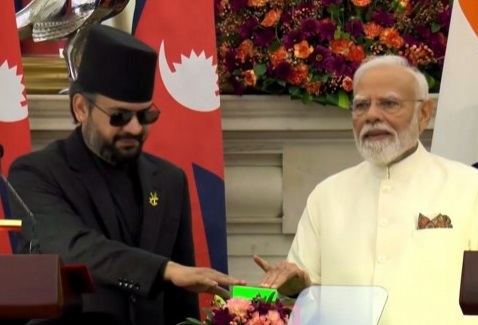
Modi and Shah also witnessed demonstrations of railway technologies and a presentation on India’s PM GatiShakti National Master Plan portal.
New train connects Ayodhya and Janakpur
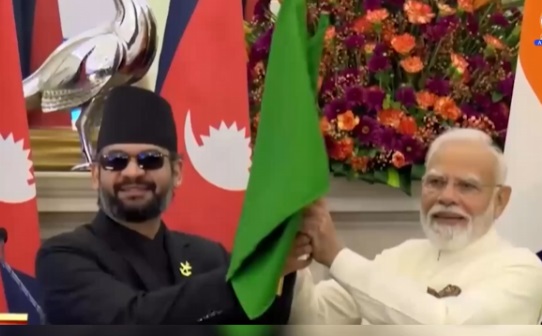
In a significant step towards strengthening religious tourism and cross-border rail connectivity, the two Prime Ministers jointly flagged off the Saryu-Kamala Express, a new weekly train service connecting Ayodhya in Uttar Pradesh with Janakpur Dham in Nepal.
The train, introduced by Indian Railways, began its inaugural journey from Ayodhya Dham Railway Station through a flag-off ceremony held in New Delhi. Uttar Pradesh Chief Minister Yogi Adityanath attended the event at Ayodhya Dham station.
The new rail service connects two destinations deeply associated with the Ramayana tradition. Janakpur Dham is revered as the birthplace of Mata Sita, while Ayodhya is regarded as the birthplace of Lord Ram.
Covering approximately 604 kilometres, the weekly service will pass through several important towns and cities in Uttar Pradesh and Bihar, including Gorakhpur, Basti, Raxaul, Sitamarhi, Madhubani and Jaynagar.
The train is expected to facilitate religious travel between the two destinations, promote Ramayana-linked tourism and provide convenient transportation for people travelling for education, business and family-related purposes.
The Saryu-Kamala Express will have eight AC coaches and seven sleeper coaches.
According to the announced timetable, the train will depart from Ayodhya Cantt at 5.50 pm every Monday and reach Janakpur Dham at 12.40 pm the following day. In the return direction, it will leave Janakpur Dham at 1.10 pm every Saturday and arrive at Ayodhya Cantt at 8.10 am the next morning.
The service is expected to provide a new travel option for pilgrims and tourists while strengthening railway links between India and Nepal.
The latest agreements and infrastructure initiatives reflect the expanding scope of India-Nepal cooperation, with connectivity, energy, health, technology and cultural exchanges emerging as important areas of engagement. The two countries share centuries-old historical, social and cultural ties, with religious traditions and cross-border community connections continuing to underpin their bilateral relationship.