
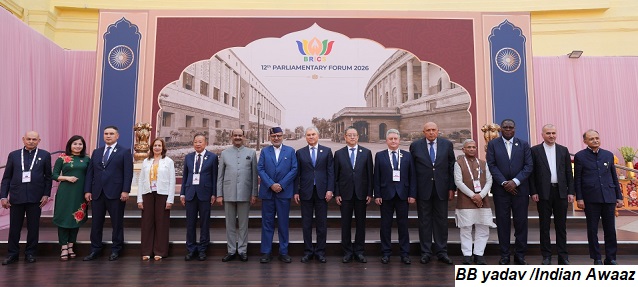
Last Updated on October 27, 2026 9:56 pm by INDIAN AWAAZ
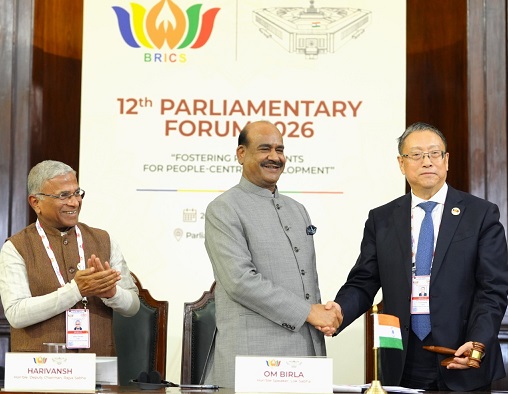
LOK SABHA SPEAKER HANDS OVER BRICS PARLIAMENTARY FORUM CHAIRSHIP TO CHINA
Andalib Akhter / New Delhi
The 12th BRICS Parliamentary Forum on Tuesday adopted a Joint Declaration reaffirming the member countries’ commitment to reforming the United Nations Security Council, combating cross-border terrorism and strengthening cooperation on digital technologies and sustainable development.
The declaration, adopted at the conclusion of the two-day forum, underscored the principles of the UN Charter, sovereign equality, mutual respect, non-interference in internal affairs and the peaceful settlement of international disputes. It also called for a more representative system of global governance, reflecting the aspirations of developing countries and the Global South.
The document reaffirmed the consensus reflected in the New Delhi Declaration, particularly its call for UN Security Council reform. Referring to Paragraph 13 of the New Delhi Declaration, the member parliaments backed efforts to make international decision-making structures more inclusive and representative of contemporary global realities.
Counter-terrorism emerged as another key element of the declaration. Building on Paragraph 40 of the New Delhi Declaration, the participating parliaments condemned cross-border terrorism, terror financing and the provision of safe havens to terrorists. The text called for zero tolerance towards terrorism and opposed double standards in addressing the threat.
The declaration also highlighted cooperation in digital transformation, including the expansion of Digital Public Infrastructure (DPI) repositories and the responsible governance of artificial intelligence (AI). On climate change, it reaffirmed the principle of Common but Differentiated Responsibilities and Respective Capabilities (CBDR-RC), which recognises the differing responsibilities and capacities of countries in addressing global environmental challenges.
The participating delegations also expressed support for India’s BRICS chairship, while China is set to assume the grouping’s chairmanship in 2027.
Delivering the valedictory address, Lok Sabha Speaker Om Birla called for dialogue, peaceful engagement and collective action to address mounting global challenges, including economic uncertainty, geopolitical instability and regional conflicts.
He said lasting solutions could be achieved through dialogue and cooperation rather than confrontation, emphasising that respect for national sovereignty and the peaceful resolution of disputes must remain central to international relations.
Birla said the strength of BRICS lay in the ability of countries with diverse backgrounds and priorities to work together towards the common goals of peace, prosperity and human welfare. He stressed that global peace must encompass security, justice, mutual respect and better opportunities for future generations.
Highlighting the role of legislatures, the Speaker said parliaments were not merely institutions for making laws but also important platforms for dialogue, consensus-building, accountability and public trust. He called on parliamentary institutions to become more transparent, effective and responsive to citizens’ needs.
On technological change, Birla said artificial intelligence and digital tools could improve parliamentary functioning and facilitate greater public participation. However, their use must be guided by human values, ethical standards, transparency and accountability.
He also emphasised that BRICS cooperation should benefit the wider international community, particularly by ensuring that the concerns and aspirations of the Global South receive greater representation in global decision-making.
The forum concluded with Birla congratulating China on assuming the BRICS chairmanship in 2027 and expressing confidence that cooperation among member countries would continue. The Joint Declaration and the Speaker’s concluding remarks called for a greater role for parliamentary diplomacy in advancing peace, international cooperation and shared prosperity.
Photo; Bir Bahdur Yadav