
Last Updated on October 16, 2026 1:55 am by INDIAN AWAAZ
By S. N. Verma
Artificial intelligence (AI) is emerging as an important tool in India’s efforts to tackle climate change, improve disaster preparedness and protect vulnerable communities. By analysing vast amounts of weather, satellite and environmental data, AI-powered systems can help scientists identify emerging risks, improve forecasts and support faster decisions during extreme weather events.
For a country as geographically diverse as India, where floods, cyclones, heatwaves, droughts and landslides threaten lives and livelihoods, these capabilities have significant implications. AI is increasingly being applied to weather forecasting, renewable energy management, climate-resilient agriculture, forest protection and urban planning.
India has also strengthened its climate response through investments in renewable energy, emissions reduction, environmental monitoring and disaster management. As the country pursues its target of achieving net-zero emissions by 2070, AI could help improve the efficiency and effectiveness of these efforts.
More precise weather forecasts for rural India
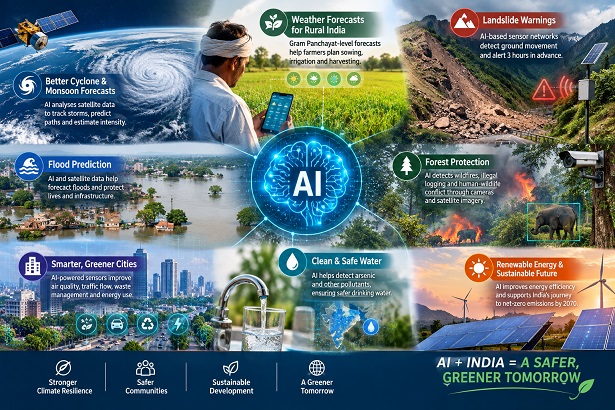
One of the most important applications of AI is the improvement of weather forecasting at the local level. The India Meteorological Department (IMD), in collaboration with the Ministry of Panchayati Raj, has introduced Gram Panchayat-level weather forecasting services to make weather information more accessible to rural communities.
The initiative provides forecasts of parameters such as rainfall, temperature, humidity, wind and cloud conditions. Information available through platforms including Meri Panchayat and other government services can help farmers make better-informed decisions about sowing, irrigation, fertiliser application and harvesting.
India’s Bharat Forecasting System, developed by the Indian Institute of Tropical Meteorology, has introduced high-resolution weather modelling at a spatial scale of approximately six kilometres. Such detailed forecasts can help identify local variations in weather that may be missed by coarser models.
For farmers, timely information can reduce avoidable losses and improve the management of scarce water resources. However, the benefits depend on forecast reliability, local accessibility and farmers’ ability to act on the information.
Improving cyclone and monsoon predictions
AI-assisted analysis is also strengthening India’s capacity to monitor tropical cyclones and other severe weather events. Satellite imagery, numerical weather prediction and machine-learning techniques can help meteorologists assess storm intensity, track movement and identify potentially vulnerable coastal areas.
The Dvorak technique, traditionally used to estimate tropical cyclone intensity from satellite images, is an important part of this process. AI-based image analysis can complement established meteorological methods by processing large volumes of satellite data more rapidly.
Indian researchers are also developing advanced neural-network models to improve monsoon prediction and rainfall estimation. These systems can identify complex patterns in historical and real-time observations, potentially improving forecasts that are critical for agriculture, water management and disaster planning.
AI-based guidance can supplement conventional numerical weather models, including those developed by the European Centre for Medium-Range Weather Forecasts. Nevertheless, forecast accuracy varies with the weather system, prediction period and quality of available observations.
Better warnings can give authorities more time to evacuate vulnerable populations, position emergency teams and protect essential infrastructure such as electricity networks, roads and water-supply systems.
Early warnings for landslides and floods
In mountainous regions, AI-powered landslide monitoring offers another potentially valuable application. Sensor networks can measure rainfall, soil moisture, temperature and ground movement, transmitting the information to analytical systems that look for patterns associated with slope instability.
Machine-learning models can help identify warning signals and support local authorities in assessing risk. In areas such as Himachal Pradesh, where heavy rainfall and fragile terrain can trigger destructive landslides, timely alerts could help communities prepare for evacuation.
However, the performance of such systems depends on the location, sensor coverage, geological conditions and quality of the training data. Claims about a particular warning lead time or accuracy rate need to be assessed against independently validated field results.
AI is also being explored for flood forecasting through the combination of satellite observations, river measurements, hydrological models and machine learning. Research supported by Indian space and scientific institutions has contributed to improved land-surface analysis and the assessment of flood-prone areas.
For river basins such as the Ganga and Brahmaputra, combining physical models with AI may improve the identification of vulnerable locations and strengthen early-warning systems. More reliable forecasts can help authorities plan evacuations and reduce damage to homes, transport links and public utilities.
Protecting forests and wildlife
India’s forests face growing pressure from wildfires, encroachment, illegal tree felling and human-wildlife conflict. AI-based monitoring systems can help address these challenges by analysing camera footage, satellite images and other environmental observations.
Computer-vision tools can identify smoke, detect unusual activity and alert forest officials to potential fire outbreaks. Early detection is particularly important because fires can spread rapidly during hot, dry and windy conditions.
AI-enabled cameras may also help monitor wildlife movement near forest boundaries, allowing officials to identify situations in which animals and people could come into dangerous contact. Satellite-based monitoring can complement these systems by identifying changes in forest cover and possible encroachment.
These technologies cannot replace field personnel, community participation or effective forest management. Their greatest value lies in helping officials detect threats earlier and direct limited resources towards areas requiring immediate attention.
AI for cleaner, healthier cities
Urban centres are another important frontier for climate technology. Rapid urbanisation, traffic congestion, air pollution, growing energy demand and inadequate waste management increase cities’ vulnerability to extreme heat and other environmental stresses.
Collaborations involving institutions such as IIT Kanpur and IIT Delhi are exploring technology-driven approaches to sustainable urban development. AI-supported sensors and analytical platforms can help monitor air quality, optimise traffic flows, improve electricity use and strengthen waste-management systems.
Researchers are also investigating methods to detect airborne biological particles, including bioaerosols, that can affect public health. Such monitoring could support better environmental management, although its effectiveness depends on reliable sensors, validation and appropriate public-health responses.
At IIT Kharagpur, research into AI-based models for identifying arsenic contamination in drinking water highlights another potential application. By combining environmental data and predictive analysis, these systems could help identify areas requiring closer testing and intervention, particularly in parts of the Ganga basin affected by groundwater contamination.
AI predictions, however, must be followed by laboratory testing and remedial action before water safety can be established.
Challenges and the road ahead
Despite its promise, AI is not a standalone solution to climate change. Models require reliable data, computing infrastructure, trained personnel and continuous validation. Poor-quality data can produce misleading forecasts, while gaps in rural connectivity may prevent vulnerable communities from receiving timely warnings.
There are also concerns about the energy consumption of large computing systems, data governance and unequal access to emerging technologies. Public institutions must ensure that AI tools remain transparent, affordable and accessible to those most exposed to climate risks.
India’s experience could nevertheless offer valuable lessons for other developing countries facing similar challenges. AI can help integrate climate science with practical decision-making, from farm-level weather advice to disaster response and urban planning.
The technology cannot eliminate the causes of global warming, but it can help societies anticipate risks, use resources more efficiently and prepare for increasingly unpredictable weather. For India, the priority should be to combine AI innovation with sound scientific evidence, resilient infrastructure and inclusive public policy.
If deployed responsibly, artificial intelligence can become a significant component of the country’s broader strategy to build climate resilience and protect livelihoods.
(The writer is an independent journalist and columnist.)