
By Our Business Correspondent
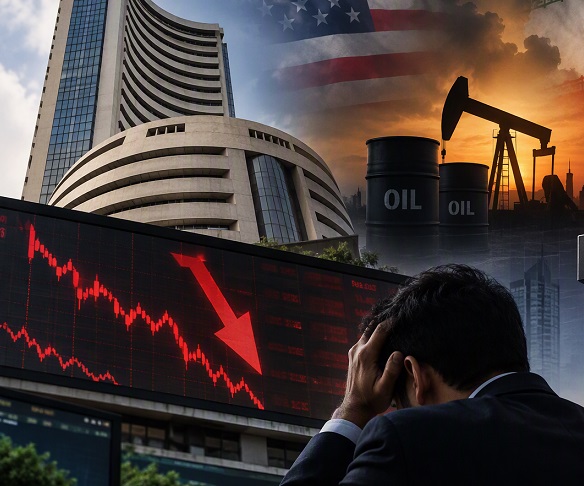
Indian equity markets witnessed a sharp sell-off on Monday as escalating tensions between the United States and Iran rattled global investors, triggering a spike in crude oil prices, rising bond yields and renewed risk aversion across financial markets. The benchmark indices ended deep in the red, with the Sensex plunging more than 1,100 points and the Nifty slipping below the crucial 22,800-mark amid broad-based selling across sectors.
The downturn reflected growing concerns that the geopolitical conflict could disrupt global energy supplies for an extended period, particularly if uncertainty surrounding the Strait of Hormuz continues. Investors also contended with a weaker rupee, persistent foreign portfolio investor (FPI) outflows, elevated global bond yields and negative cues from Asian markets.
The BSE Sensex slumped 1,124 points, or 1.52%, to close at 72,771.72, while the NSE Nifty 50 declined 360.25 points, or 1.56%, to settle at 22,780.25. Market participants rushed to reduce exposure to risk-sensitive assets as fears of higher energy costs and global economic uncertainty intensified.
Oil Surge, Global Risks Weigh on Sentiment
The primary trigger for the sell-off was the sharp rise in crude oil prices. Brent crude futures climbed close to the psychologically significant $100-per-barrel mark, reflecting growing nervousness over possible disruptions in oil shipments through the Strait of Hormuz, one of the world’s most important energy transit routes.
Higher crude prices pose a particular challenge for India, one of the world’s largest crude importers. Rising energy costs have the potential to widen the current account deficit, increase imported inflation and pressure corporate earnings, especially in fuel-intensive sectors such as aviation, logistics, paints, chemicals and manufacturing.
Adding to concerns, the US 10-year Treasury yield rose above 5.2%, indicating tighter global financial conditions. Rising yields generally reduce the attractiveness of emerging-market equities as investors shift capital toward safer fixed-income assets offering higher returns.
The Indian rupee also weakened against the US dollar, further denting investor confidence. Currency depreciation increases the cost of imports and creates additional pressure on sectors dependent on overseas raw materials.
Broad-Based Market Weakness
Monday’s decline was not restricted to frontline stocks. Selling pressure was visible across the broader market, highlighting the risk-off sentiment among investors.
The BSE MidCap Index fell 1.62%, while the BSE SmallCap Index also dropped 1.62%, underperforming benchmark indices and indicating a retreat from riskier investment segments.
Market breadth remained decisively negative. On the BSE, 3,218 stocks declined compared with 1,271 advances, while 245 shares remained unchanged. The weak breadth underscored the intensity of selling across sectors and market capitalisation segments.
Volatility also surged sharply. The India VIX, often referred to as the market’s fear gauge, jumped 12.54% to 13.69, signalling rising uncertainty and expectations of increased near-term market swings.
Banking Stocks Lead the Decline
Banking shares bore the brunt of the market correction as investors reassessed growth and liquidity expectations in the backdrop of rising global yields.
The Nifty Bank Index dropped 1.99% to 54,471.65, making it one of the worst-performing sectoral indices during the session.
Among major losers were:
- Yes Bank, down 5.87%
- Union Bank of India, down 4.69%
- IDFC First Bank, down 3.88%
- Canara Bank, down 3.47%
- Punjab National Bank, down 3.43%
- Bank of Baroda, down 3.30%
- HDFC Bank, down 2.25%
- AU Small Finance Bank, down 2.23%
- State Bank of India, down 2.14%
- ICICI Bank, down 1.87%
Federal Bank was among the rare gainers, ending 0.93% higher.
Heavyweight stocks exerted significant pressure on benchmark indices. Reliance Industries fell 2.32%, HDFC Bank lost 2.25% and ICICI Bank declined 1.87%, together accounting for a substantial portion of the Nifty’s losses.
Apart from banking, selling was evident across realty, metals and other cyclical sectors as investors reduced exposure to economically sensitive stocks.
Strong Industrial Growth Fails to Lift Mood
Despite the weakness in equities, domestic macroeconomic data remained encouraging.
India’s industrial production growth accelerated to 8.0% year-on-year in August 2026, improving from an upwardly revised 7.4% in July. The data highlighted continued resilience in economic activity despite external uncertainties.
Manufacturing, which carries the highest weight in the Index of Industrial Production (IIP), expanded 9%, up from 8.2% in the previous month, reflecting healthy production momentum.
Electricity and gas supply recorded strong growth of 12.3%, compared with 8.7% in July, indicating robust demand conditions. However, mining and quarrying output contracted 5.6%, extending weakness seen in the previous month.
Analysts noted that while the industrial output data remains supportive for India’s growth outlook, global geopolitical risks currently dominate market sentiment.
Key Market Indicators
Several financial indicators reflected the risk-averse mood prevailing across global markets:
- Brent crude for November settlement rose 3.63% to $100.98 per barrel.
- US 10-year Treasury yield climbed to 5.235%.
- India’s benchmark 10-year government bond yield increased to 7.177%.
- The rupee weakened to 96.01 per dollar from 95.75 previously.
- MCX Gold futures for October settlement slipped 2.14% to ₹1,47,490.
- The US Dollar Index strengthened to 101.15.
The rise in bond yields alongside a stronger dollar is generally viewed as negative for emerging-market equities because it encourages capital flows into developed-market assets.
Global Markets Remain Nervous
Global equity markets remained cautious as investors monitored developments in the US-Iran conflict.
US equity futures pointed to a weak start, with Dow Jones futures falling over 300 points. Technology shares also came under scrutiny after reports that OpenAI had paused training of its latest artificial intelligence models following concerns regarding the behaviour of certain AI agents.
Asian markets largely closed lower amid uncertainty surrounding geopolitical developments and global trade routes. Concerns over the future operation of the Strait of Hormuz, which carries a significant share of the world’s oil supplies, kept investors on edge.
European markets managed modest gains, supported by a rally in British housebuilding companies after the UK government indicated plans for a new support programme for first-time homebuyers. However, gains remained limited because of rising oil prices and elevated bond yields.
Stocks in Focus
Among individual counters, Som Distilleries & Breweries surged 9.2% after the Madhya Pradesh High Court directed the renewal of its manufacturing excise licences. The court also awarded costs of ₹1 lakh to the company and preserved its right to seek damages arising from operational disruptions.
Lupin slipped 1.43% despite receiving tentative approval from the US Food and Drug Administration for its Apixaban oral suspension used in preventing and treating blood clots.
Silver Touch Technologies gained 0.40% after securing an order from ISRO’s Space Applications Centre for the supply of high-end workstations.
Kalpataru Projects International fell 0.95% even after announcing a major engineering, procurement and construction contract for a gas pipeline project in the UAE valued at over ₹4,000 crore.
Jyoti CNC Automation declined 1.98% following disclosure of a fire incident at its Rajkot manufacturing facility. The company clarified that the fire was quickly controlled and production operations continued without disruption.
IPO Market Shows Mixed Response
The primary market presented a mixed picture with selective investor interest.
Among the ongoing offerings, Moneyview emerged as the standout performer, attracting bids worth 98.44 times the shares on offer, reflecting robust investor enthusiasm.
A-One Steels India received subscriptions of 11.59 times, while Orient Cables (India) garnered 8.21 times demand. German Green Steel and Power was subscribed 5.14 times.
On the other hand, demand remained subdued for Shah Investors’ Home, which achieved only 0.31-time subscription, and Runwal Enterprises, which was subscribed 0.70 times. SRIT India achieved full subscription, while AceVector was marginally oversubscribed at 1.12 times.
Outlook
Market experts believe investors will continue to monitor developments in the Middle East, particularly any updates relating to the US-Iran conflict and the Strait of Hormuz. Crude oil prices, bond yields, foreign fund flows and currency movements are expected to remain key drivers of market direction in the coming sessions.
While strong domestic industrial production data provides a supportive backdrop for India’s growth story, heightened geopolitical uncertainty and rising global energy costs are likely to keep market sentiment cautious in the near term. For now, investors appear focused on preserving capital rather than chasing risk, resulting in one of the sharpest market declines seen in recent weeks.
Disclaimer: Stock market investments are subject to market risks. Please consult with a certified financial advisor before making any investment decisions.