
Opposition demands action against CEC
By Andalib Akhter
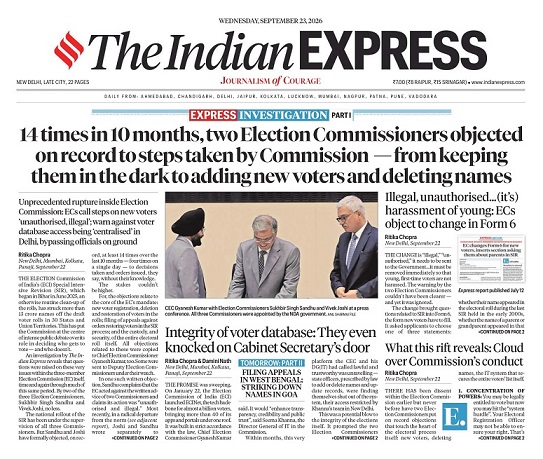
NEW DELHI: A fresh political storm has erupted over the functioning of the Election Commission of India after an investigation by The Indian Express reported that two of the three Election Commissioners had formally recorded objections at least 14 times over a period of 10 months to decisions and orders concerning electoral rolls and the Special Intensive Revision (SIR) exercise.
The investigation by The Indian Express was published on September 23 by journalist Ritika Chopra and has triggered sharp reactions from several Opposition parties, with leaders questioning the functioning of the poll panel and demanding action against Chief Election Commissioner Gyanesh Kumar. The Election Commission, however, has rejected any suggestion of a split in the final decision-making process, saying that differences and observations are part of institutional deliberations and that its decisions over the past year were taken unanimously by the full Commission. (The Indian Express)
What the Indian Express investigation reported
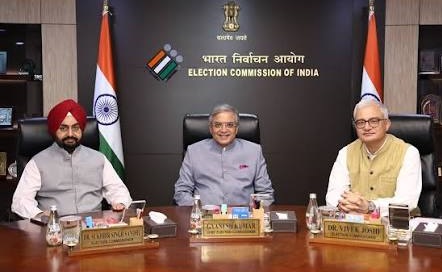
At the heart of the controversy is the nationwide SIR of electoral rolls. According to The Indian Express, Election Commissioners Sukhbir Singh Sandhu and Vivek Joshi put their objections on record at least 14 times during the past 10 months, including four objections on a single day.
The newspaper reported that their concerns covered several aspects of the management of electoral rolls, including the addition of new voters, deletion and restoration of names, appeals against electoral-roll decisions, changes to Form 6 and the control and functioning of the Election Commission’s voter database.
One of the key issues concerns Form 6, the application used by citizens to register as voters. The report said a new question was added to the form asking applicants whether their names, or those of their parents or grandparents, appeared in the electoral roll of the previous intensive revision. The investigation reported that Election Commissioner Vivek Joshi had earlier raised concerns that such a change could not be made without amending the relevant rules, while Sandhu later described the change as “unauthorised and illegal”.
Another major issue highlighted by the investigation is the increasing centralisation of the electoral-roll database and software systems.
The newspaper reported that the two Commissioners raised concerns about whether the access traditionally available to Electoral Registration Officers (EROs) was being restricted through centralised digital systems. The report cited a case in Goa involving 97 voters whose eligibility had reportedly been established by the EROs but whose names could not be entered into the final roll because of a software-related issue.
The investigation also reported that the two Commissioners raised concerns over the integrity and administration of the Election Commission’s IT systems and separately approached Cabinet Secretary T V Somanathan over an administrative order concerning the poll panel’s IT and administration structure.
The report further noted that the three-member Commission did not hold a full meeting between May and August and met together on September 9, according to the newspaper’s reconstruction of events. The Indian Express said it sent detailed questions to the Commission and the two Election Commissioners before publication but did not receive responses to its queries.
The significance of the report lies not merely in the number of objections but in the fact that the objections reportedly came from two of the three members of the constitutional body itself and concerned the administration of electoral rolls, voter registration and the technology through which electoral data is managed.
Election Commission rejects suggestion of a split
The Election Commission responded to the investigation on September 23, saying that differing views, observations and technical suggestions are normal components of institutional decision-making.
The Commission said that focusing on selected internal notes over a 10-month period presented only “one part of the picture”. It said it had taken numerous decisions, issued instructions and introduced around 40 initiatives and electoral reforms during the period.
Most importantly, the Commission maintained that all such decisions, including the electoral-roll revision and SIR, were the result of unanimous decisions of the full Commission during the past year.
The response therefore presents the controversy differently from the Opposition’s interpretation: while internal objections may have existed, the EC says they were part of the process through which final decisions were reached.
Rahul Gandhi steps up ‘vote chori’ attack
Congress leader and Leader of Opposition in the Lok Sabha Rahul Gandhi reacted strongly to the investigation, linking it to his continuing allegations concerning the integrity of electoral rolls.
Gandhi described what he called “vote chori” as a crime against the people and alleged that the BJP, RSS and the Election Commission had committed “an act of treason”. These are political allegations made by Gandhi; they have not been established by the Express investigation itself.
Congress also used the report to renew its criticism of Chief Election Commissioner Gyanesh Kumar, alleging that the latest findings supported its contention that the Election Commission’s functioning had become overly concentrated.
Akhilesh Yadav questions poll panel’s credibility
Samajwadi Party chief Akhilesh Yadav said the reported objections raised questions about whether the Election Commission could still be regarded as a fair and impartial institution.
Yadav linked the report to his earlier allegations concerning elections in Uttar Pradesh and questioned whether electoral outcomes and governments formed during the period covered by the controversy could be considered free from doubt. He also called for the Supreme Court to take cognisance of the matter.
His comments extended the controversy beyond the SIR process to a broader political question over public confidence in the Election Commission.
Mamata, Uddhav demand action against CEC
West Bengal Chief Minister Mamata Banerjee also reacted sharply, demanding the arrest of CEC Gyanesh Kumar and calling for fresh elections in states where the SIR exercise had been conducted. She alleged that the electoral process in West Bengal had been compromised and said the Opposition would intensify its campaign over the issue. These claims are Banerjee’s political allegations and remain contested.
Shiv Sena (UBT) chief Uddhav Thackeray went further, demanding that Kumar be removed and jailed. He called for an investigation into the functioning of the Election Commission and sought fresh elections in Maharashtra, West Bengal and Tamil Nadu, including a demand that ballot papers be used.
Stalin seeks resignation, halt to SIR
DMK president M K Stalin demanded Kumar’s resignation and called for an immediate halt to the SIR exercise.
Stalin said the findings reported by The Indian Express raised questions about decisions taken within the poll panel and argued that the Election Commission, being a three-member body, should function through the institutional process prescribed for it. He also called for an investigation into the functioning of the Commission..
CPI(M) and other Left leaders similarly demanded that the SIR process be stopped and questioned the credibility of the poll panel following the reported internal objections.
Omar Abdullah calls for corrective action
Jammu and Kashmir Chief Minister Omar Abdullah adopted a somewhat different emphasis, focusing on public confidence in elections.
Abdullah said corrective action was necessary and warned that if people lost faith in elections, the consequences for democracy would be serious. He also said the Election Commission and the Union government needed to reflect on the developments.
AAP leader Arvind Kejriwal and other Opposition leaders also called for action against the CEC and demanded that the SIR exercise be reconsidered.
BJP defends the Commission
The BJP has rejected the Opposition’s interpretation of the investigation.
BJP spokesperson Sambit Patra said differences among Election Commissioners during deliberations were evidence of discussion within the institution rather than proof of a “dictatorial” system. He argued that what mattered was that final decisions were reached through the Commission’s institutional process.
Patra also accused Opposition parties of attempting to undermine constitutional institutions after electoral setbacks.
The BJP has also challenged the Opposition to bring forward a formal impeachment motion against the CEC in Parliament if it believes the allegations warrant such action.
BJP leader Ram Kadam, meanwhile, said the Election Commission was a constitutional body and should not become a political platform, while stressing the importance of transparency and preventing ineligible voters from entering electoral rolls. .