
Last Updated on August 4, 2026 12:37 pm by INDIAN AWAAZ
By Our Correspondent / New Delhi
The Samyukt Kisan Morcha (SKM), one of the country’s largest umbrella organisations representing farmers’ groups, has announced a fresh nationwide agitation beginning November 26, 2026, declaring that farmers across India will launch coordinated multi-day protests in the national capital and nearly 100 locations across the country. The organisation said the movement would continue until its seven principal demands are accepted by the Union government.
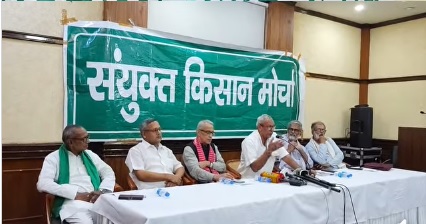
The announcement followed the SKM’s All-India Convention held at the Civic Centre Auditorium in New Delhi on July 28, where around 1,200 delegates from across the country participated. This was followed by a National Convention of Workers and Farmers at Talkatora Stadium on July 29, attended by nearly 5,000 representatives from trade unions and farmers’ organisations.
According to SKM, the upcoming agitation will be coordinated with workers’ unions, agricultural labourers, students, youth, women’s organisations and other social groups to jointly oppose what it described as policies favouring corporate interests. The organisation said the movement seeks to address the prolonged agrarian crisis, labour issues and concerns related to agriculture, employment and rural livelihoods.
The farmers’ body traced the origins of the proposed agitation to the 2020–21 farmers’ movement at Delhi’s borders, which lasted 385 days and culminated in the repeal of the three contentious farm laws in November 2021. SKM claimed that although the agitation was suspended following written assurances from the Centre on December 9, 2021, several commitments made to farmers have remained unfulfilled over the past five years.
The organisation alleged that during this period the government introduced a series of measures that adversely affected farmers and workers, including the four Labour Codes, electricity sector reforms, amendments affecting agricultural inputs and policies encouraging greater private participation in food storage and procurement. It also expressed concern over proposed trade agreements, particularly the India–US Free Trade Agreement, claiming such pacts could increase imports of agricultural products and affect domestic farmers and small enterprises.
SKM said it had already begun mobilising support earlier this year. On January 16, farmers across villages reportedly took a pledge to intensify the struggle until earlier assurances were implemented. The organisation also highlighted its support for the nationwide general strike held on February 12, the Worker-Farmer Parliament organised at Jantar Mantar on March 9, and the nationwide “Black Day” observed on April 1 against the implementation of the four Labour Codes.
At the convention, SKM adopted a seven-point charter of demands. These include enactment of a legal guarantee for Minimum Support Price (MSP) based on the Swaminathan Commission formula of C2+50 per cent with assured procurement for all crops; a comprehensive farm loan waiver; withdrawal of the four Labour Codes; restoration and expansion of the Mahatma Gandhi National Rural Employment Guarantee Act (MGNREGA) to provide 200 days of work with a daily wage of ₹700; scrapping of the Electricity Privatisation Bill, the Seed Bill and proposed amendments to the National Food Security Act; opposition to free trade agreements affecting agriculture; and protection of land rights by preventing forced acquisition and corporate land pooling.
The convention also approved a six-point programme of action leading up to the nationwide agitation. State-level conventions will be organised over the next two months to mobilise farmers. August 10 will be observed as a nationwide protest day with programmes such as Jail Bharo, Rail Roko and Road Roko at around 1,000 locations. On August 17, delegations will submit memoranda containing the charter of demands to the Prime Minister, Chief Ministers, Leaders of Opposition and elected representatives.
The mobilisation will continue through padayatras, vehicle rallies, tractor marches, public meetings and state-level rallies organised by member organisations. On October 3, village-level Maha Panchayats will be held across the country to commemorate the Lakhimpur Kheri incident and enlist volunteers for the proposed long-term agitation.
The final phase of the campaign is scheduled to begin on November 26, when Kisan Marches and multi-day demonstrations will be launched in New Delhi and around 100 locations across India. SKM said details regarding the exact venues and formats of the protests would be announced later.
The organisation reiterated that the agitation would continue until the government addresses its principal demands, signalling the possibility of another prolonged nationwide farmers’ movement similar to the 2020–21 protests.
The convention adopted 7 Principal Demands:
1. No India-US Free Trade Agreements. Repeal all Free Trade Agreements.
2. Enact Law for MSP@C2+50% with guaranteed procurement for all crops.
3. Comprehensive Loan waiver to end rural indebtedness and peasant and daily worker suicides. Provide Rs. 25 lakh compensation to each peasant suicide victim families.
4. Scrapping of 4 Labour Codes and minimum wage of Rs. 31,000 payable to all workers.
5. Restoration of MGNREGA, ensure 200 days of work and Rs.700 as wage.
6. Withdraw Electricity Privatisation Bill 2025, the Seed Bill 2025, and the NFSA Amendment Bill.
7. No Forceful Land Acquisition, no pro Corporate Land Pooling. Protect Land rights based on LARR Act 2013, FRA 2006 of tribals and non-tribal forest dwellers and PESA 1996 on self-governance and tribal self-rule.
The convention resolved to the plan of 6 Point Future Actions –
1. SKM and its member organisations to hold State Conventions in the next two months in preparation for a long haul of Independent as well as Coordinated struggles.
2. Observe 10th August as a massive protest Day – in honour of the 84th anniversary of the Quit India Day—with various forms of actions such as Jail Bharo, Rail Roko, Road Roko and other forms of protests, at 1000 spots across the country. Several organizations and platforms have decided to support and coordinate with SKM.
3. 17th August 2026: SKM mass delegations to submit the charter of Demands to the PM, L-op, CMs, L-op of the Assemblies, Members of Parliament, and Members of Assemblies, demanding favourable action on the principal demands.
4. Commence independent and coordinated campaigns- such as Mass Padayatra, Vehicle Jathas, Tractor Marches culminating in Public Meetings, Maha panchayat and State Rallies by all the member organisations.
5. SKM village maha panchayat on 3rd October Lakhimpur Kheri Martyrs Day –across India- the member organisations list volunteers for long haul of struggle since 26th November 2026 till achieving crucial demands – 6. Kisan March and multiple day mass action starting 26 November 2026 – in 100 spots including the National Capital. The form, spot and date of mass actions will be declared in due course.