
Monsoon Session Opens Amid Violent Street Protest Over Education Crisis
By Our Correspondents
The national capital witnessed one of the biggest political protests in recent years on Monday as tens of thousands of demonstrators associated with the Cockroach Janta Party (CJP) converged on Central Delhi demanding the resignation of Union Education Minister Dharmendra Pradhan over the alleged NEET paper leak and broader concerns surrounding the country’s education system.
Although the proposed “Sansad Chalo” march did not ultimately reach Parliament, the massive mobilisation brought large parts of Central Delhi to a standstill, leading to violent clashes between protesters and police, extensive security deployment, baton charges, tear gas shelling, multiple injuries and dozens of detentions.
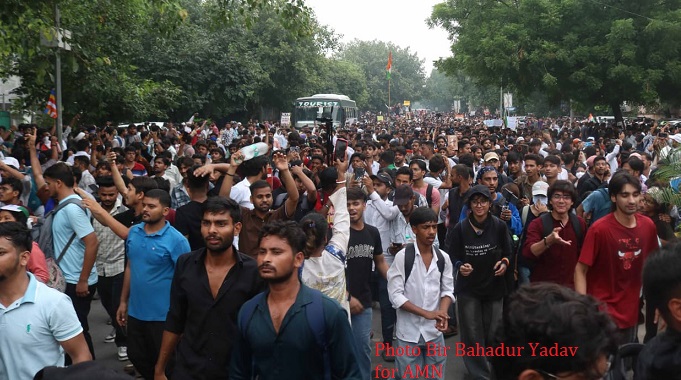
According to reporters on the ground, nearly 50,000 protesters gathered across Jantar Mantar, Parliament Street and adjoining areas, making it one of the largest demonstrations witnessed in the capital in recent years. Protesters had travelled from several states, including Haryana, Uttar Pradesh, Rajasthan, Punjab, Maharashtra and Madhya Pradesh, to join the movement, which completed one month on Monday.
The agitation is centred on demands for accountability over alleged examination irregularities, particularly the NEET paper leak, and has gained momentum following activist Sonam Wangchuk’s prolonged indefinite hunger strike.
Heavy Security Blanket Across Central Delhi
Anticipating a large mobilisation, Delhi Police imposed prohibitory orders under Section 163 of the Bharatiya Nagarik Suraksha Sanhita (BNSS) across sensitive areas of New Delhi.
Multiple layers of barricades were erected around Parliament Street, Patel Chowk, Tolstoy Marg and adjoining government buildings. Personnel from the Delhi Police, Rapid Action Force (RAF) and paramilitary units were deployed in large numbers, while riot-control vehicles remained stationed at strategic locations.
The Delhi Police had earlier clarified that no permission had been sought or granted for any march towards Parliament and appealed to the public to comply with prohibitory orders.
Despite the restrictions, thousands began assembling at Jantar Mantar from early morning before attempting to move towards Parliament.
Protest Escalates Into Violent Confrontation
As demonstrators attempted to breach multiple barricades near Parliament Street and Patel Chowk, confrontations broke out between protesters and security personnel.
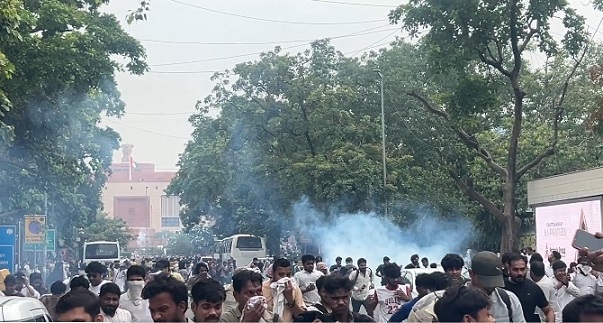
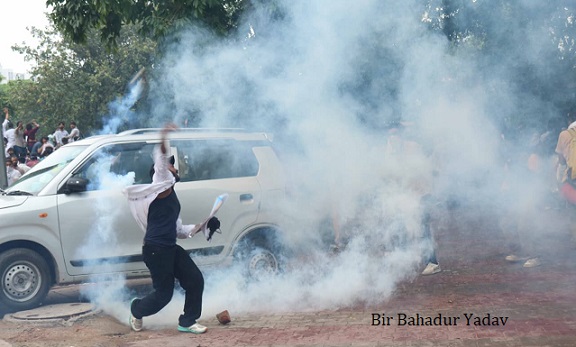
Police resorted to repeated baton charges and fired tear gas shells to disperse the crowd after protesters allegedly attempted to force their way through security barricades.
Witnesses reported that several groups of protesters became separated after police blocked access roads, resulting in crowds gathering at multiple points across Central Delhi.
Rain during the day failed to deter demonstrators, many of whom continued marching while chanting slogans demanding justice for students and accountability from the Union Government.
Visuals from the protest showed tear gas smoke engulfing sections of Parliament Street as security personnel pushed back demonstrators attempting to advance.
Police Allege Violence by Protesters
Delhi Police later issued a detailed statement accusing sections of the protesters of engaging in violence and damaging public property.
According to the police, demonstrators ignored repeated warnings and violated prohibitory orders before allegedly attacking security personnel with stones and other objects.
Police alleged that protesters attempted to breach barricades, vandalised government vehicles and caused significant damage to public property.
The police claimed that more than 118 personnel, including senior officers ranging from Special Commissioner of Police to Assistant Commissioner of Police, sustained injuries during the clashes. Several women police personnel were also reportedly injured.
Authorities further stated that around 60 protesters also suffered injuries during the confrontation. According to police estimates, between 15 and 20 government vehicles were damaged during the violence.
Around 70 protesters were detained, and police said cases are being registered under relevant provisions of the Bharatiya Nyaya Sanhita relating to rioting, assault on public servants, damage to public property and other offences.
Protest Leaders Reject Police Allegations
CJP leaders strongly disputed the police version, maintaining that the demonstration was peaceful until security forces resorted to force. Party spokesperson Ashutosh Ranka accused authorities of suppressing what he described as a democratic movement demanding educational reforms.
Following a meeting with Union Minister J.P. Nadda, Ranka said the delegation presented three principal demands before the government:
- Immediate release of activist Sonam Wangchuk.
- Resignation of Union Education Minister Dharmendra Pradhan.
- Compensation of ₹1 crore to the families of NEET aspirants who allegedly died by suicide.
However, Ranka later said that despite discussions, the government had not responded positively to the demands. Senior CJP leader Abhijeet Dipke announced that the agitation would continue until Dharmendra Pradhan resigns, asserting that police action would not deter the movement.
Government Opens Communication Channel
Amid the escalating situation, Union Minister and BJP President J.P. Nadda confirmed that discussions had taken place between government representatives and CJP leaders.
Posting on social media, Nadda said the talks were initiated after protest leaders sought dialogue with the government. According to him, discussions began shortly before noon and continued for several hours.
Simultaneously, high-level meetings were held inside Parliament House, where Union Home Minister Amit Shah met senior Cabinet colleagues, including Education Minister Dharmendra Pradhan, Parliamentary Affairs Minister Kiren Rijiju and Commerce Minister Piyush Goyal, as security agencies continuously monitored developments outside Parliament.
Security around Parliament was significantly tightened, with several entry gates temporarily closed during the height of the confrontation.
Sonam Wangchuk Continues Hunger Strike
Activist Sonam Wangchuk, who has been on an indefinite hunger strike for more than three weeks, announced that he would continue his fast following Monday’s police action.
Speaking through a statement issued from Safdarjung Hospital, Wangchuk condemned what he described as police brutality against peaceful demonstrators.
Earlier, Wangchuk had outlined conditions under which he would end his fast.
He said he would withdraw the hunger strike if the government accepted responsibility for recent failures in the education system, including examination paper leaks, or if Members of Parliament from various political parties assured him that the matter would be taken up during the ongoing Monsoon Session of Parliament.
He had also stated that if his health prevented him from participating physically, Members of Parliament could visit him in hospital and provide those assurances.
Following Monday’s developments, Wangchuk confirmed that his fast would continue.
Protest Draws Broad Public Participation
Unlike many student-led demonstrations, Monday’s mobilisation witnessed participation from a wide cross-section of society.
Parents, teachers, professionals, retired citizens and students joined the march alongside young activists. Several groups had travelled overnight from neighbouring states to participate.
Women from Haryana’s Jhajjar district said they had come to Delhi to support what they described as a movement for their children’s future.
Placards carried by protesters highlighted concerns regarding examination integrity, youth unemployment and alleged corruption in educational institutions.
While the demonstration primarily focused on education reforms, smaller groups also briefly raised other political demands before the central slogans surrounding the NEET controversy again dominated the protest.
Political Significance
The protest coincided with the opening day of Parliament’s Monsoon Session, increasing political pressure on the government.
Opposition parties have already indicated that they intend to raise issues relating to alleged examination irregularities, youth unemployment and governance during the session.
The CJP’s mobilisation ensured that education reforms remained among the principal political issues outside Parliament as legislators assembled inside the House.
Political observers believe the scale of Monday’s demonstration could influence parliamentary debates in the coming days, particularly if protests continue and discussions between the government and protest leaders fail to produce a breakthrough.
Situation Under Watch
By late evening, police had largely cleared the protest sites around Parliament Street and adjoining roads, although security deployment remained heavy.
Authorities continued reviewing CCTV footage and video recordings to identify those allegedly involved in violence and damage to public property.
Meanwhile, CJP leaders reiterated that the agitation would continue until their principal demands are addressed, indicating that further demonstrations could take place during the remainder of the Monsoon Session.
The developments have added a fresh political flashpoint to an already contentious parliamentary session, with both the government and the protest organisers accusing each other of escalating the confrontation.