
Last Updated on February 1, 2026 11:37 pm by INDIAN AWAAZ
TN Ashok / NEW DELHI

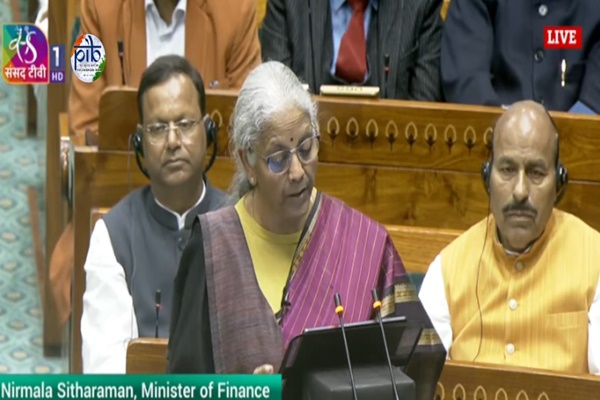
In her record-setting ninth consecutive Union Budget, Finance Minister Nirmala Sitharaman delivered a blueprint that effectively doubles down on the government’s supply-side conviction: that what is good for the boardroom will eventually be good for the bazaar.
But for a middle class weary of stubborn inflation and a youth population facing a tightening job market, the FY 2026–27 Budget feels less like a partnership and more like a cold technocratic exercise.
The Budget, presented Sunday, positions India as a disciplined outlier in a volatile global economy. By pruning the fiscal deficit to 4.3 percent and holding the line on populist handouts despite five looming assembly elections, New Delhi is signaling its commitment to “macro-stability” to global ratings agencies.
Yet, beneath the veneer of fiscal prudence lies a sharp, arguably lopsided, prioritization of corporate interests and global capital over the immediate financial health of the Indian household.
The Great Middle-Class Stasis
For the private citizen, the Budget is a study in “procedural mercy” rather than economic relief. While Ms. Sitharaman touted the New Income Tax Act, 2025 and simplified forms as wins for the “ease of living,” the reality for the salaried professional remains one of stagnation. There were no adjustments to tax slabs, no increase in standard deductions, and no reprieve from the indirect tax burden that continues to squeeze discretionary spending.
The government’s gamble is that public capital expenditure—pegged at a massive ₹12.2 lakh crore—will eventually “crowd in” private investment and create jobs. But as Opposition leader Rahul Gandhi noted, the Budget remains “blind to the real crisis” of plummeting household savings and a manufacturing sector that, despite years of incentives, remains stuck at roughly 13-15 percent of GDP.
“It is a Budget that refuses course correction,” Mr. Gandhi said, echoing a sentiment among critics that the government is confusing infrastructure with income.
A Soft Landing for Offshore Wealth
Perhaps the most contentious element of the “Sitharaman Doctrine” this year is the one-time, six-month Foreign Asset Disclosure Scheme. Nominally designed to help students and tech workers “regularize” minor overseas holdings, the scheme’s thresholds—allowing assets up to ₹5 crore to be immunized for a nominal fee—have raised eyebrows.
In a climate where domestic tax compliance is enforced with digital ruthlessness, the leniency toward offshore wealth feels like a moral hazard. Critics argue the scheme offers a convenient “exit ramp” for those who moved stashes abroad via crypto routes or opaque offshore structures, allowing them to flip non-compliance into legitimacy with a relatively light slap on the wrist.
While the government frames this as “pragmatism” for a globalized workforce, the optics suggest a two-tiered system: a “Big Brother” tax regime for the domestic middle class, and a “Big Tent” amnesty for the globalized elite.
The Corporate Courtship: Data Centers and “Champion” SMEs
If the citizen was given a handbook on compliance, industry was given a roadmap to riches. The Budget is unapologetically pro-business, carving out extraordinary concessions to secure India’s place in the global supply chain:
- Cloud Supremacy: Foreign cloud providers using Indian data centers received a tax holiday until 2047—a generational commitment aimed at making India the digital warehouse of the world.
- IT Certainty: The IT sector, long plagued by transfer pricing disputes, saw safe harbour thresholds jump from ₹300 crore to ₹2,000 crore, essentially removing tax officers from the equation for the country’s biggest exporters.
- SME Champions: A ₹10,000 crore SME Growth Fund seeks to manufacture “champions” out of small businesses, a move welcomed by India Inc. but viewed skeptically by those who fear such funds often favor well-connected players over the truly innovative.
The Global Headwinds: Fix, Repair, or Normalize?
The Budget arrives as the “Goldilocks” era of global trade fades, replaced by “de-risking” and protectionist barriers. New Delhi’s strategy is to fix the infrastructure deficit and repair the broken manufacturing narrative through ISM 2.0 (India Semiconductor Mission) and dedicated Rare Earth Corridors.
However, what it seeks to normalize is a new social contract: one where the state provides the roads, the digital stack, and the tax stability, but the individual is responsible for their own “resilience.” There is no major rural income push, no expansion of MGNREGA, and no direct employment guarantee.
The Overall Impact: A Balanced Tightrope or a Bridge to Nowhere?
| Sector | Budget Strategy | Likely Outcome |
| Manufacturing | Capex-led, cluster-based (Chemical/Textile parks) | High infrastructure growth; slow job creation. |
| IT/Tech | Safe harbours, data center tax holidays | Enhanced FDI; consolidation of big tech players. |
| Financials | Higher STT on F&O; fiscal consolidation | Cooling of retail speculation; stable bond markets. |
| Middle Class | Simplified filing; zero tax cuts | Stagnant purchasing power; high compliance “ease.” |
The Verdict: Patience as a Policy
Industry leaders, such as those at BMW India and JK Tyre, have hailed the Budget for its “stability” and “logistics efficiency.” They see a government that has finally stopped tinkering with rates and started building foundations.
Yet, the “restrained” nature of this Ninth Act carries a political risk. By ignoring the consumption squeeze, the government is betting that the “trickle-down” from its ₹12.2 lakh crore capex will reach the bottom of the pyramid before the next election cycle.
This is a dangerous bet because US President Ronald Reagan tried this Trickle down economics after the golden hour of Clinton-Robert Reich regime when house income went up and the middle class was enriched, but Regan’s experiment failed miserably as it only aided and abetted the rich by enhancing their wealth which never trickled down and the poor remained poor and the inequalities and inequities in income, wealth and assets only increased vastly causing discontent among the people
If not handled properly, only the the big two of India’s economy would get richers and those stashing money abroad would escape punitiveness with impunity and the honest taxpayer will be wonderfully compromised.
For now, the Budget succeeds in reassuring the global investor that India is a safe, predictable harbor. But for the people navigating the choppy waters of the domestic economy, the message is clear: the government has built the ship, but you’ll have to provide your own fuel.