
Last Updated on January 28, 2026 7:53 pm by INDIAN AWAAZ
By Lalit Gargg
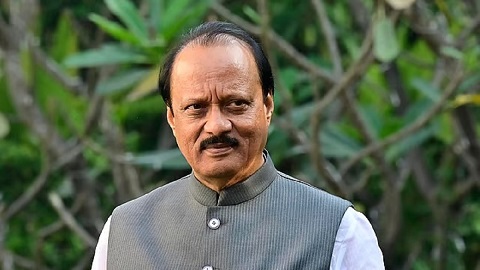
This news is not merely about the passing away of an individual; it marks the sudden halt of an entire era in Maharashtra’s politics. When the confirmation came on the morning of January 28, 2026, that Deputy Chief Minister Ajit Anantrao Pawar had lost his life in a tragic plane crash in Baramati, the moment plunged not only the Pawar family but the whole of Maharashtra—and indeed the nation—into deep shock and mourning.
A leader regarded as a symbol of authority, experience, and decisive governance departed abruptly, leaving behind a vast vacuum in power, administration, and political equilibrium. A promising political journey that shaped Maharashtra’s destiny and influenced national thought came to an untimely standstill. His death is not only an irreparable loss for Maharashtra but a profound blow to nationalist political thought and to the Nationalist Congress Party’s ideological foundations. The cooperative movement, too, has suffered a severe setback with his passing.
Ajit Pawar’s life was not a smooth tale of royal political inheritance. Born on July 22, 1959, in the Deoli Pravara region of Ahmednagar district, he experienced life through struggle and hardship. His father, Anantrao Pawar, was associated with the film industry and worked at Rajkamal Studios, yet the family’s circumstances remained modest. His formal education was limited to the secondary level, but the school of life taught him lessons that even prestigious academic institutions often fail to impart. Perhaps this is why Ajit Pawar’s politics did not emerge from textbooks but from the soil itself—rooted in farmers’ suffering, the strength of cooperative institutions, and a deep understanding of the rural economy.
His entry into politics was not from a grand stage but from the laboratory of the cooperative movement. In 1982, at just twenty years of age, he contested an election for a sugar cooperative. This was a period when cooperative institutions formed the backbone of political power in Maharashtra. Ajit Pawar quickly grasped that to command rural Maharashtra, one had to connect it with banks, sugar mills, irrigation, and electricity. This insight later became the defining strength of his political identity.
The year 1991 proved decisive in his political career. Becoming President of the Pune District Central Cooperative Bank, he demonstrated exceptional competence in financial administration and organizational leadership. Remaining in this position for sixteen years spoke volumes about his credibility and grip over the system. In the same year, he was elected to the Lok Sabha from Baramati, a testament to his rising stature, yet he relinquished the seat for his uncle, Sharad Pawar. This decision reflected not only familial loyalty but remarkable political foresight. His subsequent entry into the Maharashtra Legislative Assembly and his repeated victories from Baramati established a mass base that very few could challenge.
Ajit Pawar’s greatest strength in the corridors of power was his firm administrative command. Handling complex and sensitive departments such as agriculture, horticulture, power, and water resources, he experienced both development and controversy firsthand. As Water Resources Minister, his name became closely associated with the Krishna Valley and Konkan irrigation projects. While these initiatives brought water and hope to farmers, they also burdened him with criticism and allegations. Yet he remained among those leaders remembered not for files, but for decisions. His journey as Deputy Chief Minister is a unique chapter in Maharashtra’s political history. Reaching this position six times was not a coincidence, but the outcome of power balance, coalition politics, and organizational strength. He was often seen as the government’s crisis-manager. His mastery over budgets, financial management, and legislative strategy was such that even political opponents could not ignore his experience. He was labeled ambitious, sometimes harsh and blunt, but the truth is that he viewed governance through the prism of decisions, not emotions.
Controversies were an inseparable part of his political life—from irrigation allegations to sharp public remarks. His statement, “If there is no water in the dam, should we fill it by urinating?” drew intense criticism. He apologized, offered clarifications, and gradually rose above these storms to return to the pinnacle of power. This resilience was testimony to his political vitality; criticism and allegations could slow him down, but never stop him. Speculation surrounding his relationship with Sharad Pawar was constant—differences, distances, and rumors of separate political paths. Yet Ajit Pawar consistently described himself as Sharad Pawar’s follower. The title “Dada” bestowed upon him was not merely familial; it evolved into a political brand that inspired trust and leadership among his supporters. He was an organizer and an administrator, a strategist and a grassroots leader—giving true substance and vitality to the honorific “Dada.” His untimely demise is a cruel irony. A leader who soared for decades in the realm of power saw his life’s journey end in a plane crash. It is said that until shortly before the accident, he remained fully active—engaged in planning, meetings, and political calculations. This sudden death underlines the uncertainty inherent in both power and life.
Ajit Pawar’s personality and legacy emerge in multiple forms—as a successful politician, social architect, champion of rural upliftment, stalwart of the cooperative movement, and a capable administrator. His life did not flow in a single direction; it touched diverse paths and dimensions. It is difficult to imagine any significant sphere remaining untouched by his influence. The windows of his life were always open to offering society and the nation a new perspective. Beneath his apparent simplicity lay a daring, instinctive personality deeply invested in political responsibility.
Ajit Pawar may no longer be among us, but through the strength of his combative political life, he will continue to shimmer like a star in the sky of Indian politics and nationalist thought. As Maharashtra and the nation mourn his passing, Ajit Pawar cannot be assessed solely on scales of praise or criticism. He was surrounded by controversies, yet not defined by them. His politics was tough, but enriched by depth of experience. He believed more in influence than in popularity. Perhaps this is why his departure has left behind a silence in Maharashtra’s politics that words struggle to capture. His life teaches that politics is not driven by slogans and speeches alone, but by decisions, risks, and responsibility. His passing is both a warning and a remembrance—power is transient, but experience and impact endure. Known as “Dada” in Maharashtra’s political landscape, Ajit Pawar has now become part of history, yet his shadow will continue to shape the state’s politics for years to come.