
AMN / WEB DESK
In a major development that could reshape regional security equations, Saudi Arabia and Pakistan have signed a wide-ranging Strategic Mutual Defense Agreement (SMDA). The pact binds the two long-time allies to treat any external aggression against one as an attack on both, marking the first time Riyadh has entered such a formal security commitment with a non-Arab state.
According to Arab News, the accord comes less than two weeks after Israeli airstrikes in Doha targeted Hamas leaders, a development that has heightened regional tensions and reinforced the urgency Gulf states place on stronger security and defense partnerships.
The Riyadh agreement also signals a push by both governments to formalize long-standing military ties into a binding security commitment.
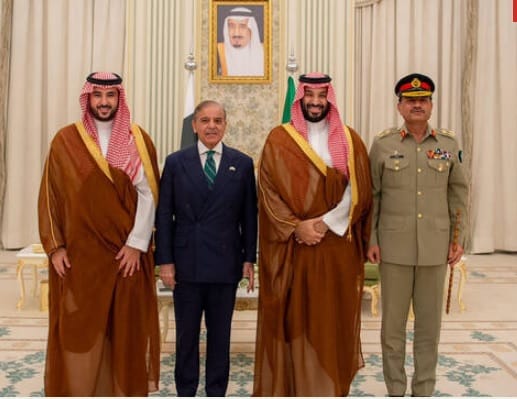
The pact was signed during Prime Minister Shehbaz Sharif’s state visit to Riyadh, where he met Crown Prince and Prime Minister Mohammed bin Salman at Al-Yamamah Palace. The two leaders, joined by senior ministers and military officials, reviewed what Sharif’s office called a “historic and strategic” relationship between the two nations and discussed regional developments.
“The agreement states that any aggression against either country shall be considered an aggression against both,” the joint statement said.
Pakistan and Saudi Arabia have shared close military, religious, and economic relations for decades. Pakistani troops have long served in the Kingdom, while Saudi financial and energy assistance has played a crucial role in Pakistan’s economy. The new pact formalises these ties into a joint defense framework, symbolising mutual trust and deepening interdependence.
Key Features of the Agreement
- Mutual Defense Clause: Both nations pledge coordinated military response in case of aggression.
- Expanded Cooperation: Includes intelligence sharing, joint training exercises, and technology transfer.
- Strategic Consultation: Regular dialogue on regional threats and defense planning.
The agreement is also expected to pave the way for greater joint production of defense equipment and possible collaboration in cyber and space security.
Regional Impact
The pact carries weight far beyond bilateral relations. For Saudi Arabia, it signals diversification of its security partnerships at a time when confidence in traditional Western protection has been waning. For Pakistan, it bolsters its strategic relevance in the Gulf, strengthens economic ties, and enhances its standing in the Muslim world.
Analysts believe the move will be watched closely in India and Iran, both of which share complex relations with Riyadh and Islamabad. While the agreement is defensive in language, its practical interpretation could influence military and diplomatic strategies in South Asia and the Gulf.
One of the most debated aspects is whether the pact implicitly extends Pakistan’s nuclear umbrella to Saudi Arabia. While officials have avoided such confirmation, the ambiguity itself is likely to spark debate in strategic circles worldwide.
Looking Ahead
Both governments hailed the pact as a “historic step” rooted in Islamic solidarity and shared security interests. Implementation, however, will be key. Joint military drills, command-level exchanges, and mechanisms for rapid coordination are expected to follow in the coming months.
For now, the Saudi-Pakistan defense pact marks a turning point—one that could redefine not only the relationship between Riyadh and Islamabad but also the evolving security architecture of the wider region.