
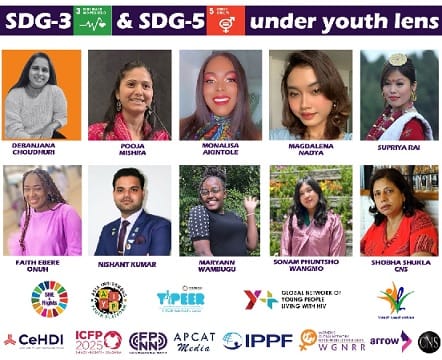
SHOBHA SHUKLA – CNS
How many health facilities truly cater to people with disabilities—whether through ramps, braille signage, sign language interpreters, or other critical support? According to Nishant Kumar, Coordinator of Y-PEER Nepal and member of the Working Group on Disabilities and the 2030 Agenda, the answer is discouraging. Even health campaigns on disease prevention or awareness are rarely available in accessible formats such as sign language, braille, or visual mediums.
“I mostly work with young people with hearing disabilities. They face disproportionate barriers in accessing healthcare. The absence of sign language interpreters, along with disability-unfriendly infrastructure, creates multiple blockages,” Nishant explained during the SHE & Rights (Sexual Health with Equity and Rights) session held alongside the International Conference on Family Planning (ICFP) 2025.
Peer Education and Gaps in Health Services
Nishant’s organisation uses a peer-to-peer education model to empower young people with disabilities to learn about sexual and reproductive health, bodily autonomy, and rights. He noted, however, that disparities between urban and rural areas persist: “Rural youth still struggle to access safe abortion, HIV prevention, and mental health support, which remain limited and heavily stigmatised.”
Young people with disabilities—particularly girls and gender-diverse individuals—also face higher risks of child marriage and gender-based violence. Yet, reporting systems in Nepal often remain inaccessible and unresponsive.
To counter this, inclusive peer education sessions are now being designed using Nepalese sign language, body mapping, visual storytelling, and role play. “These tools do more than inform. They empower participants to claim their rights and share knowledge within their communities,” Nishant stressed.
Mental Health and Disability-Inclusive Services
Nishant’s team has also developed mental health sharing circles where youth express emotions through art, storytelling, and science. Resources such as sign-language manuals on sexual and reproductive health are being rolled out. Still, much more investment is needed.
“We need trauma-informed, youth-inclusive mental health services that reach rural and disabled youth—not just the privileged urban centres,” Nishant said. He added that hotlines, shelters, and legal aid services must integrate sign language and other accessibility tools as a core principle of gender equality, not as an afterthought.
Indigenous Youth and Intersectionality
The conversation then shifted to the experiences of indigenous youth. Supriya Rai, Executive Council Member of the Asia Indigenous Youth Platform (AIYP), highlighted positive changes in Nepal, where quotas and capacity-building programmes have increased indigenous youth participation in councils and government bodies.
“Indigenous youth organisations are working actively against gender-based violence, child marriage, and for consent education. They combine legal literacy with cultural sustainability,” Supriya said. Across Asia, indigenous youth leaders are engaging in feminist movements, advocating for land rights, bodily autonomy, and intersectional policy changes.
She noted that regional institutions are gradually recognising that indigenous youth face unique gender challenges. Networks of indigenous girls and LGBTQIA+ youth are now more visible, bringing diversity into policy dialogues.
Breaking Taboos and Embracing Tradition
Menstrual health has emerged as a priority in indigenous communities. Youth-led campaigns are breaking taboos, promoting safe school environments and dignity kits. At the same time, traditional healing practices are gaining respect as complementary to modern health systems.
Mental health is another growing area of focus, with indigenous youth initiating conversations on trauma, identity crisis, and emotional wellbeing. Digital health tools and telemedicine are slowly bridging gaps in rural and remote regions, though culturally appropriate outreach remains limited.
Stigma in Bhutan
In Bhutan, where healthcare is free, stigma still deters young people—especially in rural areas—from seeking services. Sonam Phuntsho Wangmo of Y-PEER Asia Pacific noted that the Bhutan Youth Development Fund is working to address gaps, particularly around mental health support for adolescents.
Peer-Led HIV Support in India
From India, Pooja Mishra of NCPI Plus shared her personal journey. Growing up in a small village and living with HIV, she began as an outreach worker at 20 and rose over a decade to become General Secretary of NCPI Plus.
“This journey of resilience was made possible by peer networks and youth mentorship. Peer-led systems must be institutionalised—not temporary projects. We need community-led centres that offer structured counselling and mental health support for young people living with HIV,” she said.
Towards Inclusive Health Futures
The voices from Nepal, Bhutan, and India underscore a clear call: health systems and gender equality policies must integrate disability and intersectionality at the core, not as an add-on. Accessible services, peer-led models, culturally sensitive approaches, and recognition of indigenous knowledge are vital to ensuring no young person is left behind.
Every child be born free of HIV
“Nigeria and other countries in sub-Saharan Africa need to do much more to ensure that every child born to HIV positive parent(s) is born free of the virus. We also need to ensure that every child or young person living with HIV knows their status, receiving lifesaving antiretroviral therapy and remains virally suppressed – and all young people have access to full range of HIV prevention options,” said Faith Ebere Onuh, Y+ Global (Nigeria), and Gender Equality Fund Ambassador (GEF).
Address youth in all their diversities, not just within gender binary
“There are certain youths left out of conversations. How will we address issues of youth in all their diversities if we only concentrate on the youth within the binary sector?” asks Monalisa Akintole, Forum Coordinator, Uganda National Trans Forum (UNTF) and part of Y+ Global (Uganda).
“We must ensure that youth in all their diversities are included. We can no longer be a ‘token’ within a system. Our policies that we bring on board should be respected. We are tired of systems and governments that kill youth who do not bend to the gender binary. We need to be respected as a whole. We all matter,” rightly said Monalisa.
Female genital mutilation or cutting is declining but rate of decline is not enough
“Female genital mutilation or cutting has declined in Kenya – in 2003 it was 38% but in 2024 it dropped to 15% – but this is still very high rate,” rightly said Maryann Wambugu, Chair, The PACT, Board member of Y+ Kenya and Network of TB Champions in Kenya.
She called for investing in proven community-led models of health service delivery. “Community-led interventions have proven that with time we are seeing a decrease in new HIV infections. We are seeing increase in uptake of services by young people, such as HIV services, or other sexual and reproductive health services. But unfortunately, that is not something that is getting funded. There must be no gap in developing important policies and its implementation. We the young people are not just the face of HIV epidemic but also the force that can end it. When you invest in our health, you empower our choices and trust our leadership.”
Are governments walking the talk on comprehensive sexuality education?
“In most of the countries in the Global South, it is a reality that comprehensive sexuality education is not available in schools and there are certain regions where we cannot even call it comprehensive sexuality education because at times it is reduced to one biology class in school. We need to talk about comprehensive sexuality education right from school, in order to ensure that the individuals who are growing up to be adults, know what exactly is consent, what are their bodily rights, autonomy, choice and they can take informed decisions on their sexual and reproductive health journey,” said Debanjana Choudhuri, Executive Director, Women’s Global Network for Reproductive Rights (WGNRR).
Magdalena Nadya, Youth Networker at International Planned Parenthood Federation (IPPF) for East and South-East Asia and Oceania region too underlined the importance of comprehensive sexuality education. “Young people are not only the recipients of comprehensive sexuality education, but they are also co-designing and co-facilitating it whether it is in classroom or in social media platforms, utilising digital learning and campaigns which are making SRHR education more relatable and accessible.”
“We also need to ensure optimal youth representation in decision-making processes at all levels. So, young people are shaping the policies that affect them through youth advisory boards and leadership roles in IPPF member associations. They are collaborating with governments and NGOs to ensure youth voices are not just heard but also acted on,” added Magdalena.
“In the last decade there has been a considerable change in how young people are being addressed in the SRHR system, but it is still miles away from where they are mainstreamed. Young people and youth still face a lot of discrimination when it comes to accessing dignified and non-judgmental care especially around contraception and safe abortion,” said Debanjana Choudhuri of WGNRR.
“Safe abortion services are so critical to sexual and reproductive health and rights (SRHR) justice for all. But what we have noticed is that when a young person goes in order to get the service, they are stigmatised. There is a high amount of taboo and stigma that is rallied around in order to create a very unsafe and a very vulnerable situation for young people,” added Debanjana.
Next month all world leaders would convene for 80th United Nations General Assembly and SDG Moment. Would youth voices inform their decision making is to be seen.