
Last Updated on August 18, 2025 1:18 am by INDIAN AWAAZ
Zakir Hossain / Dhaka
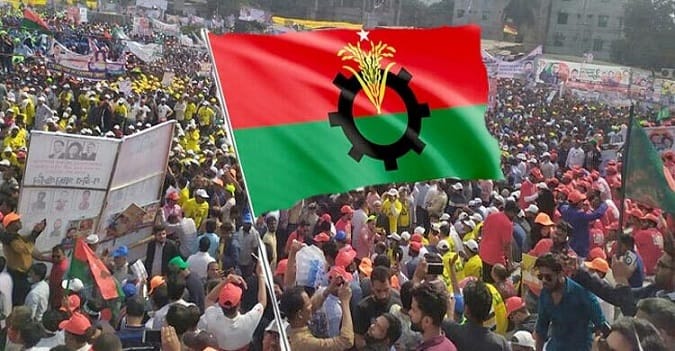
The rise of right-wing forces in Bangladesh’s post–August 5 politics has left the opposition BNP in a bind, with Islamist parties attempting to unite ahead of the next national election. BNP fears that, in the absence of the banned Awami League, Islamists may emerge as its main rival.
To counter this, BNP leaders are reaching out to religious figures and Islamist groups. Recently, Standing Committee members Nazrul Islam Khan and Salahuddin Ahmed met Hefazat-e-Islam chief Allama Muhibbullah Babunagari, Chattogram Hathazari Madrasa DG Mufti Khalil Ahmad Qasemi, Shaykhul Hadith Sheikh Ahmad, and Shah Sharsina Darbar Pir Abu Nasr Nesar Uddin Ahmad Hossain, seeking “blessings, advice and cooperation” before the polls.
BNP insiders say courtesy meetings will extend nationwide, involving madrasa heads, pirs and clerics. Regional leaders have also been tasked with building contacts to prevent madrasa-based students and teachers from shifting wholesale to Islamist parties. Meanwhile, an effort is under way to consolidate Islamist votes “into one box,” led by Charmonai Pir Syed Muhammad Rezaul Karim of Islami Andolan Bangladesh. Sources said Jamaat-e-Islami may eventually join. Jamaat chief Shafiqur Rahman recently met the Charmonai Pir, while Secretary General Mia Ghulam Parwar has voiced optimism about an alliance.
At least five parties—including Islami Andolan, Bangladesh Khelafat Majlis, a Khelafat Majlis faction, and Nezam-e-Islam Party—are already working on an electoral bloc, joined by two new groups, Bangladesh Khelafat Andolan and Bangladesh Islami Oikya Jote. However, Jamiat Ulema-e-Islam has kept distance. “We are always sincere about unity, but the atmosphere isn’t right yet,” its Secretary General Manzurul Islam Afendi told this correspondent.
BNP has meanwhile distanced itself from its long-time ally Jamaat, engaging instead with Hefazat and other groups. “We are a party that believes in Islamic values. As a Muslim-majority country, we must create unity with like-minded Islamic parties and make it visible—so that people don’t mistakenly think we are against the Islamists,” Salahuddin Ahmed told this correspondent.
BNP sources admit the Islamist vote remains the key worry. Researcher Sharif Muhammad noted, “BNP’s real concern is that with Awami League absent, where will the Islamists’ votes go? At the same time, BNP’s grassroots image is weakening.”
Despite past failures, Islami Andolan’s Gazi Ataur Rahman stressed: “Those now talking about ideological differences with Jamaat were long allied with them. This is not about ideology—they simply want seats and winning chances. They know they cannot win without BNP, and that’s the bottom line.”
Observers say the Islamist unity move may still be a bargaining tactic with BNP rather than a genuine third force. For BNP, the challenge is to keep religious leaders close—while preventing Islamists from becoming its biggest competitor at the ballot box.