
R. Suryamurthy
Prime Minister Narendra Modi’s strong public defense of Indian farmers against US trade demands is being viewed by analysts as a politically-charged move, designed to counter mounting opposition attacks and consolidate his domestic support ahead of key state assembly elections. The carefully crafted “friendship” between Modi and US President Donald Trump, a cornerstone of Indian diplomacy in recent years, appears to be taking a back seat to the pressing demands of India’s internal politics.
For years, the much-publicized camaraderie between Modi and Trump, marked by rallies like “Howdy Modi” and “Namaste Trump,” has been a source of national pride for many supporters. The opposition, however, has increasingly weaponized this relationship, questioning its tangible benefits for India and mocking the Prime Minister as a “friend” of a US President who has repeatedly used India as a punching bag on trade.
The Political Stakes of a ‘Heavy Price’
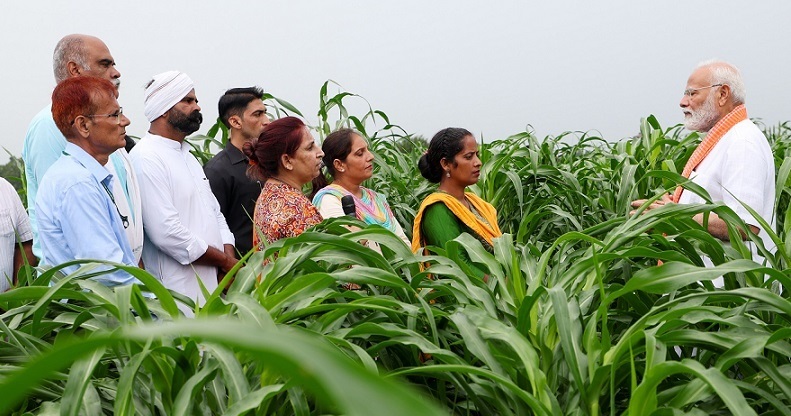
Modi’s remarks, made at the MS Swaminathan Centenary International Conference, were uncharacteristically defiant. Without naming the US or Trump, the Prime Minister declared he was prepared to “pay a heavy price” for standing by India’s farmers. This statement comes amidst fresh US tariffs on Indian goods, bringing the total duty to 50% on some items, and stalled trade talks over India’s refusal to open its agricultural and dairy markets.
Political observers believe this public stance is more of a political clarification than a simple economic one. With several state assembly elections on the horizon—including in key states like Bihar, Tamil Nadu and Bengal—the Modi government is acutely aware of the political sensitivity of agricultural issues. Farmers are a powerful voting bloc, and any perception of caving to US pressure on this front could be politically disastrous, reminiscent of the widespread farmer protests that forced the government to repeal controversial farm laws in 2021.
Opposition Pounces on the ‘Friendship’ Narrative
The opposition, particularly the Congress party, has been relentless in its criticism. Leaders like Rahul Gandhi and Mallikarjun Kharge have openly questioned the value of the Modi-Trump friendship, pointing to the latest tariffs as proof that the bonhomie was all spectacle and no substance. They’ve used social media to mock the “Dost dost na raha” (a friend is no longer a friend) narrative, suggesting that India has been rewarded for its supposed friendship with tariffs and penalties.
The opposition has also linked the trade pressure to broader geopolitical issues, accusing the Modi government of sacrificing India’s national interests and strategic autonomy. They have highlighted Trump’s claims of mediating between India and Pakistan and his targeting of India for buying Russian oil, while other countries, including some US allies, are not penalized.
Modi’s recent speech, therefore, can be seen as an effort to seize the narrative back from his political opponents. By framing the conflict as a defense of the common farmer, he is attempting to show that his government’s policies are aligned with the interests of the Indian people, not a foreign leader. The statement that he is ready to “pay the price” is a powerful political message aimed at portraying himself as a decisive and strong leader, willing to stand up for India’s sovereignty, even if it means jeopardizing a high-profile personal friendship.
Ultimately, while the economic implications of the stalled trade talks are significant, the immediate focus for Modi is on managing the domestic political fallout. With critical elections looming, his government’s posture is less about finding a middle ground with the US and more about reinforcing his image as the guardian of India’s core national and popular interests.