
Last Updated on July 17, 2026 10:34 pm by INDIAN AWAAZ
July 21 is observed in West Bengal as “Martyrs’ Day” (Shahid Diwas) to commemorate 13 Youth Congress activists who were killed in police firing in Kolkata on July 21, 1993
Aafreen Hussain in Kolkata
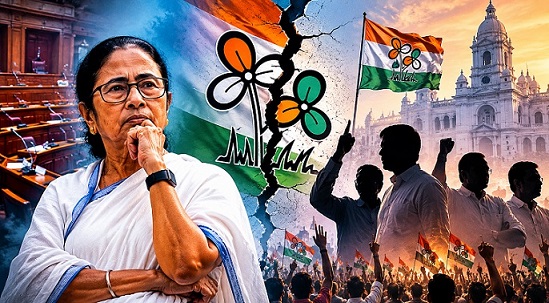
Every political party claims that 21 July is about remembering the martyrs. Yet the events unfolding in West Bengal this year raise an uncomfortable question: Has Martyrs’ Day become less about sacrifice and more about political branding?
The Kolkata High Court’s decision to allow separate programmes Kalighat faction of the Trinamool Congress near Birla Planetarium, the Ritabrata-led rebel TMC at Gandhi statue, and the Congress at Shahid Minar has transformed a single commemorative day into three competing political stages. If every group claims to represent the legacy of the same martyrs, then the public deserves to ask: Who is actually remembering the martyrs, and who is using them as political capital?
The biggest challenge is before Mamata Banerjee. Reports of internal divisions, the emergence of a rebel Trinamool faction, and the absence of support from several former loyalists have created an entirely new political reality. If a significant number of elected representatives are no longer standing with her, is it enough to rely on emotional appeals linked to 21 July? Or does the party need a completely new political strategy?
The rebel TMC has wasted no time in projecting confidence. Ritabrata Banerjee has repeatedly asserted that the Alipore court has recognised his faction as the “real” Trinamool Congress. Whether that claim ultimately survives every legal and political challenge is a matter for the courts and election authorities. Politically, however, the message is unmistakable: the rebels are no longer behaving like a breakaway group they are presenting themselves as the principal claimant to the Trinamool legacy.
That makes another question unavoidable. If two organisations claim to be the real TMC, what exactly will the public be witnessing on 21 July a tribute to martyrs or a public contest for ownership of a political brand?
The Congress, too, has entered the contest with its own Shahid Samman programme at Shahid Minar. The release of a dedicated theme song and plans to mobilise workers through music show that the party is attempting to revive its organisational presence. Yet one must ask whether symbolic programmes alone can revive a party that has struggled to regain political relevance in Bengal for years.
The irony is impossible to ignore. The original significance of 21 July lies in remembering those who lost their lives in a political movement. Today, the headlines are dominated not by the martyrs, but by court permissions, venue disputes, volunteer lists, crowd limits, rival claims and political messaging.
The High Court’s conditions—restricting crowd size, mandating volunteers and ensuring traffic is not disrupted reflect the administration’s concern for public order. Those are practical necessities. But they also underline how contentious this annual event has become. Ultimately, the real verdict will not come from speeches or slogans. It will come from the people of West Bengal. They will decide whether 21 July remains a solemn day of remembrance or has become merely another occasion for political competition.
For every party participating this year, a few uncomfortable questions remain:
– Are the martyrs being honoured, or are they being invoked for electoral advantage?
– Can a divided political movement continue to claim a united legacy?
– Will emotional symbolism outweigh organisational strength?
– And most importantly, after the rallies end, will the conversation return to the ideals of those who died—or simply to who drew the bigger crowd? Perhaps the answers to those questions matter far more than the size of any rally held on 21 July.