
Last Updated on April 13, 2026 12:18 am by INDIAN AWAAZ
Shashi Tharoor Stresses Plurality as Core to the Idea of India at Indian History Forum
Staff Reporter / NEW DELHI
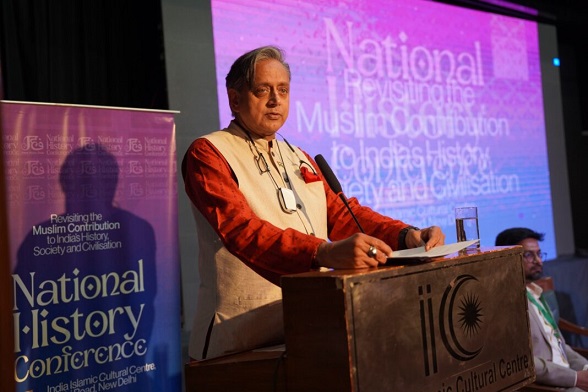
Senior Congress leader and Member of Parliament Shashi Tharoor delivered a compelling and intellectually rich address at the Indian History Forum’s two-day conference in New Delhi, powerfully asserting that the “idea of India” draws its strength from diversity, coexistence, and inclusiveness.
Held on April 11 and 12, the conference brought together an eminent gathering of historians, scholars, academicians, and public thinkers, creating a vibrant platform for dialogue on the role of Muslims in shaping India’s past. The discussions went beyond conventional history, delving into deeper questions of historiography, identity, and how the telling of history continues to influence the nation’s present and future.
In his keynote-style intervention, Tharoor framed the central theme—“who writes our past”—as a question that extends far beyond academia into the realm of politics, media, and public discourse. He observed that historical debates today are no longer confined to classrooms or scholarly journals but are actively shaping narratives in legislatures, courtrooms, television debates, and social media platforms.
“History is not simply a record of what happened,” Tharoor said, arguing that it is a dynamic field of interpretation constantly revisited by successive generations. He stressed that while the past itself remains unchanged, the meaning attached to it evolves over time, influenced by contemporary concerns, ideological positions, and structures of power.
A key distinction highlighted in his speech was between history and historiography. While history refers to events and processes that have unfolded, historiography, he explained, is the interpretation and narration of those events. This distinction, he argued, is crucial because the telling of history is never neutral—it is shaped by perspective, selective emphasis, and often by the power structures within which it is produced.
Drawing from the colonial experience, Tharoor pointed out how British historians constructed narratives that served imperial interests. These accounts, he said, often exaggerated divisions within Indian society while downplaying its cultural continuity and dynamism, thereby portraying India as a civilisation in need of external governance. Such narratives, he added, were instrumental in legitimising colonial rule and influencing how Indians perceived themselves.
He noted that the nationalist movement sought to challenge not only political domination but also intellectual subjugation. Leaders and thinkers across the ideological spectrum worked to reclaim India’s historical agency and civilisational confidence. This effort, Tharoor suggested, was integral to the broader struggle for independence, as it redefined how Indians understood their past and imagined their future.
However, Tharoor cautioned that the contest over history did not end with independence. In contemporary India, he said, historical narratives continue to be contested, often shaped by present-day political objectives. He warned against the selective use of history to serve narrow agendas, noting that such practices risk distorting the complexity of the past.
Central to his address was the concept of national history and its role in shaping collective identity. Tharoor argued that every nation constructs a narrative about its past—not merely to document events but to create a sense of continuity and belonging. The nature of this narrative, he said, determines whether a nation is imagined as inclusive and diverse or narrow and exclusionary.
In this context, Tharoor invoked the ideas of Jawaharlal Nehru and Rabindranath Tagore to illustrate India’s civilisational character. Referring to Nehru’s metaphor of India as a “palimpsest,” he described the country as a layered civilisation shaped by successive cultural influences. Tagore’s vision of India, he noted, celebrated coexistence and diversity as defining features of the nation.
“The idea of India is not based on uniformity, but on the coexistence of differences,” Tharoor emphasised, arguing that plurality is not a challenge to be managed but a reality to be embraced. He warned that reducing India to a singular cultural or religious identity would not only be historically inaccurate but would also undermine the very foundation of its national ethos.
Tharoor further elaborated that the way history is narrated has direct implications for contemporary society. A homogeneous portrayal of the past, he said, can lead to exclusionary notions of nationhood, whereas an inclusive and layered understanding fosters a more accommodating and democratic society.
The speech resonated strongly with the conference’s broader theme, which sought to highlight the diverse contributions of various communities, particularly Muslims, to India’s historical and cultural evolution. Participants noted that such discussions are increasingly relevant at a time when historical narratives are often politicised.
Concluding his address, Tharoor described history as an “ongoing conversation” rather than a fixed inheritance. He urged scholars and citizens alike to engage with the past critically and responsibly, recognising that the stories a nation tells about itself shape its present and future.
As debates over identity and history continue to intensify in India, Tharoor’s remarks underscored the importance of preserving a pluralistic understanding of the nation—one that acknowledges its many strands and sustains its democratic fabric.