
Last Updated on April 11, 2026 2:51 pm by INDIAN AWAAZ
The talks would be the first direct high-level engagement between Washington and Tehran since 1979.
AMN / WEB DESK
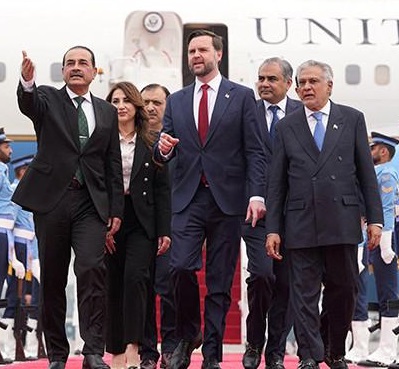
The United States delegation, led by Vice President JD Vance, has arrived in Islamabad ahead of high-level negotiations with Iran.
United States Vice President JD Vance and his delegation arrived in Pakistan on Saturday morning for historic talks with the Iranian leadership.
The talks are taking place during a two-week halt in the US-Israeli war against Iran, which began with US-Israeli attacks on February 28. The conflict, which spread across the West Asia and sent shockwaves through global economies, paused after Pakistan brokered a temporary ceasefire on April 8.
The Iranian delegation arrived in Islamabad early on Saturday morning after a last-minute hurdle over Israeli strikes in Lebanon eased. Tehran had conditioned its participation on a halt to attacks in Lebanon, a point Pakistan said was included in the US-Iran ceasefire.
The US delegation, led by Vance, includes US President Donald Trump’s son-in-law Jared Kushner and Middle East envoy Steve Witkoff.
Officials from the US National Security Council, State Department and Department of Defence are accompanying Vance, while advance security, technical and communications teams reached Islamabad earlier in the day.
The Iranian delegation is led by Parliament Speaker Mohammad Bagher Ghalibaf and also includes Foreign Minister Abbas Araghchi.
According to Iran’s Tasnim news agency, other negotiators include Supreme National Defence Council Secretary Ali Akbar Ahmadian and central bank governor Abdolnaser Hemmati.
Iran is represented by Parliament Speaker Mohammad Bagher Ghalibaf. In a social media post, Mr. Ghalibaf had said that two of the measures mutually agreed upon between the parties are yet to be implemented including a ceasefire in Lebanon and the release of Iran’s blocked assets prior to the commencement of negotiations. He said, these two matters must be fulfilled before negotiations begin. Talks are expected to focus on Iran’s nuclear enrichment programme, ballistic missile development, and the Strait of Hormuz.
The negotiations follow a two-week ceasefire window announced by the US President Trump. The strategic Strait of Hormuz remains a key point of tension. Iran is also seeking guarantees of a permanent end to hostilities, beyond the limited ceasefire framework currently on offer from the US. We spoke to Former diplomat Ashok Sajjanhar for his comments on how hopeful we can be for a postive outcome.
The talks would be the first direct high-level engagement between Washington and Tehran since 1979.