
Last Updated on October 19, 2026 5:45 pm by INDIAN AWAAZ
By Our Business Correspondent
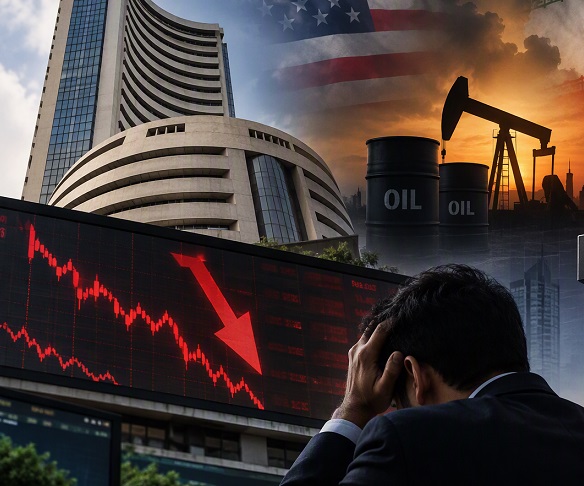
Indian equities suffered a sharp sell-off on Monday as losses in heavyweight private-sector banks, elevated crude oil prices, weak global cues and profit-taking after a recent rally dragged the benchmark indices lower. The decline came despite robust quarterly profit growth at several lenders, highlighting investors’ concerns about earnings quality, lending margins and the broader economic outlook.
The BSE Sensex plunged 876.37 points, or 1.17%, to close at 73,852.90, while the NSE Nifty 50 shed 257.20 points, or 1.11%, to settle at 22,888.95, slipping below the psychologically important 22,900 mark.
The correction followed gains over the preceding four trading sessions, during which the Sensex and Nifty had advanced 2.68% and 2.31%, respectively. Selling extended beyond large-cap stocks, with midcap and smallcap indices falling 1.04% and 1.29%, respectively.
Market breadth reflected the extent of the weakness. On the NSE, 2,717 stocks declined, compared with 846 advances, while 101 remained unchanged. The India VIX, a measure of expected near-term market volatility, rose 4.48% to 14.69.
According to a Reuters market report, private banks led the decline, while public-sector lenders gained on quarterly earnings.
Private banks drag benchmarks lower
Axis Bank emerged among the session’s biggest losers, with its shares falling 4.19% despite reporting a 37.6% year-on-year increase in standalone net profit to Rs 7,003.28 crore for the September quarter. Total income rose 14.2% to Rs 42,949.32 crore.
The divergence between reported earnings and share-price performance suggests that investors were looking beyond headline profit growth. Concerns about core operating performance, expenses and margins can outweigh strong net profit figures when expectations are high.
HDFC Bank declined 2.31%, although its standalone net profit increased 4.66% year-on-year to Rs 19,509.96 crore. Total income grew 6.8% to Rs 97,257.62 crore, while net interest income (NII)—the difference between interest earned on loans and interest paid on deposits—rose 9.7% to Rs 34,620 crore.
ICICI Bank lost 1.15% despite a 20.1% increase in standalone net profit to Rs 14,843.03 crore. Its NII advanced 17.7% to Rs 25,339 crore. However, net interest margin (NIM), which measures the profitability of a bank’s interest-earning assets, narrowed to 4.18% from 4.30% a year earlier and 4.36% in the June quarter.
The moderation in ICICI Bank’s margin illustrates why investors closely monitor profitability indicators alongside headline earnings. Funding costs, deposit mobilisation and competition for loans remain important variables for lenders.
PSU banks buck the broader downturn
Public-sector banking stocks moved in the opposite direction, with the Nifty PSU Bank index gaining more than 2% as strong quarterly results supported sentiment.
Union Bank of India surged 5.25% after reporting a 30.32% year-on-year jump in standalone net profit to Rs 5,537.20 crore. NII increased 20.09% to Rs 10,583 crore, while NIM improved to 2.86% from 2.67% a year earlier.
Punjab National Bank advanced 4.82% after its second-quarter net profit rose 12.82% to Rs 5,532.23 crore. NII grew 10.82% to Rs 11,601.29 crore, while total income increased 5.44% to Rs 38,185.41 crore.
The contrasting performance of private and public-sector lenders was a defining feature of the session. While private-bank stocks faced selling pressure despite profit growth, stronger earnings momentum at selected state-owned lenders encouraged buying.
Crude oil, currency and global cues weigh on sentiment
International developments added to investor caution. Brent crude for December 2026 delivery was quoted at $108.55 a barrel, down 1.19% on the session, but remained elevated in absolute terms.
For India, a major crude importer, sustained high oil prices can increase the import bill, put pressure on the rupee and complicate the inflation outlook. Higher imported energy costs can also constrain corporate margins and household purchasing power.
The rupee traded marginally weaker at 94.9100 against the US dollar, compared with its previous close of 94.8950. The yield on India’s 10-year government security rose to 7.403% from 7.382%, indicating continued pressure in the bond market.
The US Dollar Index edged up 0.10% to 101.94, while the US 10-year Treasury yield stood at 5.084%, according to the supplied market data.
Global equities also remained under pressure. European markets weakened amid political unrest in France and caution ahead of corporate earnings announcements. Asian markets declined as technology shares faced selling on concerns about the scale of artificial intelligence infrastructure investment and the cost of financing it.
US equities had ended sharply lower on Friday, October 16, with the Nasdaq Composite falling 2.14%, the S&P 500 declining 1.09% and the Dow Jones Industrial Average losing 0.34%. Technology and semiconductor stocks were particularly weak amid concerns about AI-related spending and stronger-than-expected inflation data.
These international developments added to the cautious mood on Dalal Street, although domestic banking-sector weakness was a major immediate driver of Monday’s decline.
Stock-specific action remains mixed
Elsewhere, Le Travenues Technology, which operates the ixigo travel platform, gained 9.51% after reporting a consolidated profit after tax of Rs 63.42 crore for Q2 FY27, against a loss of Rs 3.46 crore a year earlier. Revenue rose 12.92% to Rs 320.96 crore, while gross transaction value increased 22% to Rs 5,304.47 crore.
However, the quarterly profit included an exceptional gain of Rs 40.66 crore from the partial sale of its stake in Freshbus. The company’s underlying operating performance therefore needs to be assessed separately from the one-off gain.
Urban Company fell 10.45% after its consolidated net loss widened to Rs 182.48 crore from Rs 59.33 crore a year earlier, despite a 41.38% increase in operating revenue to Rs 537.29 crore.
UltraTech Cement declined 2.36% despite reporting a 21.29% increase in consolidated net profit to Rs 1,493.77 crore and an 18.81% rise in revenue to Rs 23,295.07 crore. HFCL hit its 5% upper circuit after consolidated revenue surged 143.62% year-on-year to Rs 2,541.79 crore and net profit jumped 448.14% to Rs 394.22 crore.
The mixed reactions underscore the market’s focus on earnings expectations, margins and the sustainability of growth rather than reported profit increases alone.
Four IPOs attract strong subscription demand
The primary market remained active, with four mainboard IPOs scheduled to close on Monday.
According to the supplied NSE subscription figures at 4:21 pm IST, Tonbo Imaging India was subscribed 135.29 times, Bonfiglioli Transmissions 45.87 times, Sahajanand Medical Technologies 14.07 times and Zetwerk Manufacturing Business 3.05 times.
Tonbo Imaging’s issue was priced at Rs 665–700 per share, while Bonfiglioli Transmissions offered shares at Rs 558–586. Sahajanand Medical Technologies set a price band of Rs 327–344, and Zetwerk Manufacturing Business priced its issue at Rs 143–151.
The wide variation in subscription levels indicates differing investor appetite across the four offerings. However, oversubscription alone does not establish a company’s long-term investment merits, and final exchange figures should be distinguished from interim subscription snapshots.
Outlook: earnings and macroeconomic risks in focus
Domestic markets will remain closed on Tuesday, October 20, for Dussehra, shortening the trading week. Investors are likely to monitor further quarterly results, foreign portfolio flows, crude oil prices and movements in bond yields when trading resumes.
Monday’s correction demonstrates that strong corporate earnings may not be sufficient to sustain a rally when valuations, margins and global risks remain under scrutiny. With private banks weighing on the benchmarks and PSU lenders providing selective support, the direction of the market will depend on whether earnings momentum can offset persistent macroeconomic and capital-flow concerns.
For investors, the immediate focus remains on the sustainability of bank profitability, the trajectory of oil prices and the ability of companies to convert revenue growth into durable earnings.
The article is structured for a business readership, with the main index movement and its drivers first, followed by sectoral divergence, macroeconomic indicators, corporate earnings and IPO activity.
Disclaimer
This report is based on market data, company disclosures, exchange filings and publicly available information as of 19 October 2026. Market conditions, stock prices, economic indicators and geopolitical developments may change rapidly. The article is intended solely for news and informational purposes and should not be construed as investment advice, a recommendation to buy or sell securities, or a solicitation for any financial transaction. Investors should consult qualified financial advisers and conduct independent research before making investment decisions.