
Last Updated on August 14, 2026 9:16 pm by INDIAN AWAAZ
Our Correspondent / New Delhi
The Ministry of External Affairs (MEA) on Friday urged political leaders to exercise restraint and uphold decorum while making public remarks involving foreign leaders, after Congress leader Rahul Gandhi’s comments about Italian Prime Minister Giorgia Meloni during his criticism of Prime Minister Narendra Modi’s foreign policy.
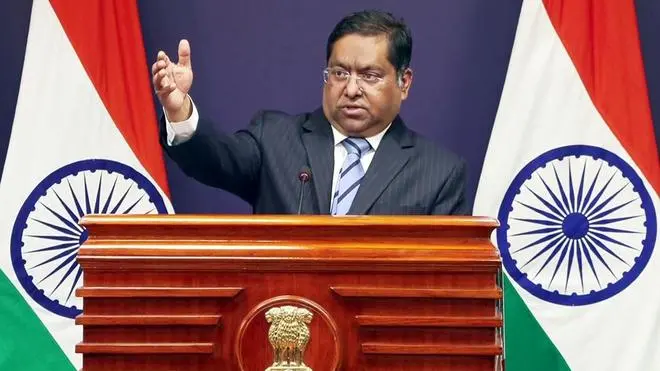
MEA spokesperson Randhir Jaiswal, responding to questions about the remarks, emphasised that India enjoys strong and expanding relations with Italy and remains committed to further strengthening bilateral ties. He said political issues and differences could be raised, but should be expressed with due respect.
” India has strong relations with Italy. We want to further strengthen these relations. Any issue should be put forward with respect,” Jaiswal said.
The MEA’s comments came a day after Gandhi criticised the Modi government’s approach to foreign policy at the Rachnatmak Congress National Convention, formerly associated with the Congress outreach cell. Gandhi argued that India’s foreign policy under Modi had increasingly come to be portrayed through his personal rapport and public interactions with foreign leaders.
To make his point, Gandhi demonstrated a hug with Rachnatmak Congress chief Sandeep Dikshit on stage and questioned the idea that diplomacy could be reduced to such personal gestures.
“Imagine the ignorance… where did he get the idea that foreign policy was about hugging leaders?” Gandhi said while referring to Modi’s interactions with foreign heads of government.
Dikshit subsequently made a reference to Italian Prime Minister Giorgia Meloni, asking Gandhi in Hindi, “Meloni samajh ke toh nahi pakda tha?” Gandhi responded, “I have not reached there yet.”
The exchange, referring to Meloni, quickly drew attention on social media. Critics accused the Congress leaders of making an inappropriate and potentially misogynistic remark about the Italian prime minister, while the comments also became part of the wider political debate over Modi’s diplomatic engagements.
The MEA, however, focused on the broader issue of maintaining diplomatic sensitivity rather than directly commenting on the political exchange between the Congress leaders.
India and Italy have in recent years sought to deepen cooperation across trade, investment, defence, technology, clean energy and other strategic areas. Against this backdrop, the MEA’s call for restraint underscored the importance the government attaches to maintaining a positive bilateral relationship with Rome.
The episode also highlights the increasing political scrutiny surrounding the Modi government’s foreign policy, particularly the Prime Minister’s interactions with global leaders. While the government has repeatedly presented such engagements as an important component of India’s growing diplomatic influence, the Opposition has questioned whether personal diplomacy should be given such prominence in the country’s foreign-policy framework.
The latest exchange is therefore likely to add another layer to the ongoing political debate over the balance between personal diplomacy, institutional foreign policy and diplomatic protocol.