

Last Updated on April 17, 2026 11:37 pm by INDIAN AWAAZ
Our Correspondent
Following reports of a ceasefire in Lebanon, Iran has announced the reopening of the strategically critical Strait of Hormuz to commercial shipping, signaling a potential easing of recent regional tensions involving United States and Israel.
Iranian Foreign Minister Abbas Araghchi stated that maritime transit through the strait would resume for commercial vessels during the ceasefire period, under specific conditions set by Iranian authorities.
“In line with the ceasefire in Lebanon, passage for commercial vessels through the Strait of Hormuz is now open for the duration of the ceasefire, along routes coordinated by the Ports and Maritime Organisation of Iran,” he said.
According to Iranian state-affiliated outlets, including Fars News Agency and Tasnim News Agency, vessels transiting the waterway are required to coordinate with Iranian maritime authorities and adhere to designated shipping routes.
The reports added that the current arrangement applies only to commercial shipping. Military vessels are excluded, and additional restrictions may apply to ships or cargo linked to countries considered hostile by Tehran.
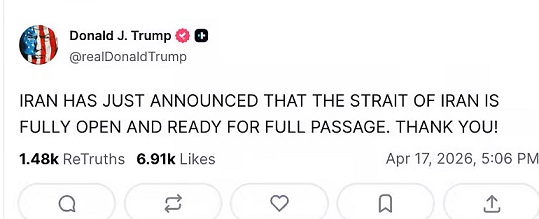
The Strait of Hormuz, a key global energy corridor through which a significant share of the world’s oil supply passes, had recently faced disruptions amid heightened regional tensions. Iranian officials have framed their actions as measures to ensure security in the waterway during the ongoing crisis.
While the reopening may provide temporary relief to global shipping and energy markets, analysts note that the situation remains fluid, with long-term stability dependent on broader geopolitical developments in the region.
On April 8, the United States formally accepted Iran’s 10-point proposal as the foundation for a permanent ceasefire. One of the conditions set by Tehran, and reiterated by mediator Pakistan, was ceasefire in all fronts, including Lebanon.
Washington had initially accepted the plan before backtracking following intense lobbying from Israel. On the same day, Israel launched a massacre across Lebanon, killing more than 300 people.
Iran maintained a steadfast and uncompromising posture. According to multiple reports, Tehran threatened to boycott the critical Islamabad talks last week if the devastating attacks on Lebanon were not immediately scaled back. This firm ultimatum successfully prompted the US to press Israel into compliance.
Finally, US President Donald Trump publicly announced the truce last night during a White House address. The fragile ceasefire in Lebanon took effect at midnight.
A high-ranking Pakistani delegation held meetings with Iranian officials on Thursday. According to reports, they carried a message from the US amid attempts to coordinate a second round of talks between Tehran and Washington.