
Last Updated on March 28, 2026 6:10 pm by INDIAN AWAAZ
R. Suryamurthy / New Delhi
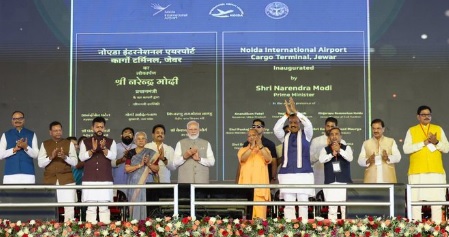
— The inauguration of Noida International Airport on Saturday marks more than the addition of a second aviation hub to the National Capital Region (NCR); it signals the beginning of a structural shift in how capital, jobs and urban growth are likely to disperse across northern India.
Located roughly 75 km southeast of Delhi along the Yamuna Expressway, the greenfield airport—bearing IATA code DXN—is being positioned as both a pressure valve for the saturated Indira Gandhi International Airport and as the nucleus of a new economic geography spanning Noida, Greater Noida and western Uttar Pradesh.
Capacity, scale, and the long game
In its first phase, the airport is designed to handle 12 million passengers annually, with a single runway and integrated cargo facilities. But the longer-term ambition is far more expansive: a phased build-out across roughly 1,334 hectares, scaling to 70 million passengers per year—with potential for six runways—by 2040–2050.
That trajectory places it among the largest aviation-led developments in Asia, not merely in terms of passenger capacity but as an integrated “aerotropolis” model—where airports anchor ecosystems of logistics, manufacturing, commercial real estate and urban habitation.
The project, developed under a public-private partnership by Noida International Airport Ltd and operated by Zurich Airport’s Indian arm, represents an investment of roughly ₹29,560 crore (about $3.5–4 billion), with Phase 1 alone costing between ₹4,500 crore and ₹10,000 crore ($540 million–$1.2 billion).
From infrastructure to economic engine
What sets Jewar apart is the scale of its projected economic spillover. Estimates suggest the airport could unlock over ₹2 lakh crore ($24 billion) in economic activity by FY38 and contribute more than 1% to Uttar Pradesh’s gross state domestic product over time—critical to the state’s ambition of becoming a $1 trillion economy.
Employment generation is equally central to the narrative. In the first five years, the project is expected to create over 50,000 direct jobs and more than 500,000 indirect jobs, with long-term projections ranging up to 4–5 million jobs across sectors—from aviation and logistics to tourism, MSMEs and supply chains.
Yet, these projections also expose a key uncertainty: the gap between potential and delivery. Early feedback from local communities suggests that while land has been acquired and infrastructure built, job creation—particularly direct employment—may take longer to materialise, with many roles currently routed through contractors.

A logistics and cost-efficiency play
Beyond passengers, the airport’s “cargo-first” design reflects a deeper economic rationale. India’s logistics costs remain elevated at roughly 13–14% of GDP, significantly higher than global benchmarks. By integrating cargo terminals, warehousing and multimodal logistics hubs, Jewar aims to compress these inefficiencies.
Initial cargo capacity exceeds 100,000 tonnes annually, with long-term projections running into millions of tonnes. A planned logistics hub alone is expected to generate around 15,000 jobs, while also attracting investments in data centres, e-commerce fulfilment and manufacturing clusters.
This industrial dimension is crucial: without it, the airport risks becoming a transit node rather than a production-linked growth centre.
Real estate: pricing in the future
Nowhere is the airport’s impact more immediately visible than in real estate. According to Square Yards, apartment prices along the Yamuna Expressway have nearly tripled between 2020 and 2025, while land prices in some pockets have surged up to fivefold. Further appreciation of 22–28% is projected by 2027.
Consultants such as CBRE argue that airport-led development historically acts as a multiplier across asset classes—commercial, logistics, hospitality and residential—by expanding the economic catchment.
At the same time, the velocity of price appreciation raises familiar concerns. A significant portion of future infrastructure value appears already priced in, leaving markets vulnerable if execution—particularly on connectivity and job creation—lags behind expectations.
Industry players insist this cycle is different. Firms like PropertyPistol and InvestoXpert Advisors point to a shift from speculative activity to fundamentals-driven growth, anchored by emerging employment hubs, logistics parks, and planned developments such as a “Singapore-style” aerocity.
The connectivity test
If the airport is the anchor, connectivity will determine whether its promise translates into reality. At present, access is largely dependent on the Yamuna Expressway. Future integration—via metro extensions, a proposed 72-km high-speed Regional Rapid Transit System corridor, and elevated road links—will be critical in stitching Jewar into the NCR’s economic fabric.
The strategy is not to compete directly with Delhi’s IGI, but to complement it—absorbing spillover demand while serving eastern NCR and western Uttar Pradesh. IGI itself is projected to approach 100–110 million passengers annually, underscoring the necessity of a secondary hub.
A multi-node NCR in the making
Perhaps the most far-reaching implication lies in urban form. For decades, NCR’s growth has been heavily skewed toward Delhi and Gurugram. Jewar could accelerate the emergence of a multi-node metropolitan structure, with Noida–Greater Noida–Yamuna Expressway evolving into a parallel growth axis.
Real estate consultants expect Noida to account for up to a quarter of NCR’s office leasing activity in the coming years, with 2–3 million sq. ft. of annual Grade A demand—a signal that corporate occupiers, not just investors, are beginning to reposition.
Such a shift could ease pressure on legacy urban cores while redistributing economic opportunity. But it also demands coordinated planning across transport, housing, and industrial policy—an area where execution has historically lagged ambition.
The risk beneath the optimism
For now, sentiment remains strongly positive, bolstered by visible progress on infrastructure and policy support. But the underlying question is whether infrastructure-led momentum can translate into sustained, broad-based economic activity.
The experience of global aerotropolis models—from Amsterdam Airport Schiphol to Dubai—suggests success hinges not just on building capacity, but on synchronising infrastructure with demand, investment and governance.
In that sense, the real test for Noida International Airport begins after inauguration. Commercial operations are expected to commence in the coming months, but the larger story will unfold over decades.
If execution keeps pace with ambition, Jewar could redefine NCR’s economic map and anchor a new growth corridor in northern India. If it doesn’t, the early surge in land and property prices may come to reflect not realised value—but expectations that ran ahead of fundamentals.