
Last Updated on September 2, 2026 12:47 am by INDIAN AWAAZ
Andalib Akhter / New Delhi
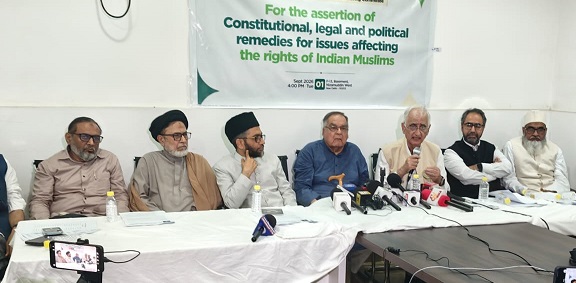
In a belated yet encouraging move, a group of Prominent Indian Muslims have come together to form a National Monitoring Committee to take up issues concerning the community through constitutional, legal and political channels.
Announced at a press conference in New Delhi on Tuesday, the 51 member committee would monitor developments affecting the community, identify matters requiring intervention and engage with government institutions and other stakeholders through democratic and constitutional means. The initiative follows a national consultation of Muslim leaders and intellectuals held in New Delhi on July 24, where participants discussed the prevailing political and social situation and agreed on the need for a structured mechanism to monitor developments and respond to emerging concerns.
According to the committee, its mandate includes identifying issues requiring intervention, examining available constitutional and legal remedies, engaging with relevant institutions and, where necessary, pursuing democratic and political avenues.
The committee said its focus would include constitutional rights, civil liberties, political representation and other matters affecting the community. A separate 10-member secretariat will assist the 51-member body in monitoring developments, coordination and follow-up.
The announcement comes amid concerns raised by several Muslim organisations and civil-society groups over developments in different states, including issues related to evictions, electoral rolls, religious sites, alleged discrimination and the implementation of laws and administrative measures. Committee members stressed that their response would remain within the framework of the Constitution and democratic institutions.
Uttarakhand first destination for committee’s field outreach
The committee has decided to undertake visits to areas where it believes serious challenges are emerging. The stated objective is to establish direct contact with affected communities, civil-society representatives and local leadership rather than relying solely on reports received at the national level.
Uttarakhand was selected for the first visit, with a delegation travelling to Dehradun for meetings with civil-society representatives and Muslim leaders.
During one meeting, members discussed the broader social and political situation in the state and concerns affecting different sections of society. Senior Congress leader Gurdeep Sappal was also present. A separate meeting with Muslim representatives brought together political, social and religious figures, who discussed concerns within the community and developments in the state.
Khurshid: Initiative seeks equal rights, not concessions
Former Union minister Salman Khurshid, addressing the press conference, described the initiative as an effort by Indian Muslims to collectively assert their rights.
“This is an initiative by the Muslims of India,” Khurshid said, stressing that the objective was not to seek favours from the authorities but to underline the principle of equal citizenship.
He said India’s diversity should not become a basis for unequal treatment and called on people from different sections of society to join the effort.
“This is not about asking for charity. Every citizen of this country has rights,” Khurshid said, adding that the initiative wanted to contribute to addressing what its organisers viewed as a larger national issue.
Maulana Ataur Rahman Qasmi said the initiative should extend beyond major urban centres and reach villages and rural areas. He called for a nationwide outreach programme to engage with people who feel marginalised or vulnerable.
Syed Saadatullah Husaini, Ameer of Jamaat-e-Islami Hind and Vice-President of the All India Muslim Personal Law Board, described the initiative as the beginning of a major campaign.
He said the committee represented different sections of the Muslim community, including senior leaders and younger people, and would continuously monitor developments and intervene whenever necessary.
Husaini also stressed that the initiative should not be seen as confined to Muslim concerns alone, saying that its stated objective was linked to wider constitutional and democratic values.
Muhammad Adeeb clarified that the committee was not intended to compete with or oppose the All India Muslim Personal Law Board.
He said matters relating to Sharia would continue to remain within the Board’s domain, while the new initiative would concentrate on political, civic and constitutional issues. The committee, he added, sought to bring different organisations and individuals together rather than work against any particular institution.
Concerns over evictions and religious places
Nadeem Khan raised concerns over what he described as demolitions, evictions, displacement and alleged attacks on religious places in different parts of the country.
Referring to Assam, he alleged that thousands of families had been displaced and expressed concern over ongoing “pushback” operations, claiming that some Indian citizens could also be caught up in such actions. He also referred to alleged incidents involving dargahs and mosques in parts of Gujarat, including Kutch, and Rajasthan.
Khan said the committee’s field teams would continue documenting incidents, meeting affected communities and examining cases requiring legal or institutional intervention.
Assam, electoral rolls and UCC among issues raised
Justice Iqbal Ahmed Ansari spoke about Assam and argued that the situation there should not be reduced simply to Hindu-Muslim tensions. He alleged that eviction actions were disproportionately affecting Bengali-speaking Muslims and called for engagement with both Assamese and Bengali Muslims on an equal basis.
Maulana Mohsin Ali Taqvi said the present circumstances made it necessary for different sections of society to work together to protect constitutional and secular values.
Fuzail Ahmed Ayyubi called for greater coordination among religious leaders, political representatives, civil-society organisations and lawyers, arguing that the scale of the challenges required a common platform.
SQ R Ilyas raised concerns over SIR, the National Register of Citizens (NRC), the Uniform Civil Code (UCC), incidents of lynching and what he described as increased scrutiny of madrasas and religious institutions. He alleged that electoral-roll revisions could disproportionately affect Muslim voters and argued that all communities should participate in efforts to protect constitutional rights.
Committee to pursue constitutional and democratic avenues
The committee said it would now focus on identifying areas requiring intervention, examining constitutional and legal remedies, approaching relevant authorities and pursuing political and democratic avenues where necessary.
Its formation marks an attempt by a broad group of Muslim leaders, lawyers, political figures and civil-society representatives to create a coordinated mechanism for responding to issues concerning the community. Organisers said the committee’s future work would combine national-level monitoring with field visits and direct engagement with affected communities.
The programme was moderated by IMCR Secretary Azam Baig. Along with the announcement of the 51-member committee, the organisers also released the names of its members and said the 10-member secretariat would support its monitoring, coordination and follow-up activities.