
Last Updated on February 18, 2026 12:06 am by INDIAN AWAAZ
AMN / NEWS DESK
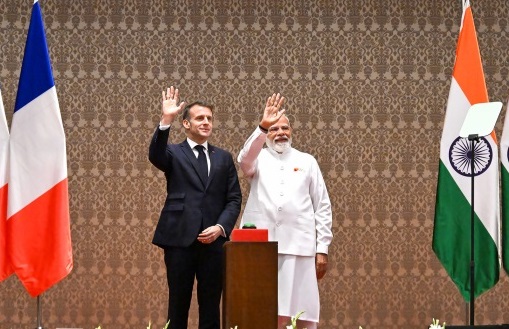
At the invitation of Hon’ble Prime Minister of India, Shri Narendra Modi, President of the French Republic H.E. Mr. Emmanuel Macron paid an official visit to India from 17 to 19 February 2026 and participated in the Artificial Intelligence Impact Summit 2026. During the visit, the two leaders held bilateral talks and jointly inaugurated the 2026 India-France Year of Innovation in Mumbai on 17 February. This is President Macron’s 4th visit to India and it follows Prime Minister Modi’s visit to France in February 2025.
On this occasion, both leaders agreed to elevate relations to a “Special Global Strategic Partnership” to guide bilateral cooperation in the coming decades. The upgrading of relations reflects the growing ambitions and vision shared by the two leaders on India-France relationship, to act as a force for global good that can help build not only prosperity and resilience in their economies and advance their countries’ security, but also work collectively towards addressing challenges in an increasingly uncertain global environment and, thus, help build a stable rules-based international order. Both countries celebrated the 25th anniversary of the Strategic Partnership in 2023, on the occasion of which they adopted the Horizon 2047 Roadmap to set the course for the bilateral relationship up to 2047, the centenary year of India’s independence, the centenary of diplomatic relations between the two countries and 50 years of Strategic Partnership. The leaders established an annual Foreign Ministers Comprehensive Dialogue for regularly reviewing the progress of bilateral cooperation and implementation of the elevated partnership, and the Horizon 2047, in particular, in the areas of economic security, global issues and people to people exchanges.
India and France have a long history of collaboration in defence and security which has only deepened with a focus on co-design, co-development and co-production of defence platforms and France has emerged as India’s one of the foremost defence partners in the world. Both countries have deepened collaboration in civil nuclear energy, through fruitful discussions on potential collaborations in both large capacity nuclear power plants and emerging areas such as Small Modular Reactors and Advanced Modular Reactors. Both countries have long-standing cooperation in the domain of space, including in areas such as joint satellite development, launchers and human flight programs. Both countries have expanded and diversified cooperation in areas such as artificial intelligence, innovation, research, technology, digital and cyber space, health, culture, economy, educational links and people to people exchanges. Trade and investment links between the two countries have deepened and both countries are cooperating on building trusted, reliable and resilient supply chains, as well as safeguarding their economic security. Through the establishment of a Special Global Strategic Partnership, India and France are committed to deeper cooperation and coordination at bilateral, regional and global levels, guided by the India-France Horizon 2047 Roadmap.
Both Leaders, acknowledging the importance of advancing scientific knowledge, research and innovation, and the long and enduring engagement between India and France in these areas, jointly inaugurated the 2026 India-France Year of Innovation. This year will feature a series of high-impact collaborations in India and France spanning diverse sectors such as Innovation, Science and Technology, Cyberspace and Artificial Intelligence, Healthcare, Sustainable Development, Cultural and Creative Economy, and Research and Education. These engagements aim to enrich existing collaborations and foster new collaborations between startups, academic institutions, research bodies and industry, showcasing the shared commitment of India and France to co-develop solutions for a smarter, more sustainable future.
President Macron congratulated Prime Minister Modi on India’s successful organization of AI Impact Summit. The summit, while addressing the risks, also highlighted the opportunities offered by AI and built on the progress made in the AI Action Summit, hosted by France and co-chaired by President Macron and Prime Minister Modi in Paris in February 2025. Recalling the India-France Declaration on Artificial Intelligence, both leaders expressed their commitment towards a secure and trustworthy AI serving people, public interest, planet and the progress of our peoples. Both sides also affirmed democratizing AI resources through openness and bridging the global AI divide as important principles. France also contributed significantly as a co-chair of the Working Group on Resilience, Innovation and Efficiency.
President Macron extended an invitation to Prime Minister Narendra Modi to participate in the G7 Summit to be hosted by France in 2026 and invited India to participate actively in the discussions and preparatory work ahead of the Summit, mainly on the key issues of tackling global macroeconomic imbalances and defining a new paradigm for international partnerships and solidarity. Prime Minister Modi warmly welcomed the invitation, noting India’s longstanding partnership with the G7 and its commitment to contributing constructively to global discussions on addressing global economic imbalances, development financing, international partnership, economic security, resilient supply chains, climate action and international security. Both leaders expressed confidence that India’s participation would further strengthen collective efforts to address global challenges and promote a more balanced, inclusive, and resilient international order. Both leaders stressed the importance of collective efforts in order to address together global challenges, especially macroeconomic issues.
President Macron recalled the invitation extended jointly with President Ruto to Prime Minister Modi to participate in the “Africa Forward: Partnerships between Africa and France for Innovation and Growth” Summit, to be held on May 11 and 12, 2026, in Nairobi, Kenya. Considering India’s longstanding and friendly engagement with both France and African countries, Prime Minister Modi thanked for the invitation and reaffirmed support in areas of mutual interest, in particular energy transition, artificial intelligence, health, agriculture and blue economy.
The two Leaders reaffirmed their commitment to a rules-based order in the Indo-Pacific region and beyond. The elevation of the relationship will strengthen cooperation between the two countries in sectors of the future, so as to reinforce their sovereignty and decision-making autonomy, and to respond together to the major challenges confronting our world, including through cooperation between India and the European Union.
They reiterated their call for reformed and effective multilateralism to sustain an equitable and peaceful international order, address pressing global challenges and prepare the world for emerging developments, including in the technological and economic domains. The two leaders stressed, in particular, the urgent need for the reform of the United Nations Security Council. They agreed to coordinate closely in multilateral fora, including on UNSC matters, and pledged to continue their efforts to conclude intergovernmental negotiations on the reform of the United Nations Security Council. France reiterated its firm support for India’s permanent membership of the United Nations Security Council. They agreed to strengthen conversations on regulation of use of the veto in cases of mass atrocities. They held extensive discussions on long-term global challenges and current international developments and agreed to intensify their engagement.
Both leaders also underlined the key importance of strengthening EU-India relations and welcomed the historic summit between India and the EU, during which the negotiations of the India-EU Free Trade Agreement were concluded. The FTA will open opportunities for further economic collaboration between India, France and Europe, strengthening the competitiveness of our businesses, ushering in a new era of sustainable prosperity and resilient value chains. Both leaders welcomed the conclusion of the Security and Defense Partnership, which will contribute to the strategic autonomy of the EU and India, and will provide a framework for in-depth exchanges and cooperation on common security challenges such as maritime security, cybersecurity, hybrid threats, space and counterterrorism, and for promoting mutually beneficial defence industrial collaboration.
The two leaders reiterated their concern over the war in Ukraine, which continues to cause immense human suffering and negative global consequences. They stressed the importance of cessation of hostilities and expressed support for a comprehensive, just and lasting peace in Ukraine through dialogue and diplomacy in accordance with the principles of the UN Charter and international law, including independence, sovereignty and territorial integrity.
The two sides discussed the recent developments of concern in Iran and the region. They underscored the importance of dialogue and diplomacy in resolving issues in a peaceful manner.
Both Leaders expressed their support to the implementation of the Peace Plan for Gaza in accordance with the Resolution 2803 adopted by the United Nations Security Council and principles enshrined in the New York Declaration. They encouraged all parties to implement the resolution in its entirety. Both sides restated their readiness to support efforts towards just and durable peace and stressed the need for rapid, safe and unimpeded aid delivery throughout the Gaza strip. Both Leaders reiterated the commitment of India and France for a just and lasting solution, based on the implementation of the two-state solution, through dialogue and diplomacy.
I. Partnership for Security and Sovereignty
Recalling the deep and long-standing defence cooperation between France and India, Prime Minister Modi and President Macron agreed to intensify joint research, co-design, co-development and co-production of advanced defence platforms, including in the field of air, naval and land systems, and emerging dual-use technologies, in line with the ambitious Defence Industrial Roadmap agreed in 2024. They looked forward to the convening of the Annual Defence Dialogue between the Ministers of Defence of both countries during this visit. They also welcomed the signing of a Technical Arrangement for cooperation in defence technologies between DGA and DRDO in November 2025 that will provide a platform for research and development partnerships between the two agencies. Building on the existing trust in high technology collaboration between India and France, both leaders agreed to constitute a Joint Advanced Technology Development Group to explore opportunities to co-develop emerging and critical technologies in identified niche areas to retain a competitive military edge, and mitigate supply chain vulnerabilities.
They welcomed ongoing discussions on furthering defence cooperation in helicopter and jet engines and the excellent cooperation between the relevant entities on both sides. In particular, both leaders commended the contract to procure 26 Rafale-Marine fighter jets. They expressed their wish to further strengthen their partnership in defence aeronautics, especially in the field of manufacturing of fighter aircraft and combat aircraft engines under the Make in India initiative, and welcomed recent positive developments in this regard. They noted the excellent cooperation between the relevant entities in the Safran group and their Indian counterparts. They appreciated the ongoing partnership between Safran and HAL for the development of the Indian Multi Role Helicopter (IMRH). Both sides welcomed the inauguration of Maintenance, Repair and Overhaul (MRO) facility for LEAP engine, the establishment of MRO facility for M-88 engines mounted on Rafale aircrafts and the Joint Venture with Bharat Electronics Limited to produce the HAMMER Missiles in India. Both leaders also jointly inaugurated the H125 Final Assembly Line, a first of its kind private sector helicopter manufacturing facility in India, a historic make in India milestone, that will combine the strength of TATA Advanced Systems and Airbus to serve India’s growing market and export to third countries. Prime Minister Modi appreciated the growing interest on the French side in India’s Pinaka MBRL.
Both leaders highlighted the success of the made-in-India Scorpène program (P75 – Kalvari), whose 6th submarine was delivered on January 15, 2025 to the Indian Navy, and welcomed the continuation of the cooperation in Submarines.
Both leaders appreciated the regular conduct of bilateral military exercises in all domains, with three major bilateral exercises held in 2025 (Varuna, Shakti and Garuda), as well as both sides’ participation in multilateral exercises, including India’s participation in French Space Military Exercises. They also welcomed conduct of regular port calls between the two countries. The two leaders also welcomed the deployment of officers in our respective armies in 2026, which will contribute to strengthening the mutual knowledge between our armed forces. The two leaders looked forward to increasing operational engagements between the armed forces of the two countries.
The two leaders reaffirmed their commitment to deepen bilateral cooperation in the field of defense space, in line with the Letter of Intent signed in January, 2024. The Technical Arrangement between DRDO and DGA which includes the field of defense space in its scope provides a framework for innovative state-level and industrial cooperation of mutual interest.
Recognizing the key role of critical minerals in supporting a green and digital economy, emerging technologies and advanced manufacturing, the two leaders agreed to deepen cooperation in exploration, extraction, processing and recycling technologies of critical minerals and rare earths in order to create diversified, sustainable, responsible and resilient supply chains. In this regard, both sides welcomed the Joint Declaration of Intent on cooperation in the field of critical minerals between France and India.
Both leaders reaffirmed their commitment to cooperate on the India-Middle East-Europe Economic Corridor (IMEC), recognizing its transformational potential in reshaping and promoting global trade, connectivity and prosperity. Appreciating the preliminary discussions around the project, they encouraged the first IMEC Ministerial Meeting to take concrete steps for advancing this initiative in 2026.
They appreciated the cooperation in trilateral formats with Australia and the United Arab Emirates and directed their concerned officials infuse new ambition to work together with officials from the Governments of Australia and United Arab Emirates to implement the mutually identified areas of work under these initiatives.
They reaffirmed their commitment to a free, open, prosperous and rules-based Indo-Pacific region and called for closer collaboration in the Indo-Pacific region, in line with their ‘Joint Strategic Vision of India-France Cooperation in the Indian Ocean Region’ of 2018 and ‘India-France Indo-Pacific Roadmap’ of 2023. They also looked forward to enhanced engagement under the Indo-Pacific Oceans Initiative (IPOI) and to strengthening cooperation in the Indian Ocean Rim Association under India’s Chairship. They welcomed the latest development of joint initiatives in the region, including recent new solar energy trainings in countries in the Indo-Pacific region through the International Solar Alliance (ISA) with both Indian and French fundings, as well as the signing of a Memorandum of Understanding between the Coalition for Disaster Resilient Infrastructures (CDRI) and the AFD Group to reinforce disaster resilience in third countries. They appreciated the progress on the Indo-Pacific Triangular Development Cooperation (IPTDC) aimed at supporting climate and SDG focused projects from third countries of the Indo-Pacific, with the two sides having jointly identified projects in the fields of Digital Startups, Health, and Digital Public Infrastructure to be implemented together.
In the space sector, they commended the strength of the partnership between CNES and ISRO and supported the development of deeper collaborations between their space industries. Taking note of the substantial contribution of the first two sessions of the India-France Strategic Space Dialogue to further this objective, they called for early convening of the third session in 2026. Building on the Letter of Intent on cooperation on defence space, inter alia, both leaders agreed to strengthen their synergies in terms of sovereign access to space and enhancing space situational awareness. India welcomed the organization by France of the International Space Summit in July 2026, for strengthening multilateralism in space, and confirmed participation.
The two leaders also stressed the importance of deepening cooperation between their major oceanographic institutions and developing synergies in the Ocean-Space nexus, notably through strengthened collaboration between CNES and INCOIS to improve ocean observation in relation to oceanographic fleets and support sustainable management, which reconciles prosperity and protection of the Ocean.
In the cyber sector, both leaders commended the strong bilateral partnership, based on the development of synergies between Indian and French industries. Both sides emphasized strengthening of cyber cooperation through regular bilateral cyber dialogue and engagements. They called for the next dialogue to take place in 2026. The two leaders reiterated the strategic significance of cyberspace and their wish to strengthen their coordination at the United Nations regarding the application of international law and the implementation of the framework for responsible State behaviour in cyberspace, as well as the need to address issues arising from the proliferation of malicious cyber tools and practices.
The two leaders unequivocally and strongly condemned terrorism and violent extremism in all its forms and manifestations including cross border terrorism. President Macron strongly condemned the April 2025 Pahalgam terror attack and expressed support to India’s right to defend itself against terrorism. He also condemned the November 2025 terror incident near Red Fort, New Delhi. The leaders reiterated their commitment to cooperate in the fight against terrorists and terrorist groups and their affiliates including those listed by the UN Security Council 1267 Sanctions Committee. Both sides also called upon all countries to continue to work towards eliminating terrorist safe havens and infrastructure as well as to disrupt terrorist networks and combat the financing of terrorism, consistent with the Financial Action Task Force (FATF). Both countries reiterated their commitment to work together in UN, FATF and other multilateral platforms. India expressed support to France’s hosting of the next No Money For Terror (NMFT) Conference that will be held in Paris in May 2026.
Both Leaders appreciated the signing of a Letter of Intent for cooperation on counter terrorism between the National Security Guard (NSG) of India and the Groupe d’Intervention de la Gendarmerie Nationale (GIGN) in November 2025. They appreciated mutual support between the two countries in organization of MILIPOL exhibitions in each other’s countries in the year 2025, and looked forward to the successful organization of MILIPOL 2027 in New Delhi and Paris, respectively. The two leaders welcomed the outcomes of the counter-terrorism dialogue held in September 2025, reflecting the growing India-France counter-terrorism and intelligence cooperation.
II. Partnership for the Planet
Both leaders recognized the worsening impacts of climate change — marked by the increasing intensity and frequency of extreme weather events — and reaffirmed the importance of the Paris Agreement and promoting sustainable lifestyles. They agreed to cooperate closely for its effective implementation and to join forces to raise global ambition, including by holding the increase in the global average temperature to well below 2°C above pre-industrial levels and pursuing efforts to limit the temperature increase to 1.5°C above pre-industrial levels. France and India reaffirmed their determination to defend the role of science as the basis of climate action, and support the work of the Intergovernmental Panel on Climate Change (IPCC). They welcomed the bilateral cooperation carried out in multilateral fora, within the framework of the Franco-Indian presidencies of the Coalition for Disaster Resilient Infrastructure (CDRI) since 2024 and the International Solar Alliance (ISA) since 2018. They reiterated their commitment to these two organizations based in New Delhi, reflected in the hosting in France, as co-president, of the international conference of the CDRI in 2025 and the concrete support of India and France to both organizations. They also welcomed the ongoing discussions for establishment of a European office of the International Solar Alliance in Paris. They will engage for decarbonization and resilience of the buildings sector, notably through the Declaration de Chaillot and its Intergovernmental Council for Buildings and Climate and support efforts to decarbonise hard-to-abate sectors, including through the Leadership Group for Industry Transition (LeadIT) initiative.
Both leaders commended the strong bilateral cooperation between India and France on climate and environment issues. They welcomed the renewal of the Memorandum of Understanding between the Ministry of New and Renewable Energy and the Ministry of Economies, Finance and Industrial and Digital Sovereignty on renewable energy cooperation. They expressed appreciation at the bilateral cooperation in projects in urban mobility, energy transition, green finance, biodiversity preservation and disaster management in India with involvement of the AFD Group. They noted the progress in discussions on the Statement of Intent between Niti Aayog and the AFD Group to develop jointly a new macroeconomic modelling of the impacts of the energy transition in India.
Both leaders welcomed the success of the United Nations Ocean Conference (UNOC-3) held in Nice in June 2025. France and India welcomed the entry into force of the Agreement on the Conservation and Sustainable Use of Marine Biodiversity in Areas Beyond National Jurisdiction (BBNJ Treaty), which is one of the pillars of an inclusive and comprehensive international ocean governance. Aware of the major breakthrough that the agreement offers for multilateralism, science and future generations, the Leaders agreed on the importance of the ratification by the largest number of States to ensure effective implementation starting from the first Conference of the Parties. Convinced of the crucial importance of protecting the Ocean biodiversity, France and India called for the expansion of marine protected areas worldwide. India and France also reaffirmed their commitment to the full and effective implementation of the Kunming-Montreal Global Biodiversity Framework. France and India reaffirmed their commitment to strengthen their cooperation in the exploration and observation of the Ocean, to support the generation and sharing of reliable scientific data for the implementation of the Treaty on the High Seas, the strengthening of governance of international marine spaces and the development of new marine protected areas.
Recognizing the complementarity between all low carbon energies among which nuclear energy would be important for strengthening energy security and transitioning towards a low-carbon economy, President Macron lauded India’s ambitious target to achieve 100 GW nuclear power capacity by 2047 and India’s recent reforms of its nuclear sector, including the allowing of private investment in this sector. The leaders agreed to deepen India-France cooperation in nuclear energy across the value chain from research, skills development to industrial applications, and explore possibilities to collaborate, for making it a major pillar in India’s energy mix. They also noted the regular meetings of the Special Task Force on civil nuclear energy, including the evolving discussions on the Jaitapur Nuclear Power Plant Project. In the same context, they expressed satisfaction over the participation of Indian companies and industry delegates in the 6th World Nuclear Exhibition (WNE) held in Paris in 2025 and the forthcoming participation of India in the second World Nuclear Energy Summit in France in cooperation with the IAEA.
In this regard, the leaders welcomed the longstanding relationship between Department of Atomic Energy (DAE) and Commissariat a l’Energie Atomique et aux Energies Alternatives (CEA) and called for a renewed and strengthened cooperation in the field of Nuclear Science and Technology for peaceful purposes. Furthermore, both Leaders agreed to explore possibility of strengthening cooperation between their respective regulatory bodies.
Recalling the Declaration of Intent (DoI) for establishing cooperation on Small and Advanced Modular Reactors (SMR/AMR) between India and France signed in 2025 and their commitment to apply the highest standards of safety, security and non-proliferation, the two leaders noted efforts from both sides to strengthen cooperation between French start-up companies and relevant Indian companies in this sector. Separately, within the framework of this DoI, the two sides agreed to explore the possibility of establishing cooperation in research and development on SMR/AMR between the French Alternative Energies and Atomic Energy Commission (CEA) and India’s Department of Atomic Energy (DAE).
The Leaders welcomed the sustained growth in bilateral trade and the strong two-way investments between the countries. They reaffirmed their commitment to fully realizing untapped economic potential, including through MSMEs, startups, digitalization, AI and innovation-driven enterprises. In this context, both leaders expressed happiness at the holding of the India-France CEO Forum during this visit. They also shared a commitment of holding the Economic and Financial Dialogue this year. The leaders expressed happiness at the deepening of business ties between companies of both countries, especially in the areas of aerospace, energy and logistics, agri-food, telecoms and tech sectors. The CEO Forum being held tomorrow will take further the agenda of business partnerships between the two countries.
The Leaders also welcomed the signature of the amendment to the bilateral tax treaty, which will secure economic activity for French and Indian businesses and pave the way for greater investments and collaborations between the two countries.
Both leaders expressed their satisfaction over continuous progress made by UPI in France, the first European country to offer UPI. Several flagship stores already accept UPI, making Paris a more attractive destination for Indian tourists. Both leaders agreed to work towards greater acceptance of secure and efficient digital payment methods in order to improve payments made by tourists.
Both leaders welcomed cooperation in the railway sector and expressed their intent to collaborate across a wide range of domains, including operations and maintenance, passenger amenities, sustainability and environmental impact management, training and upskilling of railway personnel, construction technologies such as high-speed rail, infrastructures, as well as manufacturing technologies, including hydrogen-powered trains. In this regard, they looked forward to the signing of a Joint Declaration of Intent on cooperation on railway and high-speed railway development in India.
III. Partnership for the People
Recalling the rich history of India-France cooperation in science and technology, the leaders emphasized the need to further deepen the cooperation in this field, especially in the context of the India-France Year of Innovation 2026. They welcomed the progress in existing bilateral cooperation on critical and emerging technologies, including on space, civil nuclear energy, cyber and AI, and encouraged to go further in technology cooperation. They welcomed the launch of the India-France Innovation Network to bring together the innovation ecosystems of France and India through a digital network, by connecting key stakeholders including innovators, start-ups, businesses and incubators of both countries.
Following the success of the ten Indian startups at Station F last year, the leaders welcomed ongoing discussions on further startup incubation and greater interactions of Indian and French startup ecosystems and the LoI signed between T-Hub and Nord France Invest for collaboration between the two startup ecosystems. In this context, the French side also expressed its commitment to bring VivaTech, Europe’s largest tech fair, to India, in partnership with the Bangalore Tech Summit. Taking forward the existing strong scientific partnership on multiple projects, the two leaders also welcomed the announcement on the opening of a binational center on digital sciences and technology in India between lnstitut National de Recherche en Informatique et en Automatique (INRIA) and the Department of Science and Technology (DST) towards which both sides have signed a Joint Declaration of Intent, and the renewal of the Memorandum of Understanding for Scientific Collaboration between The Centre National de la Recherche Scientifique (CNRS) and DST as well as Letter of Intent between DST and CNRS to establish a Joint Center for Advanced Materials. They called for early finalization of the joint call for projects by ANR and DST in the field of AI and applied mathematics.
In line with their objective of deepening bilateral cooperation in civil aviation, both parties welcomed the recent signing of a declaration of intent in the field of civil aviation. They welcomed the launch of a new airline route between Saint-Denis de la Réunion and Chennai, which will help develop economic and cultural exchanges between La Réunion and India. Both Leaders welcomed signing of the Letter of Intent for establishment of a National Centre of Excellence in Aeronautics and allied sectors at the National Skill Training Institute (NSTI), Kanpur, and underscored the importance of further strengthening bilateral cooperation under the existing Memorandum of Understanding in the fields of skill development, vocational education, and training, with a focus on enhancing skilling outcomes.
India and France welcomed the unprecedented dynamism in the field of Health cooperation. Following the signing of the Declaration of Intent for Cooperation in the Field of Health and Medicine during the last presidential visit in New Delhi in January 2024, India and France have placed AI and digital health at the core of this strategic cooperation. In furtherance of this, both leaders look forward to the launch of a unique research Centre dedicated to AI in healthcare during the visit, involving a collaboration between Sorbonne University, All India Institute of Medical Sciences (AIIMS), New Delhi, and the Paris Brain Institute. Promising Indo-French cooperation in the field of digital health will strengthen this dynamic, including partnerships between PariSanté Campus and the C-CAMP (Centre for Cellular and Molecular Platforms), and between Health Data Hub and ICMR (Indian Council of Medical Research). The two leaders also hailed the progress and ambition of the French-Indian Campus on Life Sciences for Health, a flagship project bringing together over 22 prestigious higher education and research institutions in both countries to address major global health challenges. They both welcomed the signing of a Letter of Intent on India-France Collaboration to promote Research and Development on Infectious Diseases and Global Health Research.
Building on the long-standing cultural collaboration between the two nations, both leaders reaffirmed their commitment to deepening cultural ties, particularly in the context of the India–France Year of Innovation 2026, by organizing a series of cultural events in both countries, aimed at celebrating and promoting the rich cultural heritage shared by India and France. Both leaders acknowledged the importance of the reciprocal ‘Villa Swagatam’ residency network to foster cultural exchanges.
Recalling the signing of the Agreement between the National Museum in Delhi and France Muséums Développement in December 2024, both Leaders commended the progress made in establishing the Yuge Yugeen Bharat Museum as a global cultural landmark. Both leaders also welcomed progress in discussions for cooperation on the National Maritime Heritage Complex in Lothal. They welcomed the announcement of a cultural year dedicated to India at the French National Museum of Asian Arts (Guimet Museum) in 2028 and an exhibition dedicated to contemporary Indian photography at the Musée du Quai Branly – Jacques Chirac to celebrate the 30th anniversary of the Franco-Indian strategic partnership in 2028. The exhibition “Ce qui se trame” / “Textile Matters”, devoted to the textile expertise of both countries, which was presented at the Mobilier National at the end of 2025, will soon be shown in India.
Both France and India, with their rich cultural and creative traditions, announce their wish to cooperate in promoting cultural and creative industries (CCIs) aimed at encouraging new collaborations and sharing of best practices.
Building on the success of the reciprocal invitation of India to the Paris Book Festival 2022 and of France to the New Delhi World Book Fair 2023, France and India intend to strengthen their cooperation in fields of books and literature by encouraging reciprocal invitations of professionals, two-way translation flows and collaborative ventures.
Building on the success of Namaste France in 2023, both leaders agreed to celebrate the next edition of Namaste France to mark the 30 years of strategic partnership in the year 2028 and to make it as a regular feature of bilateral cultural cooperation.
They hailed the work accomplished by the Alliance française network in India and the Indian cultural Centre in La Réunion. They welcomed the opening of the Indian Cultural Centre in Paris (Swami Vivekananda Cultural Centre – SVCC) and further directed their officials to conclude a bilateral agreement in order to acknowledge the specific missions of the Indian Cultural Centre in Paris and the Alliance française network in India. In this context, both sides remain committed to the goal of expanding the teaching of the French language in secondary schools, universities and vocational education centers in India, including through the French for All, French for a Better Future program.
Both leaders reaffirmed the priority given to strengthen educational cooperation and student mobility. To this end, they appreciated the International Classes initiative, which facilitates access to French universities for students from the Indian secondary school system by offering them dedicated linguistic and methodological training. This will promote student mobility with the objective to meet the target of welcoming 30,000 Indian students to France by 2030 from the present 10,000. Both leaders welcomed the establishment of a hub in Mumbai that will bring together ESSEC Business School and CentraleSupélec engineering school. The two leaders welcomed the upcoming revision of the agreement on Mutual Recognition of Academic Qualifications.
Both Leaders commended the growth of Academic and Scientific cooperation and the success of the High Level Academic and Scientific Meetings hosted by AIIMS in New Delhi on the 18th and the 19th of February. These high-level meetings brought together more than 200 universities and research institutes and scientific organisations from both countries and highlighted the vibrant cooperation between the leading universities and academic institutions on both sides including double and joint degree arrangements. In the field of social sciences, both leaders expressed their appreciation and support to the work accomplished by CEFIPRA in promoting and funding bilateral scientific research.
With a view to expanding mutually beneficial skills and talent mobility between the countries, both leaders emphasised the importance of the India-France Migration and Mobility Partnership Agreement (MMPA) and Young Professional Scheme (YPS). Both leaders welcomed the signing of Memorandum of Understanding on cooperation in the fields of skill development, vocational education and training that would strengthen opportunities for mobility of youth and professionals and strengthen people-to-people bonds between India and France. In this spirit, the leaders welcomed the announcement of the upcoming visa free transit of Indian nationals through French airports, which will be reviewed after a six month pilot period.
Both leaders welcomed the inaugural Mediterranean Edition of Raisina Dialogue, held in Marseille, to foster high-level dialogue involving representatives of governments, industry leaders, experts on trade and connectivity issues and other relevant stakeholders with an aim to enhance trade and connectivity between the Mediterranean and the Indo-Pacific regions and noted that it will further enhance bilateral exchanges between the academics and think-tanks of both sides as well as with those of the countries in the Mediterranean region. In this regard, both leaders are looking forward to the upcoming edition of this Forum.
The establishment of the India-France Special Global Strategic Partnership opens a new chapter in the India-France relationship creating further opportunities for the peoples of the two countries and advancing international peace, stability and prosperity.