
Last Updated on July 8, 2026 11:09 pm by INDIAN AWAAZ
A AKHTER / New Delhi
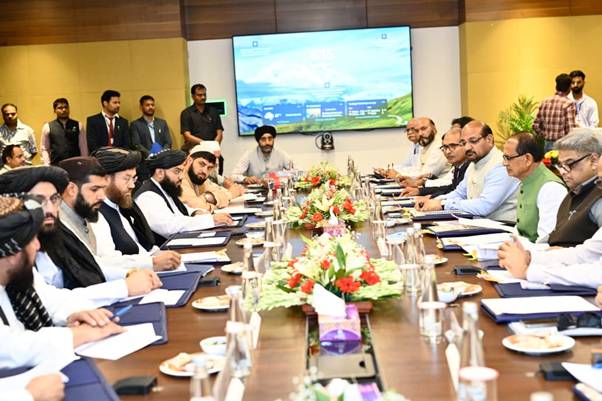
India and Afghanistan have agreed to broaden bilateral cooperation in agriculture, with a focus on food security, climate-resilient farming, irrigation, seed technology and agricultural trade, as Union Agriculture and Farmers’ Welfare Minister Shivraj Singh Chouhan held bilateral talks with Afghanistan’s Acting Minister for Agriculture, Irrigation and Livestock Mawlawi Ataullah Omari in New Delhi on Wednesday.
The meeting reviewed the existing agricultural partnership between the two countries and explored new areas of collaboration, including agricultural research, education, livestock development, capacity building, technology transfer and private-sector participation. Senior officials from the Ministry of Agriculture and Farmers’ Welfare and the Indian Council of Agricultural Research (ICAR) also participated in the discussions.
Welcoming the Afghan delegation, Chouhan said India and Afghanistan share longstanding civilisational ties and reiterated New Delhi’s commitment to supporting Afghanistan’s agricultural development by sharing scientific expertise, technological innovations and institutional experience.
Food security and crop productivity emerged as key priorities during the talks. The Afghan delegation sought India’s support in improving wheat yields through advanced seed technologies and research collaboration. India expressed readiness to supply quality wheat, maize and potato seeds, including climate-resilient and biofortified crop varieties, while extending the expertise of ICAR institutions to strengthen Afghanistan’s seed systems.
The discussions also focused on sustainable water management and climate-resilient agriculture. Afghanistan highlighted challenges arising from water scarcity and climate change and sought cooperation in irrigation and watershed development. India offered to share its experience in micro-irrigation, rainwater harvesting, farm ponds, check dams and efficient water-use technologies to help develop sustainable irrigation infrastructure.
Both sides agreed to strengthen collaboration in agricultural research and human resource development through joint research programmes, faculty and student exchanges, laboratory support and specialised training for scientists, veterinarians and agricultural extension personnel. Cooperation in horticulture, dairy, livestock, poultry, fisheries, digital agriculture, soil health and post-harvest management also figured prominently in the discussions.
Recognising the untapped potential in bilateral agri-commerce, the two countries discussed expanding trade in agricultural commodities, quality seeds and value-added products while encouraging greater business-to-business engagement and private sector participation. Afghanistan also sought India’s support in strengthening agricultural value chains and improving market access for its farm products.
The two sides agreed to work towards establishing a Joint Working Group to prepare a structured roadmap for long-term cooperation in agriculture and livestock, facilitate regular institutional engagement and identify new areas of mutual collaboration.
Concluding the meeting, Chouhan expressed confidence that the proposed initiatives would deepen bilateral ties and contribute to sustainable agriculture, food security and enhanced farmer prosperity in both countries.
For Afghanistan, this partnership provides the technical “know-how” required to achieve food security and increase the income of its farming population. For India, it secures a reliable supply of traditional agricultural imports while strengthening its regional influence through soft-power diplomacy and capacity building.
The success of these initiatives will likely be measured by the operationalization of the Joint Working Group and the subsequent rise in agricultural exports that meet international quality standards.