
Last Updated on September 11, 2026 3:53 pm by INDIAN AWAAZ
R. Suryamurthy
India’s call for deeper and more balanced intra-BRICS trade is likely to push the grouping towards a more practical phase of economic cooperation, with market access, resilient supply chains, local-currency payments and technology partnerships emerging as key areas to watch in the years ahead.
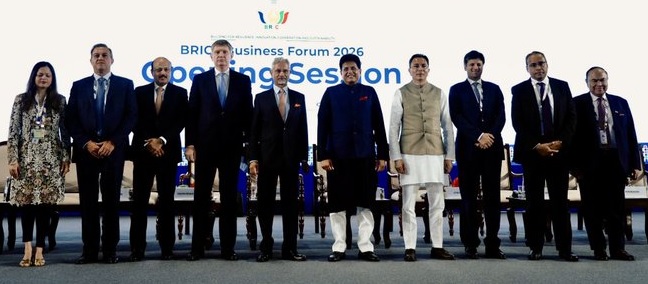
Addressing the BRICS Business Forum in New Delhi on Thursday, Commerce and Industry Minister Piyush Goyal urged member and partner countries to open markets, simplify regulatory procedures and build supply chains that “run both ways,” signalling India’s growing emphasis on converting BRICS political engagement into commercially meaningful outcomes.
The immediate challenge for BRICS will be whether its expanding economic weight can translate into greater trade integration among its members. BRICS accounts for nearly one-fourth of global trade, but trade relations within the grouping remain constrained by tariff and non-tariff barriers, regulatory differences, logistical bottlenecks and uneven access to each other’s markets.
Goyal’s emphasis on “balanced” trade could therefore become an important theme as BRICS economies seek to deepen commercial ties.
For India, the opportunity lies in expanding exports of engineering goods, electronics, pharmaceuticals, automobiles and services while securing more reliable access to raw materials and critical minerals. New Delhi sees BRICS as an increasingly important market for sectors in which India is seeking to expand its global manufacturing and export footprint.
Market access to be the next big test
The next phase of BRICS cooperation could increasingly focus on reducing the practical obstacles confronting businesses rather than merely expanding political declarations.
Goyal’s call for simpler regulations and faster clearance of consignments points to an agenda that could include greater cooperation on customs procedures, standards, certification and digital trade documentation.
This could prove particularly important for small and medium-sized enterprises, which often lack the resources to navigate complex regulatory systems across multiple markets.
Commerce Secretary Rajesh Agrawal said trade among BRICS countries had increased from $84 billion in 2003 to nearly $1.2 trillion in 2024, demonstrating the grouping’s growing commercial importance. He called for stronger global value chains through BRICS Connect, business-to-business partnerships, an annual BRICS Trade and Investment Expo and greater use of digital trade documentation.
If these proposals move beyond discussion, they could create new institutional platforms for companies to identify suppliers, investment partners and export opportunities across the expanding BRICS economic space.
Payments and local currencies in focus
One of the most closely watched areas will be financial connectivity.
Goyal urged BRICS member and partner countries to link their payment systems and promote trade in each other’s local currencies. He pointed to India’s Unified Payments Interface, which processes more than 250 billion transactions annually and is accepted in 11 countries.
The immediate direction of travel, however, appears to be towards greater interoperability between national payment systems rather than the creation of a common BRICS currency.
For businesses, the potential gains could include lower transaction costs, faster settlements and reduced dependence on third-country currencies for trade conducted between BRICS economies.
Whether such arrangements can operate at scale will depend on the development of compatible financial infrastructure, regulatory coordination, currency liquidity and confidence among banks and businesses.
Supply-chain diversification opens new opportunities
Global supply chains are also likely to become a central pillar of future BRICS economic cooperation.
External Affairs Minister S. Jaishankar said geopolitical conflicts, pandemics, climate-related disruptions and technological change were reshaping the global economic landscape. He stressed the importance of dependable logistics, diversified commercial relationships and transparent trade and investment practices.
That environment could create fresh opportunities for BRICS countries to develop alternative production networks and reduce excessive dependence on concentrated sources of supply.
For India, this could mean deeper partnerships in critical minerals, electronics, pharmaceuticals, advanced manufacturing and agricultural technologies.
Goyal specifically called for greater cooperation involving raw materials and critical minerals, areas that are expected to become increasingly strategic as countries expand electric mobility, renewable energy, battery production and advanced manufacturing.
Technology could drive the next phase
Artificial intelligence, semiconductors, digital public infrastructure and fintech are likely to move higher on the BRICS economic agenda.
Minister of State Jitin Prasada called for greater technology exchange and cooperation in artificial intelligence and highlighted India’s Semiconductor Mission 2.0, backed by incentives of about $13 billion. He also urged BRICS countries to co-develop, co-invest and co-innovate, particularly through research, development and startup ecosystems.
The success of such cooperation will depend on whether BRICS countries can develop practical mechanisms for investment, technology sharing and joint research rather than limiting cooperation to broad statements of intent.
India is also seeking to leverage its experience in digital public infrastructure. The possibility of linking digital systems and payment platforms could become a major area of experimentation, particularly among emerging economies seeking lower-cost alternatives for financial inclusion and digital service delivery.
From dialogue to delivery
As BRICS marks 20 years of institutionalised cooperation, the grouping faces a larger question: can its growing economic and political influence produce concrete results for businesses?
Jaishankar said the most useful contribution of the business community would be to provide a clear perspective on the opportunities and challenges confronting companies and identify what governments could do to address them.
That could become the defining test of the next phase of BRICS.
For India, the agenda is increasingly clear: wider market access, stronger supply chains, easier movement of professionals, digital and financial connectivity, and greater cooperation in technology and manufacturing.
As India moves towards its Viksit Bharat 2047 goal, Goyal said there was immense potential to deepen cooperation with BRICS members and partner countries.
The coming years will show whether BRICS can convert that potential into measurable commercial outcomes. The grouping has already built political visibility and expanded its economic footprint. Its next challenge will be more difficult — creating the rules, institutions and business links that can turn a vast collection of major emerging economies into a more connected and resilient economic network.