
Last Updated on March 13, 2026 9:55 pm by INDIAN AWAAZ
A R DAS / AMN
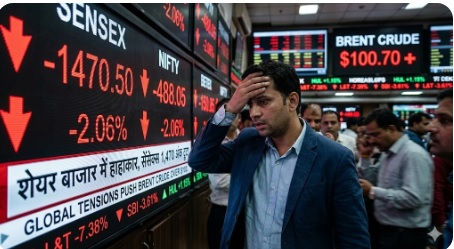
India’s equity markets ended sharply lower on Friday, 13 March 2026, extending their losing streak for the third consecutive session amid rising global uncertainties, surging oil prices, and weakness in global markets. Benchmark indices witnessed heavy selling across sectors, particularly in infrastructure, banking, and broader market stocks.
The benchmark BSE Sensex fell sharply by 1,470.50 points or 1.93 percent, closing at 74,563.92 after tumbling over 1,579 points during intra-day trading. Meanwhile, the NSE Nifty 50 dropped 488.05 points or 2.06 percent to settle at 23,151.10.
Over the last three trading sessions, the Sensex has declined 4.65 percent, while the Nifty has fallen 4.57 percent, reflecting sustained selling pressure across the market.
Global Factors Weigh on Markets
Global market sentiment remained fragile due to escalating geopolitical tensions in the Middle East and a sharp rise in crude oil prices. The international benchmark Brent Crude climbed above $100 per barrel, trading around $100.7, raising concerns over inflation and energy supply disruptions.
Asian markets also ended lower, including Nikkei 225, Hang Seng Index, Kospi, and SSE Composite Index, mirroring global risk-off sentiment.
Overnight, US markets recorded their weakest close of 2026, with the Dow Jones Industrial Average dropping nearly 740 points.
Sector-wise Performance
Banking and Financial Sector
Banking stocks were among the biggest losers of the day. The Nifty Bank remains under pressure and is now 12.96 percent below its 52-week high.
Major banking stocks such as State Bank of India declined 3.61 percent, while HDFC Bank fell 1.93 percent, contributing significantly to the Nifty’s decline.
Rising bond yields and currency weakness added to investor concerns in the financial sector.
Infrastructure and Capital Goods
Infrastructure stocks witnessed sharp selling. Larsen & Toubro emerged as the biggest drag on the benchmark index, plunging 7.38 percent during the session.
Investors booked profits in capital goods stocks amid concerns over rising input costs and slowing global economic growth.
FMCG Sector
The consumer goods sector provided some support to the market. Hindustan Unilever was among the few gainers in the Nifty 50, reflecting investor preference for defensive stocks during volatile market conditions.
Telecom Sector
Telecom stocks showed resilience amid the broader market decline. Bharti Airtel was another major gainer, supported by stable earnings outlook and strong subscriber growth.
Pharma and Export-Oriented Companies
Pharmaceutical stocks witnessed pressure. Laurus Labs fell more than 4 percent after reports indicated a sharp 47 percent decline in export revenue during February 2026.
Renewable Energy Sector
In contrast, renewable energy stocks saw selective buying. ACME Solar Holdings surged 6.43 percent after commissioning a battery energy storage system project in Rajasthan.
Infrastructure and Engineering Contracts
Infrastructure firm Ramky Infrastructure jumped nearly 4.85 percent after securing a contract from the Maharashtra Industrial Development Corporation to develop a high-tech pharmaceutical park in Raigad district.
Broader Market Weakness
The broader markets underperformed benchmark indices.
- S&P BSE MidCap Index fell 2.61 percent
- S&P BSE SmallCap Index declined 2.67 percent
Market breadth was sharply negative, with 3,348 stocks declining against only 941 gainers on the BSE.
Volatility and Currency Movement
Market volatility surged sharply, with the India VIX rising 5.23 percent to 22.65, indicating heightened uncertainty among investors.
The Indian rupee weakened further, falling 20 paise to a record low of ₹92.45 per US dollar, reflecting pressure from rising oil prices and foreign capital outflows.
Meanwhile, the US Dollar Index strengthened to 100.17, adding to emerging market currency pressures.
Commodities and Bonds
In the commodities segment, gold prices declined slightly as investors booked profits. MCX gold futures for April settlement fell 0.54 percent to ₹59,400 per 10 grams.
The yield on India’s 10-year government bond rose to 6.682 percent, reflecting tightening liquidity and global interest rate concerns.
Outlook
Market experts believe volatility may persist in the near term due to global geopolitical tensions, elevated oil prices, and uncertainty in international markets. Investors are expected to remain cautious ahead of key global developments and domestic economic indicators.
Defensive sectors such as FMCG and telecom may continue to attract buying interest, while banking, infrastructure, and mid-cap stocks could remain under pressure if global uncertainty persists.