
Last Updated on April 22, 2026 10:02 pm by INDIAN AWAAZ
Our Business Correspondent
India’s benchmark equity indices ended their three-day rally with a sharp decline on Wednesday, as heavy selling in information technology (IT) stocks and escalating geopolitical uncertainty rattled investor confidence. Weak global cues, particularly surrounding stalled diplomatic progress in West Asia, further dampened sentiment, triggering a broad-based market correction.
Volatile Session Ends in the Red
The Nifty 50 opened sharply lower at 24,470.85, reflecting overnight global weakness after the United States and Iran failed to reach a breakthrough ahead of a ceasefire deadline. The index witnessed a highly volatile trading session, oscillating between an intraday high of 24,515.95 and a low of 24,352.90. Despite intermittent recovery attempts, sustained selling pressure dragged the index below the psychologically crucial 24,400 level by the close.
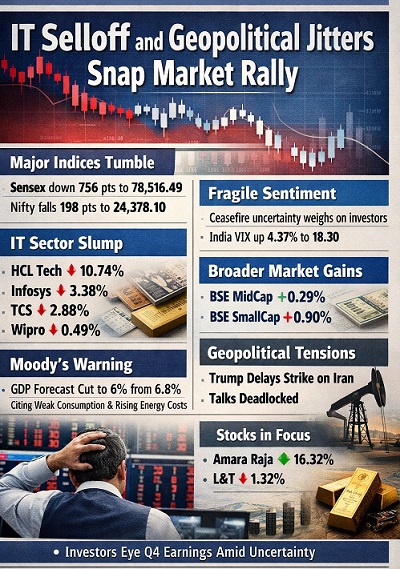
The BSE Sensex declined 756.84 points, or 0.95%, to settle at 78,516.49, while the Nifty 50 fell 198.50 points, or 0.81%, to end at 24,378.10. The correction comes after a brief rally in the previous three sessions, during which both indices had gained over 1.5%, suggesting that markets were due for consolidation amid rising uncertainty.
Investor sentiment remained fragile throughout the session. Although reports of a temporary ceasefire extension offered some relief, the absence of a concrete diplomatic resolution kept participants cautious. Market focus has now shifted decisively toward the ongoing Q4 earnings season, which is expected to provide clearer direction in the near term.
IT Stocks Lead the Selloff
The sharp downturn was primarily driven by heavy losses in IT stocks, following disappointing earnings and cautious forward guidance from sector bellwether HCL Technologies. The stock plunged over 10%, emerging as the worst performer among frontline indices.
Other major IT names also came under pressure. Infosys fell 3.38%, while companies such as Coforge, Mphasis, and Tata Consultancy Services registered declines ranging between 2–4%. The broader Nifty IT index dropped 3.89%, reflecting widespread concerns over slowing demand, delayed client decision-making, and reduced discretionary spending.
HCL Technologies’ subdued revenue growth guidance of 1–4% for FY27, below market expectations, triggered concerns about the sector’s near-term outlook. The company also reported a sequential decline in net profit, reinforcing fears of margin pressure across the IT space.
Broader Markets Show Resilience
Interestingly, the broader market demonstrated relative resilience despite weakness in large-cap indices. The BSE MidCap index edged up 0.29%, while the SmallCap index gained 0.90%, indicating selective buying in non-index stocks.
Market breadth remained positive, with 2,440 stocks advancing compared to 1,838 declines on the BSE. This suggests that while frontline indices faced pressure, investor interest in mid- and small-cap segments remained intact, possibly driven by stock-specific triggers and earnings optimism.
However, rising volatility underscored the cautious mood. The India VIX, often referred to as the market’s “fear gauge,” climbed 4.37% to 18.30, reflecting heightened uncertainty in the near term.
Macro Pressures Add to Concerns
On the macroeconomic front, concerns intensified after Moody’s downgraded India’s GDP growth forecast for FY27 to 6% from 6.8%. The revision reflects weaker consumption trends, slower industrial output, and rising energy costs linked to geopolitical tensions in West Asia.
Elevated crude oil prices are expected to increase India’s import bill and add to inflationary pressures, given the country’s heavy reliance on Middle Eastern energy supplies. Sectors such as aviation, cement, and chemicals are particularly vulnerable to rising input costs, which could squeeze margins in the coming quarters.
At the same time, government finances may face strain due to higher subsidy requirements, although strong foreign exchange reserves and resilient services exports are expected to provide some cushion.
Key Market Indicators
Bond yields and currency movements also reflected the cautious sentiment. The yield on India’s 10-year government bond rose to 6.915%, indicating tightening financial conditions. Meanwhile, the Indian rupee weakened slightly to 93.78 against the US dollar.
In the commodities space, gold prices gained 1%, signaling a flight to safety amid global uncertainty. Brent crude oil prices rose to nearly $99 per barrel, driven by supply concerns linked to geopolitical tensions.
Global Cues Remain Mixed
Global markets offered mixed signals. While US Dow Jones futures indicated a strong opening for Wall Street, European markets declined due to renewed inflation concerns, particularly in the United Kingdom where inflation accelerated to 3.3%.
Asian markets closed on a mixed note, reflecting cautious optimism over ceasefire developments but lingering concerns about diplomatic uncertainty. Notably, Japan’s Nikkei index touched a record high, supported by robust export data.
Meanwhile, US markets had ended lower overnight, as investors reacted negatively to the lack of progress in geopolitical negotiations. The possibility of prolonged tensions continues to weigh on global risk appetite.
Stocks in Focus
Beyond IT, several stocks witnessed sharp movements driven by earnings and corporate developments. Companies like Persistent Systems and Tech Mahindra declined despite reporting growth, as investor expectations remained high.
On the positive side, Cyient DLM surged following strong earnings, while Amara Raja Energy & Mobility rallied sharply on optimism surrounding its expansion into lithium-ion battery manufacturing.
Meanwhile, infrastructure major Larsen & Toubro slipped after announcing a green ammonia partnership, and pharmaceutical firm Lupin saw marginal losses despite regulatory progress in the US market.
Earnings and Geopolitics in Focus
Looking ahead, market direction is likely to remain influenced by two key factors: corporate earnings and geopolitical developments. While earnings announcements will provide stock-specific triggers, broader market sentiment will hinge on clarity around global tensions and commodity price trends.
Investors are expected to remain cautious in the near term, with volatility likely to persist. However, strong domestic fundamentals and selective sectoral opportunities may continue to offer support, particularly in mid- and small-cap segments.
For now, the market appears to be navigating a delicate balance between global risks and domestic resilience, with sentiment likely to remain sensitive to both earnings surprises and geopolitical headlines.