
Last Updated on September 27, 2026 12:29 am by INDIAN AWAAZ
Staff Reporter / New Delhi
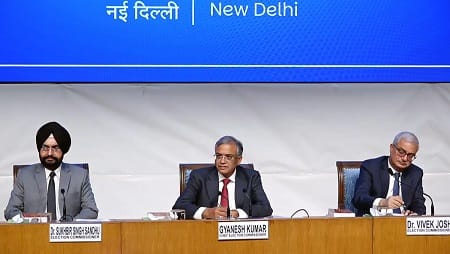
The full bench of Election Commission met on Saturday against the backdrop of mounting furore over reported differences within the poll panel, the functioning of ECINet and the Special Intensive Revision of electoral rolls.
Far from being a routine full-bench meeting, the meetings appeared largely at issuing clarifications on the controversies surrounding the Commission, including the letter written by two Election Commissioners to Cabinet Secretary T V Somanathan.
The meeting came days after The Indian Express reported that Election Commissioners Sukhbir Singh Sandhu and Vivek Joshi had raised repeated objections over the functioning of the electoral-roll software and had separately approached the Cabinet Secretary over an administrative order.
The Commission ordered a review of ECINet by a committee headed by a Senior Deputy Election Commissioner and including an independent expert from an IIT/IIIT.
In a press note, released after the meeting, the poll body said, “The work redistribution orders issued by the concerned officer were not actually implemented after the orders of the two Commissioners and the oversight over the IT division by the DEC was never actually withdrawn.”
The clarification comes after a report by The Indian Express, based on internal documents and interviews, said Sandhu and Joshi had separately written to the cabinet secretary over changes in work allocation. The report said the two commissioners had objected to changes that they believed reduced their oversight of the IT systems managing electoral rolls.
What is the row about
The issue centres on ECINet, which the ECI launched on January 22 as a unified technology platform bringing more than 40 applications and portals under one system. At its launch, Chief Election Commissioner Gyanesh Kumar said the platform had been built in accordance with the law, while Director General (IT) Seema Khanna said it would “enhance transparency, credibility and public trust”.
The Indian Express report, however, said concerns were later raised over the access available to state-level election officials responsible for updating electoral rolls. Sandhu and Joshi reportedly flagged what Joshi described as the “gradual centralisation of the electoral roll database” and questioned whether ECINet was restricting the statutory powers of officers responsible for preparing and finalising voter lists.
The two commissioners reportedly raised their concerns on multiple occasions and also copied their notes to CEC Gyanesh Kumar. Joshi had proposed an audit involving an outside IIT expert to verify that only the concerned statutory authorities had credentials to make changes to the voter database. Sandhu, meanwhile, questioned the centralisation of access control and sought full access for statutory authorities.
What Election Commission said
Addressing the issue in its key meet on Saturday, the Election Commission said, “Field officers have role-based access to the ECINET system as per their statutory powers. A Committee headed by Sr Deputy Election Commissioner (DEC) and including an independent expert from IIT/IIIT will review the ECINET to double-check that it complies with the provisions of the Acts and Rules and submit report to the Commission.”
The Election Commission said several upgradations have already been made to the portal based on the inputs from State CEOs over the past few months. “In case, any further flexibility is required by the field officers, that will be made operational. Henceforth, all the new initiatives about IT modules and portals will be discussed in the Committee of Officers (COO) before approval by the Commission.” it said.
The ECI has maintained that ECINet is a decentralised platform and that statutory functions remain with designated officials in the field. It said Booth Level Officers (BLOs), Assistant Electoral Registration Officers (AEROs), Electoral Registration Officers (EROs), District Election Officers (DEOs) and Chief Electoral Officers (CEOs) perform their respective functions through individual IDs and passwords.
The developments have meanwhile triggered protests and a widening political campaign against Chief Election Commissioner Gyanesh Kumar.
The CJP has announced plans for a nationwide agitation from Mumbai on October 2 if Kumar does not resign, while Opposition parties have stepped up efforts to coordinate their response to the ECI and the SIR controversy. The INDIA bloc is also expected to chalk out its next course of action in the coming days.
The Commission said Chief Electoral Officers had been directed to facilitate such applications and that CEOs, DEOs and EROs would immediately launch special drives to enrol such electors.
The Commission also said the declaration attached to Form 6 specifically for SIR had been upheld by the Supreme Court. Outside the SIR process, it said the forms prescribed under the Registration of Electors Rules, 1960, would continue to apply.
The ECI further said that in Goa, where voters were left out of the electoral rolls, Booth Level Officers had been directed to make house-to-house visits to collect forms. Of 97 voters identified in the exercise, 81 had already filed Form 6 for inclusion.
In its post-meeting press note, the ECI also addressed the Cabinet Secretary letter, saying it was not related to any policy matter of the Commission or its IT division but concerned the functioning of an officer on deputation. The Commission maintained that the work-reallocation orders issued by the officer were not implemented and that oversight of the IT division by the Deputy Election Commissioner was never withdrawn.