
Last Updated on October 23, 2026 9:10 pm by INDIAN AWAAZ
Zakir Hossain from Dhaka
Bangladesh’s Hindu community celebrated Durga Puja, its biggest religious festival, in a largely peaceful and festive atmosphere this year, marking a significant political and social moment for the country under Prime Minister Tarique Rahman’s Bangladesh Nationalist Party (BNP) government.
The celebrations, which began on October 16 and concluded with idol immersion on Bijoya Dashami on October 21, took place amid heightened security, increased government assistance and unprecedented political outreach by the new administration.
What made this year’s festival particularly significant was the involvement of both the ruling BNP and its principal political rival, Jamaat-e-Islami, whose leaders pledged support for the Hindu community despite their differences on national politics.
With 33,851 Durga Puja mandaps organised nationwide, including 258 in Dhaka, the festival drew large crowds, colourful processions and participation from people of different religious backgrounds.
For many Hindus, the celebrations offered a welcome sense of reassurance after years marked by episodes of communal violence, political uncertainty and concerns over religious security.
Tarique Rahman’s government steps up security
The festival was widely viewed as an early test of Prime Minister Tarique Rahman’s commitment to protecting religious minorities after the BNP returned to power following Bangladesh’s February 2026 parliamentary elections.
The government introduced extensive security arrangements involving police, Border Guard Bangladesh (BGB), Ansar personnel and specialised security units.
More than two lakh Ansar and Village Defence Party personnel were mobilised, with additional response teams deployed to prevent violence and respond quickly to emergencies.
Security measures included CCTV surveillance, intelligence monitoring, special patrols, emergency response teams and coordination with local puja committees.
Prime Minister Tarique personally instructed BNP lawmakers to remain vigilant and cooperate with local authorities to ensure peaceful celebrations.
The administration also increased government funding for Durga Puja mandaps from Tk 4 crore to Tk 5 crore and extended the festival holiday to three days.
Combined with the regular Friday-Saturday weekend, the decision provided a five-day holiday from October 20 to 24, fulfilling a longstanding demand of the Hindu community.
Home minister Salahuddin Ahmed described this year’s celebrations as unprecedented in terms of the number of mandaps, government funding, holidays and festive participation.
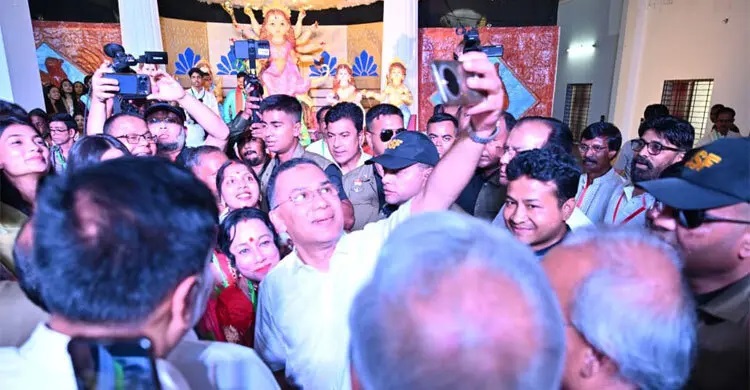
In a politically significant gesture, Tarique visited Durga Puja venues in Rangpur, Rajshahi and Chattogram on October 20, meeting Hindu devotees and pledging equal rights and security for all citizens.
During his visit to Rajshahi, he said, “People of different faiths have coexisted peacefully in our country for thousands of years. We must ensure that this tradition of harmony and peace continues for another thousand years.”
The prime minister’s visits outside Dhaka were particularly notable because they brought the government’s message of religious coexistence directly to Hindu communities beyond the capital.
Opposition Jamaat also extends support
The role of Bangladesh Jamaat-e-Islami, the country’s main opposition party, was another important aspect of this year’s celebrations.
Jamaat chief and Leader of the Opposition Shafiqur Rahman met representatives of Hindu organisations at his official residence in Dhaka on October 14 and called for joint efforts by the government and opposition to safeguard their rights.
“None of us is a minority or majority in this country. Hindus, Muslims, Buddhists, Christians and ethnic communities are all Bangladeshis and proud citizens of this country,” Jamaat secretary general Mia Golam Porwar quoted him as saying.
During the meeting, Hindu representatives raised concerns over discrimination, security and difficulties facing their community.
Porwar said the representatives had also appreciated assistance provided by Jamaat leaders and activists in protecting temples and religious ceremonies since the political upheaval of August 2024.
On October 15, Shafiqur issued another statement saying Jamaat would play a responsible role during Durga Puja and urging government agencies to ensure that devotees could celebrate without obstruction.
He said party leaders and activists would extend cooperation to people of all religious communities.
The outreach was politically significant given Jamaat’s Islamist identity and its historically contentious relationship with Bangladesh’s secular political forces.
How does this year’s Puja compare with Hasina’s rule?
The relatively peaceful festival has also revived debate over the record of former Prime Minister Sheikh Hasina’s Awami League, which ruled Bangladesh for more than 15 consecutive years before being ousted in August 2024.
During Hasina’s tenure, the Awami League frequently portrayed itself as the principal defender of Bangladesh’s Hindu minority and secular traditions.
However, the country’s communal violence record during that period was mixed.
The most serious recent episode occurred during Durga Puja in October 2021, when violence triggered by allegations of desecration of the Holy Quran spread across several districts.
Hindu temples, idols, homes and businesses were attacked, and at least six people were killed in the violence. The incidents caused widespread alarm in Bangladesh and neighbouring India.
The Hasina government subsequently strengthened security arrangements, deployed additional forces and arrested suspects.
Durga Puja in 2022 passed off largely peacefully, with Hindu community leaders thanking Hasina and her administration for ensuring security.
A similar situation was reported in 2023, when the Bangladesh Puja Udjapan Parishad publicly expressed gratitude to Hasina and law enforcement agencies after the festival concluded peacefully.
The difficult transition years of 2024 and 2025
The political upheaval following Hasina’s removal created new uncertainty for Bangladesh’s Hindu community.
During the unrest in August 2024, attacks on Hindu homes, businesses and temples were reported across the country, triggering concern in India and international calls for minority protection.
That year’s Durga Puja took place under the interim government led by Nobel laureate Muhammad Yunus.
Police reported 35 untoward incidents linked to the festival by October 11, registering 11 cases and arresting 17 people.
Although authorities maintained heightened security, several Hindu devotees expressed anxiety over their safety.
In 2025, the second Durga Puja under Yunus’s interim administration, police reported 49 unpleasant incidents, including idol vandalism and attempts to disrupt worship, by September 30.
However, the festival also concluded without widespread communal violence. Government reports described the celebrations as peaceful overall and acknowledged security assistance from political parties, including the BNP and Jamaat.
A political message to the Awami League
The success of this year’s celebrations has nevertheless provided the BNP government with an opportunity to challenge the Awami League’s longstanding political narrative about the security of Hindus.
On Thursday (October 22), Information and Broadcasting Minister Andaleeve Rahman said the Awami League had previously claimed that Hindu religious festivals would not be celebrated safely if the BNP returned to power.
“However, Hindus celebrated their religious festivals this year peacefully and amid festivities,” he said.
The minister described this year’s Durga Puja as among the most beautiful and secure celebrations he had witnessed in Bangladesh.
Who deserves credit for the peaceful celebrations?
The peaceful conclusion of this year’s Durga Puja reflects several contributions rather than the actions of a single political party.
Concerns over attacks have not disappeared
Despite the positive atmosphere, Hindu organisations cautioned against treating the festival’s peaceful conclusion as evidence that minority security concerns had been resolved.
Ahead of the celebrations, the Bangladesh Puja Udjapan Parishad reported 34 incidents involving idol vandalism, temple attacks and related violence, saying arrests had been made in 11 cases.
The incidents were reported in districts including Sylhet, Rajbari, Panchagarh, Netrokona and Tangail.
Police subsequently said their examination of several incidents found no evidence of an organised conspiracy to disrupt communal harmony, citing causes ranging from local disputes and theft to accidental damage.
Bangladesh Puja Udjapan Parishad general secretary Santosh Sharma had earlier stressed that protecting religious minorities must extend beyond the festival.
“Security cannot be a concern for only the five days of Puja. We must ensure security for all 365 days of the year,” he said.
The organisation has continued to demand stronger minority-protection measures, accountability for attacks and institutional safeguards.
For Bangladesh’s Hindu community, the most important measure of success may ultimately be whether this year’s sense of safety extends beyond Durga Puja.
The celebrations have demonstrated that a BNP-led government and a Jamaat-led opposition can publicly support the protection of a major Hindu religious festival.
Whether that cooperation becomes a lasting commitment to religious equality and security will be determined not by a single successful festival, but by how Bangladesh protects its minorities throughout the year.