
Last Updated on August 28, 2026 11:15 pm by INDIAN AWAAZ
Aafreen Hussain / Kolkata
The 73rd foundation day of the Congress-affiliated Chhatra Parishad on August 28 was marked by programmes across West Bengal, but this year’s celebrations stood out against a sharply changing student political landscape. Alongside the Congress organisation’s traditional observance, the Trinamool Congress’s student wing, Trinamool Chhatra Parishad (TMCP), held separate programmes after an internal organisational dispute split the celebration between the Mamata Banerjee led camp and the rebel faction associated with Ritabrata Banerjee.
The Congress Chhatra Parishad’s central programme was held at Kolkata’s historic Mahajati Sadan, with senior Congress leaders, former and present student leaders and supporters in attendance. Former MP and professor Pradip Bhattacharya was the principal speaker, while West Bengal Congress president Shubhankar Sarkar, former MP Deepa Dasmunsi, Komud Bhattacharya and other leaders addressed the gathering.
The Congress celebration was presented as a continuation of the organisation’s historical legacy. Chhatra Parishad traces its foundation to August 28, 1953, and its decades-long student politics spans the period of the Congress government, the long Left Front era and the subsequent rise of Trinamool Congress.
The contrast with the Left Front period is significant. During the decades when the Left Front dominated Bengal, student politics was largely shaped by the powerful presence of the CPI(M)-backed Students’ Federation of India (SFI), while Chhatra Parishad and other organisations operated as competing political forces. Student-union elections were a regular and important feature of campus politics during much of that period, making colleges and universities significant arenas of organised student competition.
The political scenario changed considerably after Trinamool Congress came to power in 2011. Over the years, regular student-union elections became increasingly limited, while TMCP emerged as the dominant student organisation across many campuses. Consequently, August 28 celebrations in recent years were largely associated with the Trinamool student organisation rather than the competitive multi-party student politics that characterised earlier decades.
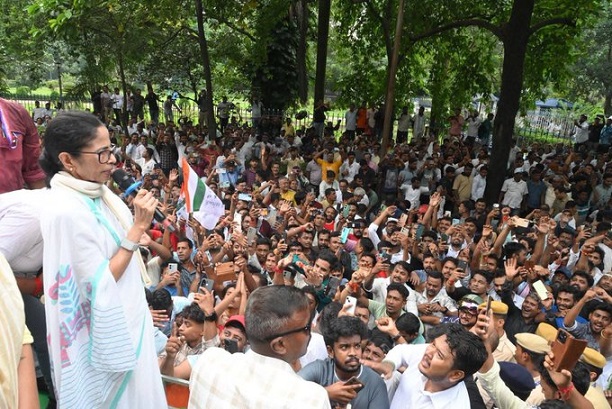
This year, however, TMCP’s own foundation-day programme became a symbol of its internal tensions. The Mamata Banerjee-led camp and the Ritabrata Banerjee-backed rebel faction held separate events following a dispute over the organisation’s control and programme arrangements. One programme was held at Rani Rashmoni Avenue, while the other was organised on Cathedral Road, following legal intervention over the venues.
The division gave August 28 an unusual political dimension: the Congress Chhatra Parishad celebrated its 73-year legacy, while TMCP marked the same day amid an internal organisational confrontation.
The developments underline how dramatically Bengal’s student politics has evolved from competitive campus elections during the Left era, to Trinamool dominance after 2011, and now to visible organisational divisions within the ruling camp’s student wing. The absence of regular student-union elections has consequently emerged as one of the central issues in the latest debate over democratic student politics in West Bengal.