
Last Updated on October 26, 2025 10:44 pm by INDIAN AWAAZ
As the campaign intensifies, Bihar’s voters stand at a crossroads. Will they choose a model that promises social protection and inclusivity, or one that pledges technological progress and economic reform?
Our Correspondents | Patna
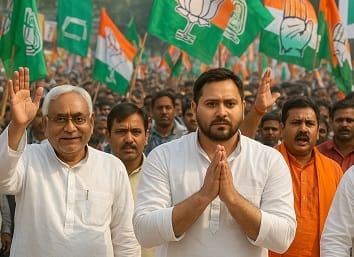
As Bihar Elections coming closer, the political atmosphere is thick with promises and counter promises. Both the Mahagathbandhan (Grand Alliance) and the ruling NDA have launched a flurry of announcements, each seeking to convince voters that their vision will define Bihar’s future.
Tejashwi’s populist pitch: Empowering the grassroots
Mahagathbandhan’s chief ministerial candidate Tejashwi Prasad Yadav unveiled a string of welfare measures aimed at strengthening Bihar’s grassroots governance system. Speaking in Patna, Yadav promised ₹50 lakh insurance coverage for all Panchayati Raj representatives, along with a twofold increase in their honorarium.
He also proposed a pension scheme for retired panchayat members, higher commissions for Public Distribution System (PDS) dealers, and a ₹5 lakh financial support package over five years for traditional workers such as barbers, potters, and blacksmiths.
Yadav said these initiatives would bring dignity and security to those who form the foundation of local governance. “Our panchayat representatives and rural workers are the soul of Bihar’s democracy. They deserve respect, protection, and fair compensation,” he remarked.
Political observers see this as a calculated outreach to village-level influencers who play a vital role in mobilizing voters. It also revives the social justice narrative that has long powered the RJD’s base among marginalized and rural communities.
Amit Shah’s counterpoint
Meanwhile, the BJP’s top strategist and Union Home Minister Amit Shah presented a contrasting vision. Addressing rallies in north Bihar, Shah reiterated that only the NDA’s “double-engine government”—the combined efforts of the Centre and the State—can steer Bihar toward sustainable progress.
He said Prime Minister Narendra Modi and Chief Minister Nitish Kumar share a clear roadmap for Bihar’s transformation. “We are committed to making Bihar a hub for artificial intelligence, digital data, and agri-based industries,” Shah declared. He argued that long-term development, not short-term populism, is the key to lifting Bihar from the shadows of backwardness.
Shah also highlighted NDA’s record in improving infrastructure, electricity access, and women’s empowerment programs, contrasting it with what he termed as “the empty promises of the RJD-Congress combine.”
Promises versus performance
The two competing narratives reflect Bihar’s dual realities — the need for immediate welfare and the aspiration for long-term modernization. While Tejashwi’s promises resonate with rural voters seeking security and recognition, Shah’s message appeals to the aspirational youth and urban electorate eager for investment, innovation, and industrial growth.
Economists note that both approaches carry risks. Expanding welfare could strain Bihar’s already limited budget, while promises of high-tech industries may take years to materialize. The real challenge lies in bridging the gap between populist welfare and sustainable development.
The road ahead
As the campaign intensifies, Bihar’s voters stand at a crossroads. Will they choose a model that promises social protection and inclusivity, or one that pledges technological progress and economic reform?
With both alliances sharpening their narratives, the 2025 Bihar Assembly election is shaping up not just as a contest for power — but as a referendum on what kind of future the people of Bihar truly want.As the campaign intensifies, Bihar’s voters stand at a crossroads. Will they choose a model that promises social protection and inclusivity, or one that pledges technological progress and economic reform?
Our Correspondents | Patna
As Bihar Elections coming closer, the political atmosphere is thick with promises and counter promises. Both the Mahagathbandhan (Grand Alliance) and the ruling NDA have launched a flurry of announcements, each seeking to convince voters that their vision will define Bihar’s future.
Tejashwi’s populist pitch: Empowering the grassroots
Mahagathbandhan’s chief ministerial candidate Tejashwi Prasad Yadav unveiled a string of welfare measures aimed at strengthening Bihar’s grassroots governance system. Speaking in Patna, Yadav promised ₹50 lakh insurance coverage for all Panchayati Raj representatives, along with a twofold increase in their honorarium.
He also proposed a pension scheme for retired panchayat members, higher commissions for Public Distribution System (PDS) dealers, and a ₹5 lakh financial support package over five years for traditional workers such as barbers, potters, and blacksmiths.
Yadav said these initiatives would bring dignity and security to those who form the foundation of local governance. “Our panchayat representatives and rural workers are the soul of Bihar’s democracy. They deserve respect, protection, and fair compensation,” he remarked.
Political observers see this as a calculated outreach to village-level influencers who play a vital role in mobilizing voters. It also revives the social justice narrative that has long powered the RJD’s base among marginalized and rural communities.
Amit Shah’s counterpoint
Meanwhile, the BJP’s top strategist and Union Home Minister Amit Shah presented a contrasting vision. Addressing rallies in north Bihar, Shah reiterated that only the NDA’s “double-engine government”—the combined efforts of the Centre and the State—can steer Bihar toward sustainable progress.
He said Prime Minister Narendra Modi and Chief Minister Nitish Kumar share a clear roadmap for Bihar’s transformation. “We are committed to making Bihar a hub for artificial intelligence, digital data, and agri-based industries,” Shah declared. He argued that long-term development, not short-term populism, is the key to lifting Bihar from the shadows of backwardness.
Shah also highlighted NDA’s record in improving infrastructure, electricity access, and women’s empowerment programs, contrasting it with what he termed as “the empty promises of the RJD-Congress combine.”
Promises versus performance
The two competing narratives reflect Bihar’s dual realities — the need for immediate welfare and the aspiration for long-term modernization. While Tejashwi’s promises resonate with rural voters seeking security and recognition, Shah’s message appeals to the aspirational youth and urban electorate eager for investment, innovation, and industrial growth.
Economists note that both approaches carry risks. Expanding welfare could strain Bihar’s already limited budget, while promises of high-tech industries may take years to materialize. The real challenge lies in bridging the gap between populist welfare and sustainable development.
The road ahead
As the campaign intensifies, Bihar’s voters stand at a crossroads. Will they choose a model that promises social protection and inclusivity, or one that pledges technological progress and economic reform?
With both alliances sharpening their narratives, the 2025 Bihar Assembly election is shaping up not just as a contest for power — but as a referendum on what kind of future the people of Bihar truly want.