
Last Updated on October 14, 2025 9:11 pm by INDIAN AWAAZ
Zakir Hossain from Dhaka
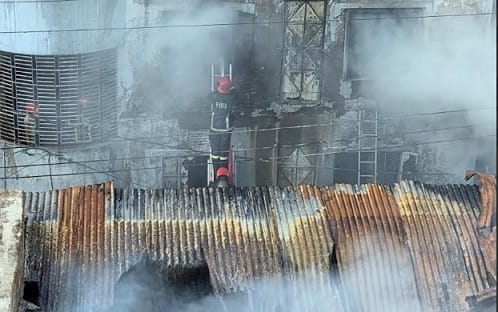
At least 16 people were killed and several others injured after a devastating fire swept through a garment factory and an adjoining chemical warehouse in the Mirpur area of Bangladesh’s capital on Tuesday, officials said.
The blaze erupted around 11:40am on the third floor of a seven-storey building housing a garment unit before spreading rapidly to a nearby warehouse that stored bleaching powder, plastic, and hydrogen peroxide, fire service officials confirmed.
“Nine bodies have been recovered from the second and third floors of the garment factory,” said Fire Service and Civil Defence Director (Operation and Maintenance) Lt Col Mohammad Tajul Islam Chowdhury. “We suspect they died after inhaling toxic gas.”
Fire Service officer Talha Bin Jashim said the first rescue team reached the site within 16 minutes of receiving the alarm. “Nine firefighting units managed to bring the blaze under control after nearly three hours,” he said, adding that “several others were injured, and the number of casualties might go up.”
The two affected buildings are located side by side in front of Bangladesh University of Business and Technology (BUBT) in Rupnagar. Witnesses reported hearing small explosions before thick smoke engulfed the area.
Authorities said the cause of the fire has yet to be determined. However, preliminary information suggests that the adjoining chemical warehouse may have been operating illegally. “We don’t know about the licence yet, but as far as we’ve heard, it is illegal,” Chowdhury said. “We will be able to confirm after the investigation.”
Rescue operations continued into the night as firefighters searched for any remaining victims. Police and army personnel have reportedly joined efforts to locate the owners of the factory and warehouse, who are yet to be identified.
Bangladesh’s garment sector, which employs over four million workers—most of them women—and earns nearly $40 billion in annual exports, has faced repeated scrutiny over poor safety standards.
The country has witnessed several industrial tragedies in recent years. In 2013, the Rana Plaza factory collapse killed more than 1,100 people. Earlier, in 2012, a fire at a Dhaka garment factory killed 117 workers, and in 2019, a blaze in Old Dhaka claimed at least 67 lives.
Experts have long urged the government to tighten monitoring and enforcement of fire and building safety codes, warning that recurring accidents continue to endanger thousands of workers in one of Bangladesh’s most vital industries.