
AMN / Jaipur
The future of ear, nose and throat care in India will no longer be limited to just treating the disease, but will move towards early detection, prevention and personalized treatment as per the patient’s needs.
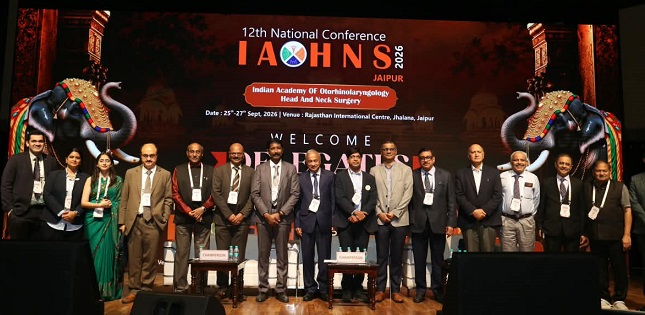
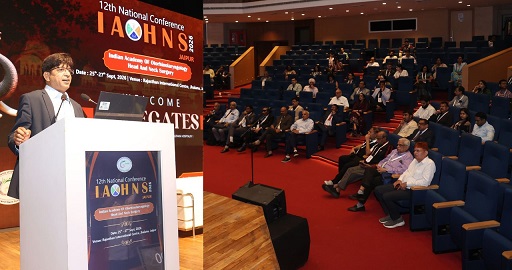
The 12th conference of the Indian Academy of Otolaryngology and Head-Neck Surgery (IAOHNS) was formally inaugurated on Friday at the Rajasthan International Centre (RIC), Jhalana, Jaipur. In this conference organized from 25 to 27 September, experts from all over the country are discussing topics related to ENT, Head and Neck Surgery, Neurotology, Rhinology, Otology, Pediatrics, Allergy, Artificial Intelligence (AI) and modern surgical techniques. On the first day, lectures, symposiums, panel discussions, guest lectures and instructional courses were organized in five different halls, in which doctors, students and engineers participated.
Dr. Pawan Singhal, senior professor in the ENT department at SMS Hospital and scientific chairman of the conference, said, “Robots are rarely seen at ENT conferences. Robotic surgery for ENT and head, mouth, and throat diseases is not as prevalent in the country as it is abroad.”
He stated that the conference will provide practical and scientific discussions on new technologies and modern treatment methods in robotic surgery. Special attention is also being paid to aspects such as improved visibility, instrument movement, and precision functionality in robotic surgery.
Special discussion on AI and skull base surgery on the first day
The conference’s inaugural session featured a keynote lecture by Dr. Arun Kumarendu on Neonatal Brain Development in the main auditorium. Dr. Rajesh Vishwakarma then delivered a lecture on lifestyle approaches to hearing loss management in India, from newborns to the elderly. In the former President’s Oration, Major General M.D. Venkatesh spoke on the journey from clinical practice to academic leadership and the key aspects involved.
A special symposium on Collaborative Practice for ENT surgeons was organised in which experts discussed topics like Cardiopulmonary Bypass, EXIT procedure, Interventional Radiology, Head and Neck Reconstruction, Endoscopic Anterior Skull Base Surgery, Pre-operative Embolization and Data Management and Analysis.
Additionally, a special guest lecture on Artificial Intelligence (AI) and Head & Neck Oncology was held. Scientific insights were shared on the current and future potential of AI in the diagnosis, treatment, and care of head and neck cancer.
Expert discussion on dizziness and neurotology
On the first day, during the neurotology session, experts discussed various types of dizziness and balance problems related to the vestibular system and the brain. The causes of dizziness, complications related to the balance system, and important aspects of their clinical evaluation were explained.
Dr. Pawan Singhal shared technical information on Meniere’s Disease, explaining that it is a disorder of the inner ear, which can cause symptoms like severe dizziness (vertigo), ringing in the ears (tinnitus), and hearing loss.
Focus on children, thyroid, and head and neck surgery
Another important session at the conference discussed various topics related to ear, nose, and throat (ENT) diseases in children and newborns. Information was shared on important aspects including pediatric tracheostomy, point-of-care ultrasound, pediatric airway, swallowing difficulties, hearing screening in the NICU, ENT evaluation in children with laryngomalacia and syndrome, among others.
At the same time, in the sessions related to thyroid and head and neck surgery, modern techniques and their nuances of nodular goiter surgery, thyroid surgery, post-laryngectomy rehabilitation and trans-vestibular endoscopic thyroidectomy were discussed.
Trans-vestibular endoscopic thyroidectomy is a modern and advanced surgical technique for removing the thyroid gland, commonly known as “scarless” thyroid surgery. It avoids the traditional incision in the patient’s neck, leaving no visible scar.
Lectures on Endoscopic Ear Surgery and Rhinology
A special scientific session on endoscopic ear surgery was held at the conference. Experts discussed modern surgical techniques such as facial nerve decompression surgery, endoscopic eardrum surgery, endoscopic ear bone surgery, and stapedotomy, and shared information on their practical aspects and uses in treatment.
In the Rhinology session, experts discussed important surgical techniques such as anterior skull base, nasal complications after endoscopic skull base surgery, endoscopic orbital decompression, and posterior nasal neurectomy. Information was shared on the use of modern endoscopic techniques in the treatment of complex conditions involving the skull base and nose.
Discussion on allergies and modern treatment techniques
In the Allergy and Rhinology session, experts discussed modern treatment options for allergic rhinitis and immunotherapy. Lectures covered important aspects of skin prick testing, sublingual immunotherapy, and the use of biologics.
Along with this, scientific information and treatment aspects were also shared on modern endoscopic techniques like Eustachian tuboplasty, flexible laryngoscopy, fiberoptic endoscopic examination of swallowing and sialoendoscopy.
Sessions on research and social media for doctors
The conference’s instructional courses included training on selecting a thesis topic, writing protocols, research grants, and publications. A special panel discussion was also held on the use of social media for doctors.
On the topic “Social Media for Doctors: Boon or Bane,” experts discussed the utility of social media in the medical field, its impact, and various related aspects. During this discussion, they also discussed ways to share medical achievements, disease diagnoses, and other information through social media.
Artificial intelligence, digital diagnostics, tele-ENT and minimally invasive techniques are likely to play a key role in making patient care more accessible and tech-driven in the coming years, said ENT surgeon Dr Anubhuti Dhanuka at a technical session at the 12th conference of the Indian Academy of Otolaryngology and Head-Neck Surgery (IAOHNS) on Saturday.
Dr. Dhanuka said that AI can support endoscopy, imaging, and voice analysis, helping ENT surgeons identify subtle changes associated with disease earlier. In laryngology in particular, digital voice analysis, stroboscopy, and AI-assisted diagnostics have the potential to make objective voice assessment more accessible even outside of major cities.
Dr. Dhanuka said that the high burden of allergic rhinitis, chronic sinusitis, hearing loss, and sleep-disordered breathing in India is expected to drive demand for multidisciplinary ENT care in the future. At the same time, cochlear implants and new-generation hearing technologies are also likely to reach more people as technology and indigenous innovation advance.
He added that pediatric airway and sleep medicine could also become an important area of focus in the future, especially with increasing awareness of obstructive sleep apnea and airway disorders in children. Furthermore, the increased use of office-based procedures, lasers, and minimally invasive interventions may lead to a shift in some ENT treatments away from the operating theater.
Dr. Dhanuka also highlighted the importance of tele-ENT and remote diagnostics for the future. These technologies can help bridge the significant gap in access to specialist services between metropolitan and smaller cities, providing relief to both physicians and patients. This could open new avenues for providing expert advice to patients in areas where the availability of ENT specialists is limited.
Dr. Dhanuka emphasized the role of doctors as central to this transformation, saying, “Technology will never replace surgeons—the future belongs to ENT specialists who combine their precise surgical skills with data, AI, and multidisciplinary decision-making. Today’s era is not just about wielding a scalpel, but about understanding every aspect of a patient’s complex condition and choosing the right course of action. When a doctor combines cutting-edge data analytics and AI-driven insights with their traditional expertise and sensitivity, not only does the accuracy of treatment increase, but patient lives are also saved.”
He said that the ENT specialist of the future will not only be a surgeon, but will also be a bridge between modern technology and human compassion, making even the most complex decisions easier. This means that technology cannot replace surgeons. The future belongs to ENT specialists who can combine surgical skills with data, AI, and multidisciplinary decision-making.
He said the next decade of Indian ENT medicine will be defined not just by better machines, but by smarter, earlier and more accessible patient care.
A discussion focused on where we are lagging behind in postgraduate training, with doctors sharing their experiences. The session was moderated by Dr. Amit Goyal of AIIMS, Jodhpur.
Moderating the session, Dr. Prahlad Duggal of Amritsar said that improving quality of life after head and neck cancer treatment isn’t just about physical recovery, but also about finding a renewed energy and balance in life. Swallowing, speaking, and neck stiffness can be challenging after surgery or radiation. Speech therapy, physiotherapy, and a soft diet rich in proper nutrition play a vital role in overcoming these challenges.
Dr. Duggal said that drinking small amounts of water throughout the day and maintaining good oral hygiene are essential to prevent dryness of the salivary glands. Most importantly, while accepting physical changes, take care of your mental health—family support, meditation, and counseling can help restore self-confidence. Overcoming cancer is the beginning of a new life, where patience, proper rehabilitation, and a positive attitude make each day better and healthier.
Dr. Pawan Singhal, senior professor of the Ear, Nose, and Throat Department at SMS Hospital and scientific chairman of the conference, stated that several sessions on ENT were held on the second day of the conference. These included discussions on what life is like for initially deaf children. Sessions focused on blood vessel tumors, stages of cancer, discussions on postgraduate education in medical science, the role of ENT in the school base, dizziness, and sleep apnea, among other topics.
ENT was discussed in these technical sessions
More than 30 sessions were organised including poster session, thesis competition, stages of thyroid cancer, surgical management, oral cancer surgery, robotic surgery.