
Zakir Hossain from Dhaka
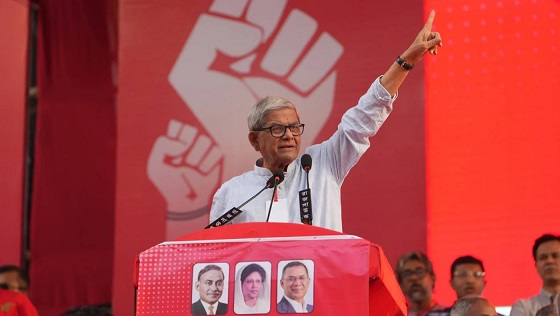
From an economics lecturer and left-wing student activist to one of Bangladesh’s most recognisable political figures, Mirza Fakhrul Islam Alamgir is now on course for Bangabhaban, the presidential palace, after a public life spanning more than five decades.
Bangladesh’s ruling Bangladesh Nationalist Party (BNP) on Thursday formally nominated the 78-year-old veteran as its candidate for the August 20 presidential election. Prime Minister and BNP Chairman Tarique Rahman announced the decision at a meeting of the party’s senior leadership, after which Fakhrul resigned as BNP secretary general and from its powerful Standing Committee. His nomination papers were subsequently submitted to the Election Commission.
“I am happy to announce that BNP Secretary General Mirza Fakhrul Islam Alamgir has become the presidential candidate from the Bangladesh Nationalist Party,” BNP Senior Joint Secretary General Ruhul Kabir Rizvi said after the meeting.
Fakhrul is strongly placed to become Bangladesh’s 23rd president. Tarique’s BNP won a two-thirds parliamentary majority in the February 2026 general election, giving its presidential nominee a decisive numerical advantage. The Jamaat-e-Islami-led opposition alliance has, however, fielded Liberal Democratic Party chairman Colonel (retired) Oli Ahmed, paving the way for Bangladesh’s first contested presidential election in about 35 years.
Unlike India, where the president is elected by an electoral college comprising elected MPs and MLAs, Bangladesh’s president is chosen by members of the Jatiya Sangsad, the national parliament. If both nominations remain valid after scrutiny and withdrawal, MPs will vote from 2pm to 5pm on August 20.
From student politics to teaching
Born on January 26, 1948, in Thakurgaon in northern Bangladesh, Fakhrul studied economics at Dhaka University, completing both his bachelor’s and master’s degrees. His involvement in politics began well before he joined the BNP.
During his university years in the 1960s, Fakhrul was involved with the East Pakistan Students’ Union, associated with the then East Pakistan Communist Party. He served first as general secretary of the organisation’s SM Hall unit and later became president of its Dhaka University unit during the 1969 mass uprising against Pakistan’s military ruler Ayub Khan. He was also arrested and jailed for political activities during that period.
After university, politics did not immediately become his full-time career. Fakhrul began teaching economics at Dhaka College in 1972 under the government education service and later taught at other government colleges. He also worked in the Directorate of Inspection and Audit and with the Bangladesh National Commission for Unesco.
Between 1979 and 1982, he served as private secretary to then-deputy prime minister SA Bari during the presidency of BNP founder Ziaur Rahman. Fakhrul eventually left government service in 1986 to enter active politics.
Rise from Thakurgaon to BNP leadership
His electoral journey began at the grassroots. In 1988, Fakhrul contested as an independent and was elected chairman of Thakurgaon municipality. He later joined the BNP during the movement against military ruler HM Ershad and became president of the party’s Thakurgaon district unit in 1992.
He gradually climbed the BNP hierarchy, serving in its executive bodies and leading its farmers’ wing before moving into national politics.
Fakhrul won the Thakurgaon-1 parliamentary seat on a BNP ticket in the 2001 general election. During Khaleda Zia’s 2001-06 government, he served first as state minister for agriculture and later for civil aviation and tourism.
His importance within the BNP grew significantly after the party lost power. He became senior joint secretary general in 2009, acting secretary general in March 2011 and was formally appointed secretary general on March 30, 2016.
BNP’s face through difficult years
Fakhrul’s rise coincided with one of the most difficult periods in the BNP’s history.
With former prime minister Khaleda Zia facing imprisonment and later ill health, and Tarique Rahman directing the party from London for years, Fakhrul became the BNP’s most visible leader on the ground in Bangladesh. He led protests and political programmes against Sheikh Hasina’s Awami League government and was jailed several times during that period.
That role transformed the former teacher and district politician into the public face of the BNP at home. He remained at the centre of the party’s political strategy until its return to power in the February 2026 election under Tarique’s leadership. The BNP and its allies secured at least 212 seats in the election, returning the party to government after nearly two decades.
Fakhrul was elected from Thakurgaon-1 in the new parliament and joined Tarique’s cabinet as minister for Local Government, Rural Development and Cooperatives when the government was sworn in on February 17. Bangladesh Parliament’s current membership record also lists him as the MP for Thakurgaon-1.
A rare contest for Bangabhaban
His path to Bangabhaban will not technically be uncontested. The Jamaat-led 11-party opposition alliance has submitted the nomination of veteran politician and LDP chairman Oli Ahmed, saying it wants to ensure a competitive democratic process.
“Winning or losing is not the issue. What we do not want is an election without competition. That is the beauty of democracy,” Jamaat Assistant Secretary General Hamidur Rahman Azad said while explaining the opposition’s decision.
The nominations will be scrutinised on August 16, while candidates may withdraw until August 18. If both remain in the race, the August 20 ballot will mark the first time in roughly 35 years that Bangladeshi MPs have been called upon to choose between rival presidential candidates.
The arithmetic, however, leaves Fakhrul firmly ahead. With the BNP commanding a two-thirds majority in parliament, Oli’s candidature is more likely to make the election competitive than to alter its expected outcome.
For Fakhrul, the nomination completes an unusual political arc: from left-wing student politics during the turbulent days of East Pakistan, through classrooms and government service, to municipal politics, parliament, cabinet and ultimately the leadership of one of Bangladesh’s two historically dominant political parties.
Now, more than five decades after beginning his public career, the former economics teacher stands one parliamentary vote away from Bangladesh’s highest constitutional office.