
Bibhudatta Pradhan / NEW DELHI
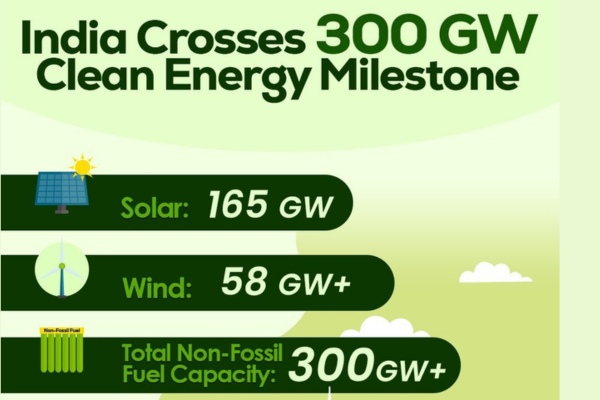
India has achieved a historic milestone in its clean energy transition, crossing 300.50 GW of non-fossil fuel-based installed electricity generation capacity as of July 31, 2026. This accomplishment represents over 60% of the nation’s ambitious target to reach 500 GW by 2030, reinforcing the country’s leadership in global climate action and sustainable development.
Key Capacity Breakdown (As of July 31, 2026)
Non-fossil sources now account for over 54% of India’s total installed electricity generation capacity of approximately 552 GW.
| Energy Sector | Installed Capacity (GW) |
| Solar Power | 164.59 |
| Wind Power | 58.14 |
| Hydro Power (Large & Small) | 57.24 |
| Bio-Power | 11.75 |
| Nuclear Power | 8.78 |
| Total Non-Fossil Capacity | 300.50 |
Growth Trajectory and Scale of Expansion
The rapid transformation of India’s energy landscape is highlighted by remarkable multi-fold growth across key sectors since 2014:
- Solar Energy: Emerged as the primary growth engine, surging from 2.8 GW in 2014 to over 164 GW.
- Wind Energy: Expanded steadily from 21 GW in 2014 to over 58 GW.
- Annual Additions: During the 2025–26 fiscal year alone, India added a record 55.29 GW of clean energy capacity (comprising 44.6 GW of solar and 6 GW of wind).
- Generation Output: Total renewable energy generation grew from 190.96 billion units (BU) in 2014–15 to 477.79 BU in 2025–26.
Industrial Self-Reliance and Policy Enablers
Anchored by proactive government policies and robust administrative frameworks, India is actively building an Aatmanirbhar (self-reliant) energy ecosystem:
- Domestic Manufacturing: Supported by initiatives such as the Production Linked Incentive (PLI) scheme, domestic manufacturing has scaled exponentially.
- ALMM Expansion: The capacity enlisted under the Approved List of Models and Manufacturers (ALMM) for Solar PV Modules has surpassed 200 GW, a dramatic increase from just 2.3 GW in 2014.
Future Outlook
Beyond meeting climate commitments, India’s clean energy strategy is integral to driving industrial competitiveness, long-term energy independence, and economic resilience. Through the National Green Hydrogen Mission, the Ministry of New and Renewable Energy is further advancing industrial decarbonization, positioning India as a global hub for the production, utilization, and export of Green Hydrogen and its derivatives.